#patented-process

[ follow ]
#trade-secrets
Intellectual property law
fromPatently-O
3 days ago

Same Problem, Same Solution: Reading Trade Secrets Across Fields

The Federal Circuit reversed a jury verdict against Texas urologists for misappropriating trade secrets related to the Penuma penile implant.
Intellectual property law
fromPatently-O
3 weeks ago

Disclosed but Still Secret? The Federal Circuit Weighs Patent Publications Against Trade Secret Claims

The case examines the balance between patent disclosures and trade secret protection under California law regarding a cosmetic penile implant.
Intellectual property law
fromPatently-O
3 days ago

Same Problem, Same Solution: Reading Trade Secrets Across Fields

The Federal Circuit reversed a jury verdict against Texas urologists for misappropriating trade secrets related to the Penuma penile implant.
Intellectual property law
fromPatently-O
3 weeks ago

Disclosed but Still Secret? The Federal Circuit Weighs Patent Publications Against Trade Secret Claims

The case examines the balance between patent disclosures and trade secret protection under California law regarding a cosmetic penile implant.
#uspto
Intellectual property law
fromPatently-O
1 month ago

The 14-Month Fiction: Only 10% of First Actions Arrive on Time

USPTO frequently fails to meet the 14-month deadline for issuing a First Office Action or Notice of Allowance, impacting patent term adjustments.
Intellectual property law
fromPatently-O
2 months ago

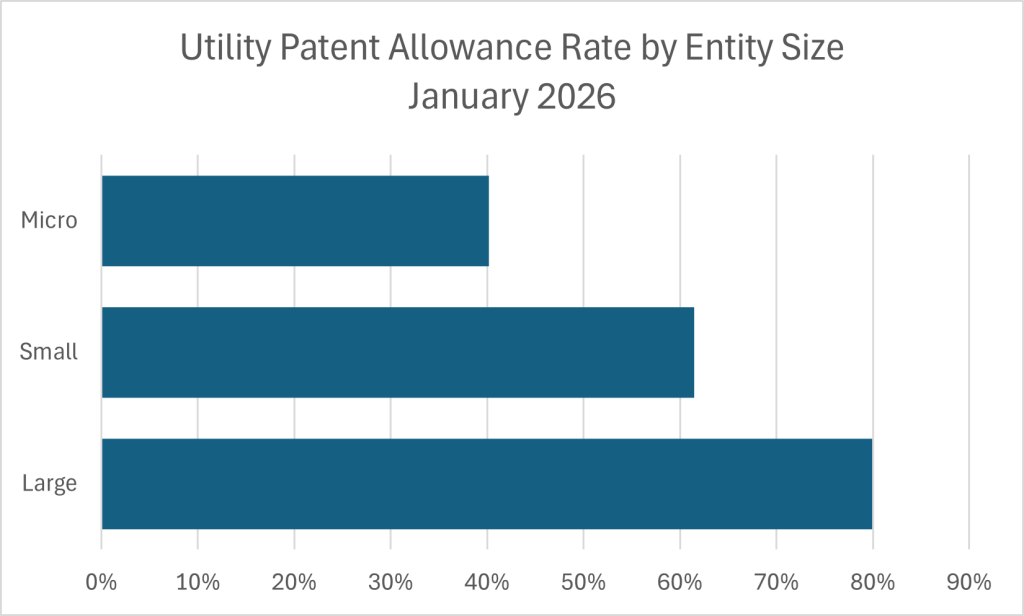
Large Entities Achieve Double the Patent Allowance Rate of Micro Entities

Large entities secure patents at far higher rates than small and micro entities, with allowance rates of 80%, 61%, and 40% respectively.
Intellectual property law
fromPatently-O
1 month ago

The 14-Month Fiction: Only 10% of First Actions Arrive on Time

USPTO frequently fails to meet the 14-month deadline for issuing a First Office Action or Notice of Allowance, impacting patent term adjustments.
#patent-law
fromPatently-O
5 days ago
Intellectual property law

Extraordinary by Design: How the USPTO Is Bypassing Its Own Reexamination Rules

fromPatently-O
3 days ago
Intellectual property law

Extra Credit, Not Required: Teva v. Lilly and the Limits of Amgen's Reach

Intellectual property law
fromPatently-O
6 days ago

Mind the Gap: The Middle Layer of Obviousness Doctrine

The obviousness determination in patent law lacks a structured method for concluding whether an invention is obvious after evaluating the required factors.
Intellectual property law
fromPatently-O
5 days ago

Extraordinary by Design: How the USPTO Is Bypassing Its Own Reexamination Rules

A new procedure allows patent owners to argue against reexamination requests before the USPTO decides on substantial new questions of patentability.
Intellectual property law
fromPatently-O
3 days ago

Extra Credit, Not Required: Teva v. Lilly and the Limits of Amgen's Reach

The Teva v. Eli Lilly decision clarifies the evaluation of patent claims for methods of using known compounds under the Amgen disclosure requirements.
Intellectual property law
fromPatently-O
6 days ago

Mind the Gap: The Middle Layer of Obviousness Doctrine

The obviousness determination in patent law lacks a structured method for concluding whether an invention is obvious after evaluating the required factors.
#intellectual-property
#patent-licensing
#federal-circuit
Intellectual property law
fromPatently-O
1 week ago

Moving Target: When Amended Claims Outrun Your Standing Declaration

Federal Circuit's standing requirements create challenges for patent challengers seeking appellate review after PTAB proceedings.
Intellectual property law
fromPatently-O
1 week ago

Moving Target: When Amended Claims Outrun Your Standing Declaration

Federal Circuit's standing requirements create challenges for patent challengers seeking appellate review after PTAB proceedings.
#ptab
#patent-eligibility
fromPatently-O
1 month ago
Intellectual property law

Tie Goes to the Runner? Three Months of SMED Practice at the USPTO

Patent Director John Squires implemented a policy favoring applicants in close Section 101 eligibility calls through Subject Matter Eligibility Declarations, shifting examination standards toward applicant-friendly interpretations.
Intellectual property law
fromPatently-O
1 month ago

Patent Law Year in Review: USC IP Institute 2026

The USC Intellectual Property Institute held its annual IP Year in Review session covering major patent law developments, featuring panels on trademarks, publicity rights, and copyright.
fromPatently-O
1 month ago

The Patent Term Distribution, and What it Reveals

Congress set the patent term at twenty years from the earliest effective filing date. 35 U.S.C. § 154(a)(2) (not counting provisional or foreign national filing). But that statutory baseline is just the starting point. But, the actual term is shaped by a series of prosecution decisions, USPTO delays, terminal disclaimers, and patent family structure.
Intellectual property law
fromPatently-O
1 month ago

Are Rising Maintenance Fees Shortening the Effective Patent Term?

Approximately 60% of U.S. patentees abandon their patents before expiration by not paying maintenance fees, with full-term maintenance rates declining to roughly 40%.
Intellectual property law
frompatentlyo.com
1 month ago

Untethered: USPTO Loosens the Article of Manufacture Requirement for Digital Designs

The USPTO relaxed design patent rules for computer-generated interfaces and icons, removing display panel requirements, allowing 'for' prepositions in claims, and extending eligibility to projected, holographic, virtual, and augmented reality designs.
Intellectual property law
frompatentlyo.com
1 month ago

Guest Post: Protectionist PTO Memo is on a Collision Course with TRIPS

USPTO Director's new policy considers U.S. manufacturing status when deciding whether to institute IPR and PGR proceedings, potentially conflicting with WTO TRIPS obligations requiring nondiscriminatory patent treatment.
Intellectual property law
fromPatently-O
1 month ago

The Expanding Patent Document: Fewer Claims, More Words, and a Trend That Predates Alice

Patent specifications have nearly doubled in length over twenty years to over 13,000 words, but claim counts have declined since 2005, contradicting expectations that Alice Corp. v. CLS Bank would cause a structural break in 2014-2015.
Intellectual property law
fromPatently-O
1 month ago

Twenty and Done: The Fee-Driven Collapse of Claim Count Diversity

Patent fee structures have created a hard threshold at 20 claims, causing 28% of 2025 utility patents to issue with exactly 20 claims compared to 6% in 2005.
#uspto-allowance-rates
Intellectual property law
fromPatently-O
1 month ago

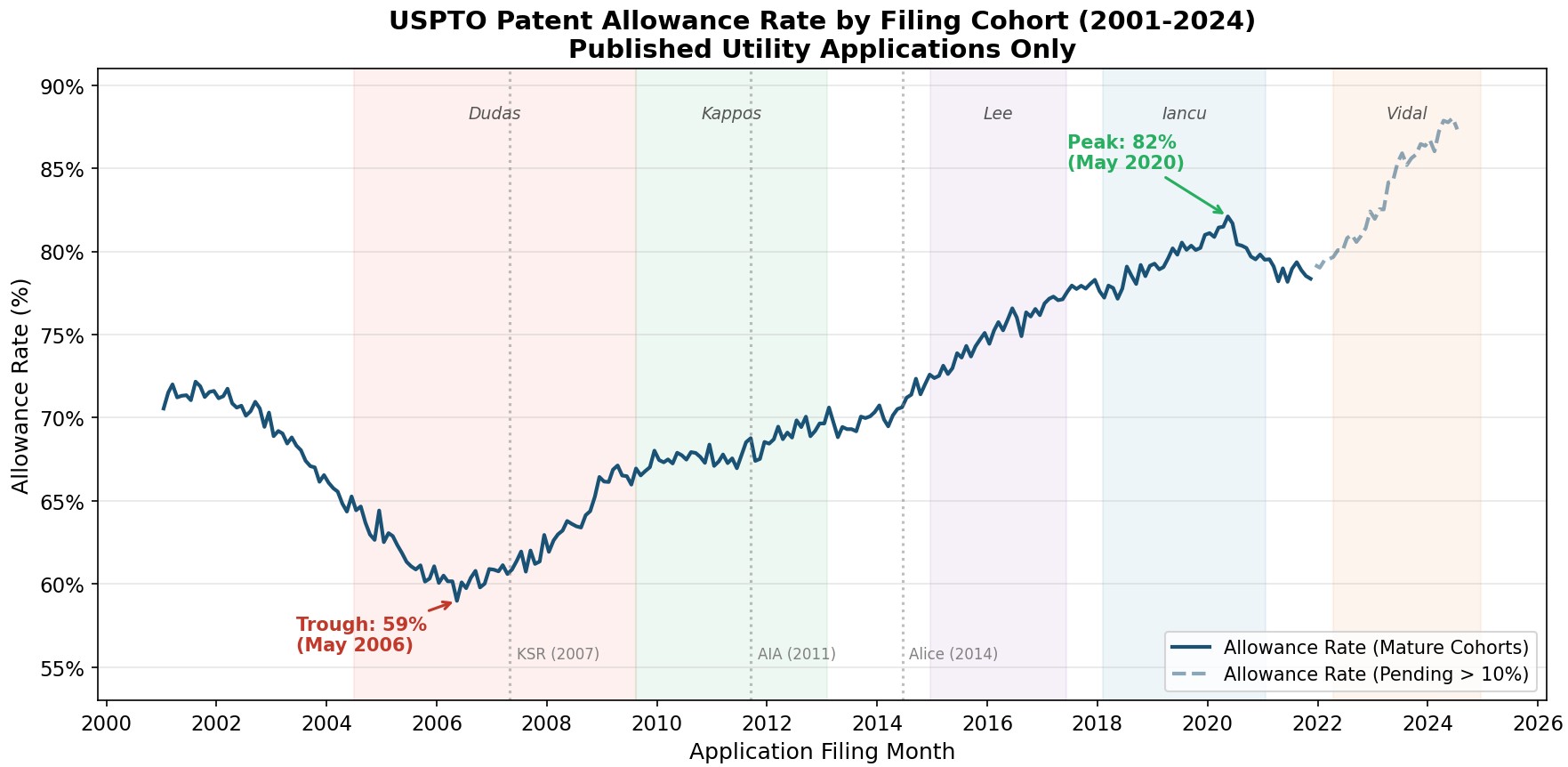
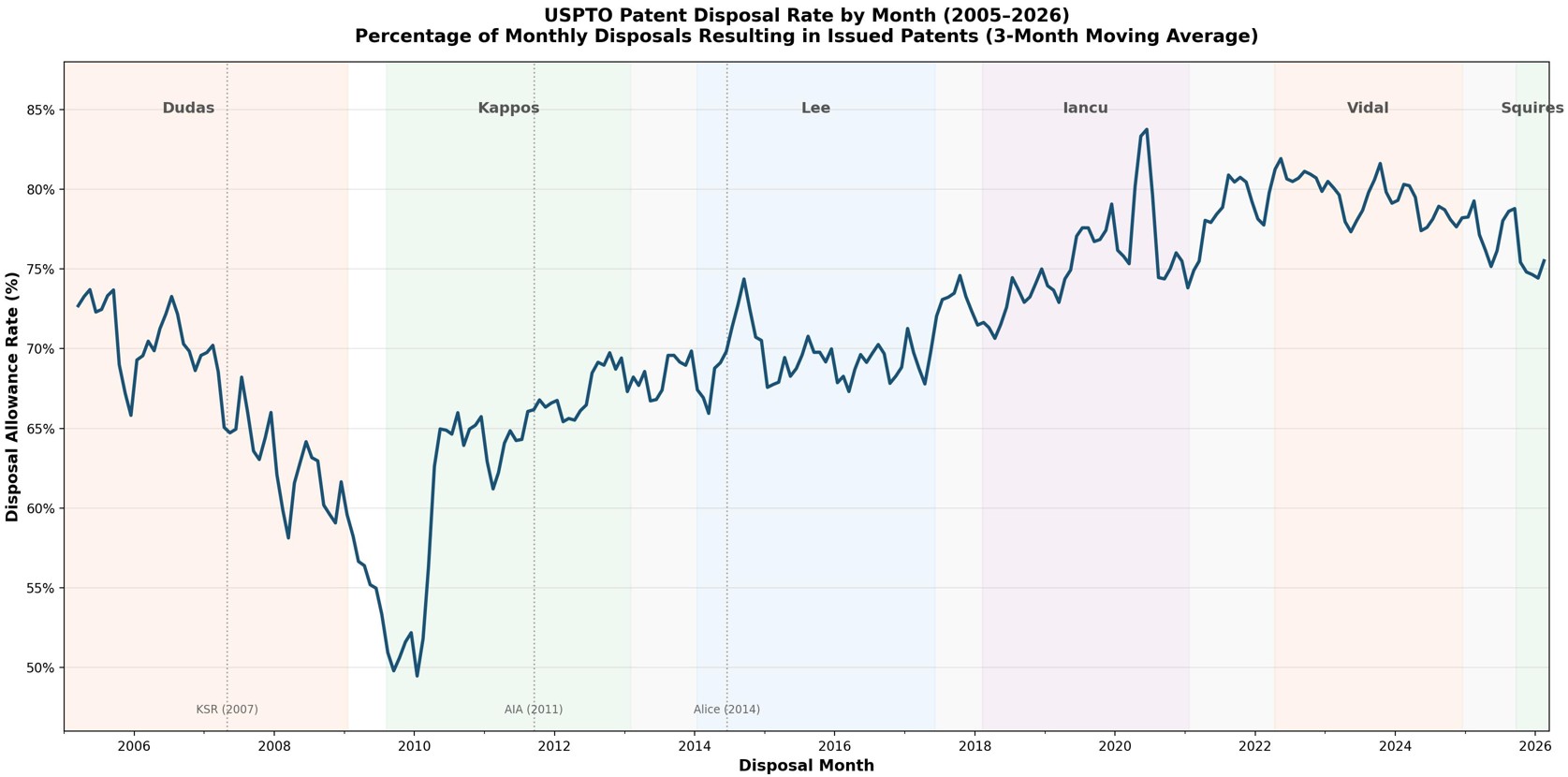
The Third Way: Examiner Action Dates and the Allowance Rate Curve

Examining USPTO allowance rates by anchoring outcomes to examiner mail dates provides the most direct measure of examination policy by capturing the moment examiners make final decisions.
Intellectual property law
fromPatently-O
1 month ago

The Third Way: Examiner Action Dates and the Allowance Rate Curve

Examining USPTO allowance rates by anchoring outcomes to examiner mail dates provides the most direct measure of examination policy by capturing the moment examiners make final decisions.
#patent-strategy
#patents
Intellectual property law
fromPatently-O
1 month ago

Extolling the Virtues: 'Space-Efficient' Preamble Fails to Limit

The Federal Circuit reversed an indefiniteness ruling while affirming dismissal of breach-of-contract claims in NimbeLink Corp. v. Digi International Inc., with the patent issue centering on whether claim preambles impose substantive limitations.
Intellectual property law
fromPatently-O
2 months ago

An Old Trick in the Patent Book: Targeted Drafting from 1876 to 2026

Patent applicants strategically draft filings to steer USPTO art‑unit assignment and increase claim allowance odds, a practice known as targeted drafting.
fromAbove the Law
2 months ago

From Cost Center To Value Engine: Patent Management In The AI Era - Above the Law

In a recent Tradespace and Above the Law survey, two-thirds of companies that draft patents in-house described IP as a value driver, while 71 percent of companies that outsource drafting viewed IP as a cost. When drafting and prosecution move inside, IP teams work closer to engineers and product leaders. This proximity improves invention quality, strengthens claim strategy, and aligns patent decisions with product direction, market timing, and business priorities.
Intellectual property law
fromPatently-O
2 months ago

Privity Without Duty: When Patent Inventors Are Bound but Not Represented

University-employed inventors often lose control and compensation decisions when universities and licensees litigate patents without including inventors.
fromIPWatchdog.com | Patents & Intellectual Property Law
2 years ago

Since 2020, Patent Errors Have Decreased by 11.24%

In an ideal world, issued patents would not contain errors. In reality, patent drafting is tedious and time-consuming work and perfection is not an attainable goal. The patent industry seems to be steadily getting better, though. In a recent study, we uncovered an 11.24% decrease in errors per patent over the past four years. We observed this decrease by reviewing every patent issued by the U.S. Patent and Trademark Office (USPTO) since 2020 - nearly 1.4 million patents.
Intellectual property law
#patent-allowance-rates
Intellectual property law
fromPatently-O
2 months ago

When Obviousness Rejections Pile On: Rethinking Multi-Reference Combinations

Combining numerous prior art references to reject a patent claim often reflects hindsight and risks improper obviousness findings; doctrinal tests already address this.
fromIPWatchdog.com | Patents & Intellectual Property Law
2 months ago

USPTO De-Designates Two PTAB Decisions on RPIs in Light of Corning Optical

The Office de-designated Proppant Express Invests., LLC v. Oren Techs., LLC, IPR2017-01917, Paper 86 (PTAB Feb. 13, 2019); and Adello Biologics LLC v. Amgen Inc., PGR2019-00001, Paper 11 (PTAB Feb. 14, 2019). According to a USPTO email sent Tuesday, both decisions conflict with the decision in Corning Optical Communications RF, LLC v. PPC Broadband Inc., IPR2014-00440, Paper 68 (PTAB Aug. 18, 2015) (precedential).
Intellectual property law
fromPatently-O
1 month ago

Guest Post: Design Patents at the ITC

The ITC applied a lower visual similarity standard than the Federal Circuit requires in finding design patent infringement, potentially allowing judges to disregard claimed design elements as minor or trivial.
fromIPWatchdog.com | Patents & Intellectual Property Law
1 month ago

Harrity & Harrity is Seeking a Patent Attorney / Patent Agent - Electrical & Mechanical Innovations

Harrity & Harrity is looking for experienced patent attorneys and agents who want a smarter way to practice law. Our practice is built around streamlined workflows, custom AI and automation tools, and a data-driven approach that keeps the focus where it belongs: on quality, strategy, and client service-not busywork or billable-hour math. You'll work on high-value patent portfolios for top-tier technology companies while enjoying true flexibility, strong support, and meaningful autonomy.
Intellectual property law
fromPatently-O
2 months ago

The Thaw Begins?: What's Driving IPR Institutions Under Director Squires

IPR institution rates rose from about 15% to roughly 35–55% by late 2025, reflecting renewed, discretionary institution under Director John Squires.
[ Load more ]