#scientific-sleuths
#scientific-sleuths
[ follow ]
#artificial-intelligence #scientific-research #investigation #research-integrity #science #machine-learning

#artificial-intelligence

fromNature
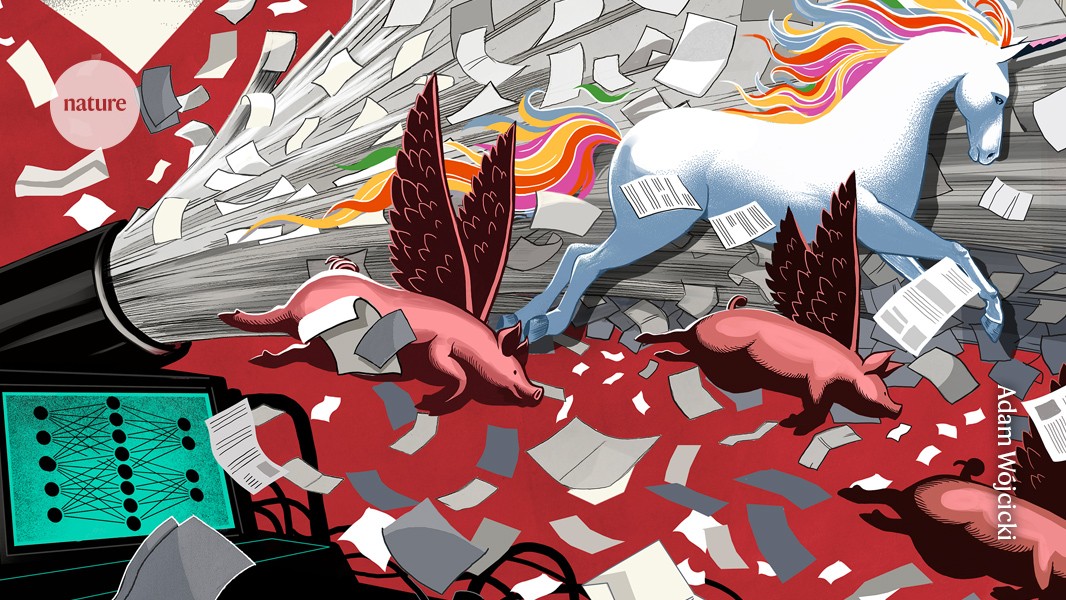
3 weeks agoNow is the time for scientific societies to guide global research
Modern scientific societies are increasingly vulnerable due to their dependence on membership fees and journal subscriptions, which are being challenged by the rise of virtual networking and open-access publishing.
Science
fromwww.scientificamerican.com
3 weeks agoWhat happens when AI starts checking mathematicians' work
Computer programs that check mathematical arguments have existed for decades, but translating a human-written proof into the strict programming language of a computer is extremely time-consuming, often taking months or even years.
OMG science
fromwww.scientificamerican.com
1 month agoAI techniques speed up forensic analysis of crucial crime scene larvae
A maggot's age and species can give essential information to forensic entomologists investigating murders. Combing through these fly larvae, investigators can potentially learn when and where a crime happened, whether the body has been moved or whether toxins were involved. For example, blowflies are among the earliest insect colonizers of corpses; they typically sniff out and lay eggs on a dead body within minutes to hours.
Roam Research
US news
fromwww.mercurynews.com
1 month agoGenealogical sites have helped solve major crimes. Police in Nancy Guthrie's case might turn to them
Investigators may use DNA genealogy databases to match DNA from Nancy Guthrie's case and potentially identify suspects or relatives when CODIS yields no matches.
UK news
fromwww.independent.co.uk
1 month agoAlmost half of officers' DNA still missing from Met Police database
Nearly half of Metropolitan Police officers' DNA and over a fifth of their fingerprints are missing from elimination databases, potentially hindering criminal investigations and internal misconduct detection.
Science
fromNature
1 month agoKeep calm and be transparent: advice from scientists who retracted their papers
Scientists who self-retract papers due to honest mistakes maintain citation rates and receive community support, suggesting shifting attitudes toward retractions as responsible scientific practice rather than career-damaging misconduct.
fromNature
2 months agoI know science can't fix the world - here's why I do it anyway
His message is clear: our world is built on abundant energy, around 80% of which has come from fossil fuels over the past 50 years. Because supplies are limited, energy consumption will peak in decades - sooner if humans attempt to limit climate change. To keep global warming below 1.5 °C by 2100, the use of fossil fuels must fall by 5-8% each year - a pace that is too fast for low-carbon energy to keep up with.
Environment
Higher education
fromwww.mercurynews.com
2 months agoOpinion: Sociology is taking it on the chin. Here's how we can preserve this critical field of study.
Sociology faces politicized attacks, curricular exclusion, and erosion of departmental standing despite teaching critical thinking, inequality analysis, interdisciplinary synthesis, and scrutiny of power.
fromwww.theguardian.com
1 month agoPlease drive carefully: scientists plan to transport volatile antimatter for first time
A core question we want to understand is where did matter come from. And then, if you know about antimatter, it's natural to ask, why is that not here? The process is not understood and we are hunting for clues as to why it happened, says Dr Christian Smorra, a physicist on the Baryon Antibaryon Symmetry Experiment (Base) at Cern.
OMG science
fromSFGATE
2 months agoBody found halfway across country ties back to horrific Calif. criminal
Ronald Joseph Cole was a 19-year-old with a shy smile and a buzz cut in 1965, the year he moved from San Diego to Fillmore, a town about 25 miles from Santa Clarita. He was just starting out in life and, hoping to find a job, moved in with his older half-brother David LaFever. By May 1965, Cole had stopped contacting relatives. He had disappeared.
Artificial intelligence
fromwww.scientificamerican.com
2 months agoHow one chemist is using AI and robots to automate lab experiments
AI-driven laboratory automation like Coscientist accelerates chemistry by reducing repetitive work, improving accuracy, and enabling experiments previously limited by human error or fatigue.
fromThe Conversation
2 months agoAI cannot automate science - a philosopher explains the uniquely human aspects of doing research
Consistent with the general trend of incorporating artificial intelligence into nearly every field, researchers and politicians are increasingly using AI models trained on scientific data to infer answers to scientific questions. But can AI ultimately replace scientists? The Trump administration signed an executive order on Nov. 24, 2025, that announced the Genesis Mission, an initiative to build and train a series of AI agents on federal scientific datasets "to test new hypotheses, automate research workflows, and accelerate scientific breakthroughs."
Philosophy
Science
fromwww.scientificamerican.com
1 month agoScientists created a digital library full of ants
Researchers created Antscan, a digital library of 3D scans and morphological data from 2,193 ants across 212 genera, using particle accelerator technology to advance biodiversity research and understanding of ant anatomy.
fromPsychology Today
1 month agoHow Science Is Learning to Explore Ground Truth
Some clinicians have an uncanny quality. A colleague describes herself and others with this instinct as "witchy"-a capacity to know things about patients they haven't said yet, to follow a stray association to a song lyric or a half-remembered cultural reference and arrive, reliably, at something the patient urgently needed to say but couldn't reach on their own. We see with artificial intelligence these intriguing possibilities for discovery, especially as connections that human beings never would see pop out of apparently unrelated data.
Science
OMG science
fromArs Technica
1 month agoResearch roundup: Six cool science stories we almost missed
Scientists revived Edison's nickel-iron battery design using protein scaffolding and graphene oxide, creating an aerogel structure for improved renewable energy storage with extended range and longevity.
fromNature
2 months ago'It means I can sleep at night': how sensors are helping to solve scientists' problems
In fact, Stawicki was on a mission to save the lives of around 1,000 zebrafish ( Danio rerio) in her laboratory. Similarities between lines of hair cells on the fish's flanks and those in the mammalian inner ear enable her to use them as a model to study hearing problems in humans caused by some antibiotics and chemotherapy drugs. A sensor had picked up that the lab's heating system had been knocked out by a power fault.
Science
fromNature
1 month agoThe age of animal experiments is waning. Where will science go next?
Last November, the UK government announced a bold plan to phase out animal testing in some areas of research. Animal tests for skin irritation are scheduled for elimination this year, and some studies on dogs should be slashed by 2030. The long-term vision is 'a world where the use of animals in science is eliminated in all but exceptional circumstances'.
Science
fromenglish.elpais.com
2 months agoThousands of scientists inflate their CVs with self-published studies that cost millions of dollars of public money
Three scientists have coined a rather scatological, yet revealing, term: PISS, short for Published In Support of Self. The acronym defines a disconcerting phenomenon. Specialized scientific journals that were once published every two weeks or weekly now churn out special issues every few hours. Previously, these monographs were selective and entrusted to a leading figure in a scientific discipline. Now, even the most mediocre researchers receive a flood of invitations to edit one of these countless special issues, which have become a multi-million dollar business.
Science
Science
fromwww.nature.com
2 months agoAuthor Correction: An autonomous laboratory for the accelerated synthesis of inorganic materials
Prediction platform correctly identified 36 of 40 synthesized compounds; four were inconclusive, and novelty claims were clarified as 'new to the prediction platform', not new to science.
fromPsychology Today
2 months agoThe Hidden Lives of Lab Animals and the Need for Reform
Countless millions of nonhuman animals (animals) of all sorts are used in a diverse array of laboratory research. Their treatment varies from being unspeakably inhumanely abused to being treated with kindness, depending on the questions at hand and the values and attitudes of the researchers themselves. The lives of these animals truly are hidden, and most people are incredulous when they learn that laboratory rats and mice still are not considered "animals" under the current federal Animal Welfare Act.
Science
[ Load more ]