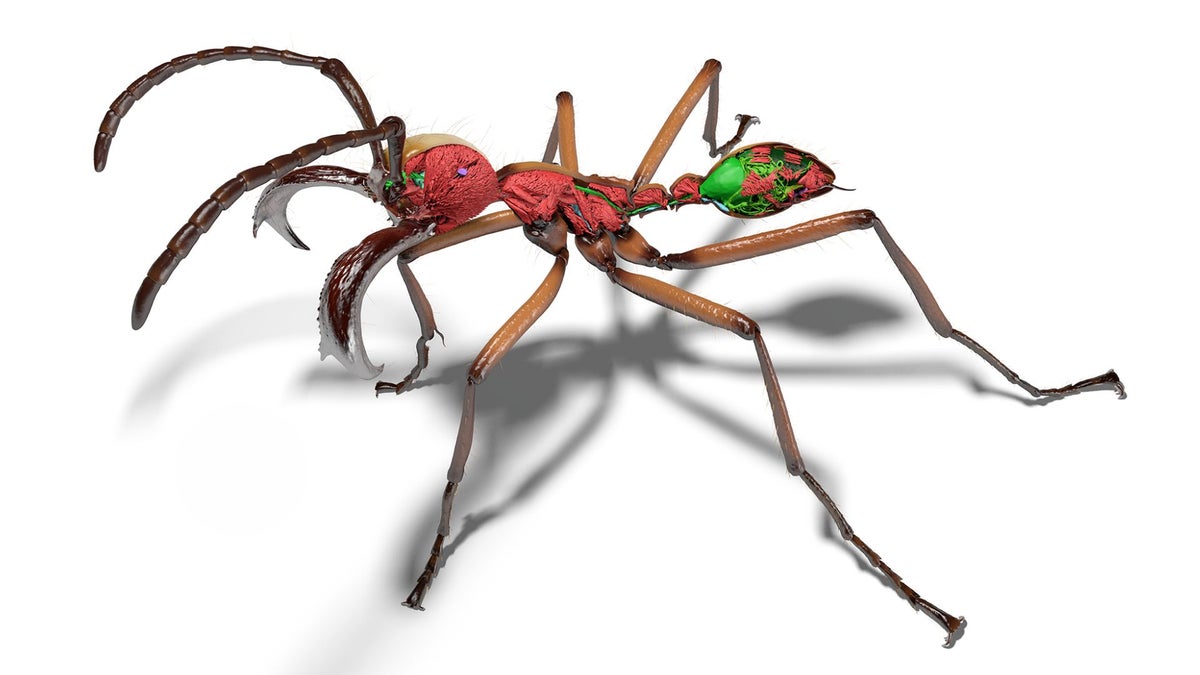
"There are more than 20 quadrillion ants out there—so many that it's difficult to get a handle on just how diverse the behavior and body structure of different ant species can be. To better understand biodiversity within the ant family, researchers used a particle accelerator to create Antscan, a digital library full of three-dimensional scans and morphological data from 2,193 individual ants."
"We're just at the beginning of even looking at the data, says one of the study's senior authors, Evan Economo, a University of Maryland, College Park, entomologist. There's many other things you could do with the project, and I'm sure there are really amazing things in there that people will dig out."
"To capture the wide range of ant traits, they chose individuals from 212 different genera. More than 90 percent of all described ant species belong to one of the genera represented in the study."
Ants represent a crucial component of global ecosystems, with over 20 quadrillion individuals exhibiting remarkable behavioral and structural diversity across species. To comprehensively study this diversity, researchers developed Antscan, a digital library containing three-dimensional scans and morphological data from 2,193 individual ants representing 212 different genera, covering more than 90 percent of all described ant species. The project utilized particle accelerator technology to create detailed imaging, replacing traditional CT scans with a faster, higher-resolution approach. Ethanol-preserved ant specimens were gathered from museums and personal collections worldwide. This innovative combination of advanced imaging technology and biodiversity research demonstrates how new data technologies can accelerate scientific understanding of complex biological systems.
Read at www.scientificamerican.com
Unable to calculate read time
Collection
[
|
...
]