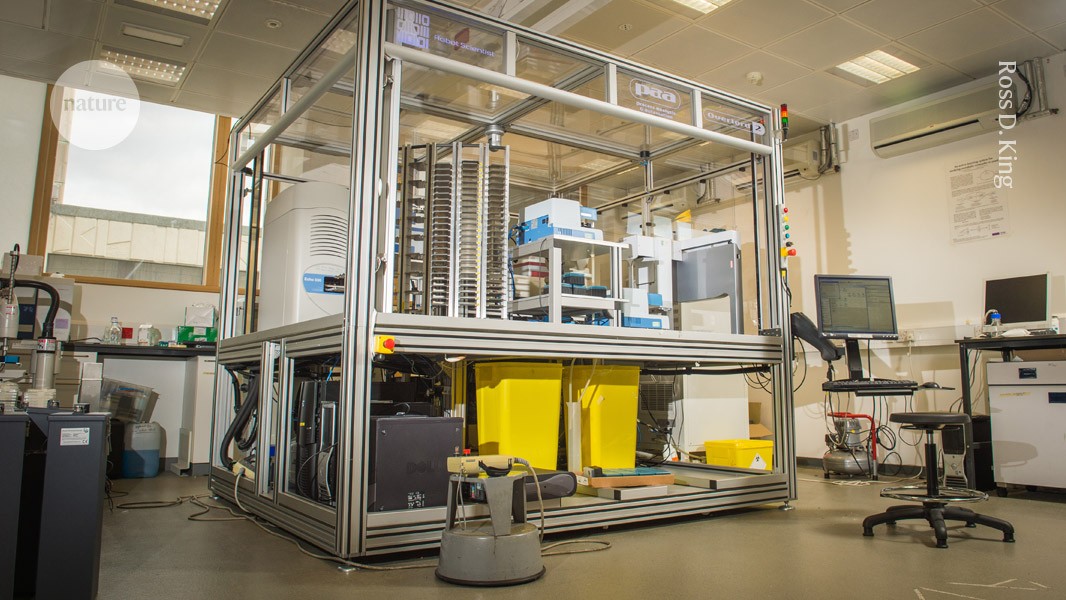
"Eve automates the process of early-stage drug design, achieving significant milestones such as identifying that triclosan can target an enzyme crucial to Plasmodium malaria parasites."
"Eve's robotic arm can move a few metres per second, with a positional accuracy of a fraction of a millimetre, although it is usually operated at slower speeds for safety."
"King describes Eve's function as 'trying to make the scientific method in a machine,' highlighting the potential for mechanization in scientific research."
"A lot of biology is done like craft work, with traditional lab structures resembling artisan practices, which King believes can be transformed through automation."
Eve is a robotic platform developed at Chalmers University of Technology, designed to automate early-stage drug design. It operates with high speed and precision, capable of moving several metres per second with millimetre accuracy. In 2018, Eve successfully identified a potential treatment for malaria by screening 1,600 chemicals. The robot utilizes machine learning to develop hypotheses and conduct experiments autonomously. Ross King, the creator, envisions a future where scientific processes are mechanized, transforming traditional biology practices into more efficient methodologies.
Read at Nature
Unable to calculate read time
Collection
[
|
...
]