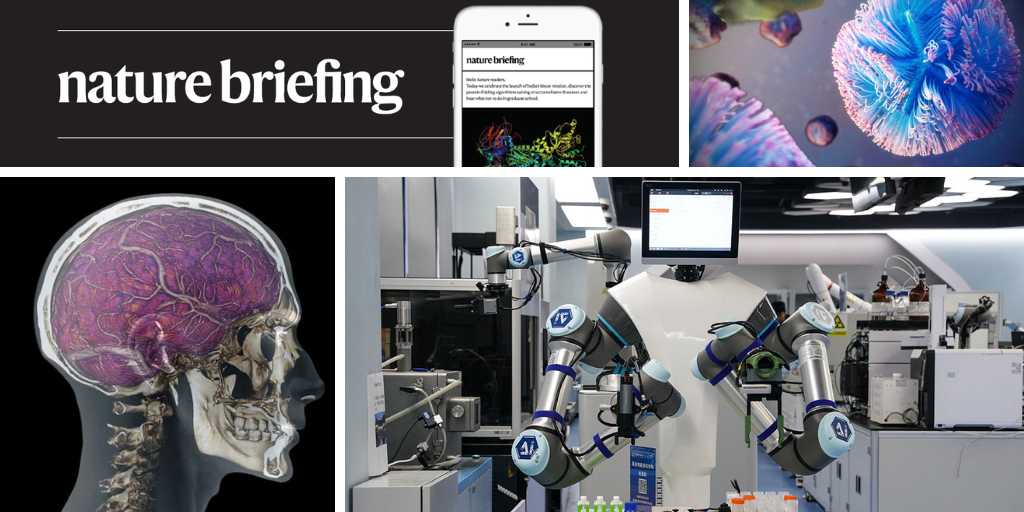
"Small trials of autonomous laboratory systems made up of artificial-intelligence-controlled robot 'scientists' have sparked debate among researchers over the extent to which such technology could replace humans. These systems, which can automate simple tasks such as liquid transfer, are "going to be the future of biology", says protein engineer Philip Romero. But the technology currently struggles with tasks that require more dexterity, and might not be useful for experiments without a clear-cut measure of progress, say others."
"Scientists have identified a giant virus that can hijack a host cell's protein-making machinery to churn out copies of itself - the first experimental evidence that viruses can co-opt this particular system, which is typically associated with cellular life. To take control, the virus attaches a three-protein complex to the host's ribosomes - part of the apparatus cells use to make proteins - which gives viral RNA preferential access."
Autonomous laboratory systems with AI-controlled robots can perform simple tasks such as liquid transfer but struggle with dexterity and experiments lacking clear progress metrics. A giant virus can hijack host ribosomes by attaching a three-protein complex, granting viral RNA preferential access to the protein-making machinery. Venous sinuses in the brain actively constrict and stretch to drain blood and cerebrospinal fluid and can rearrange their borders to accommodate patrolling immune cells, a behaviour termed ruffling. Additional developments include a glass tile capable of storing terabytes of data and science-informed approaches that improve service-dog training graduation rates.
#autonomous-laboratory-robots #giant-virus-ribosome-hijacking #brain-venous-sinuses #data-storage-glass #service-dog-training
Read at Nature
Unable to calculate read time
Collection
[
|
...
]