#corded-ware-culture

[ follow ]
Digital life
Compression technology enables efficient data storage and transmission by discarding imperceptible information, crucial for platforms like YouTube and Spotify.
#ancient-greece
History
fromwww.dw.com
4 days ago

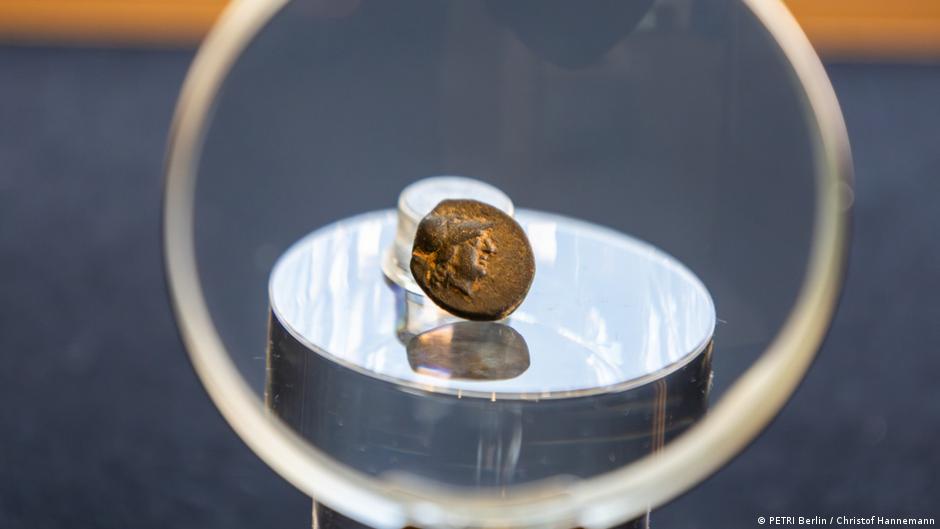
Teen discovers first ancient Greek artifact found in Berlin

A 13-year-old discovered a rare ancient Greek coin from Troy in Berlin, revealing potential links between ancient Greece and northern Europe.
History
fromwww.dw.com
4 days ago

Teen discovers first ancient Greek artifact found in Berlin

A 13-year-old discovered a rare ancient Greek coin from Troy in Berlin, revealing potential links between ancient Greece and northern Europe.
fromwww.thehistoryblog.com
6 days ago

Bronze Age jewelry hoard found during wind farm construction

The most significant find was discovered during construction of one of the wind turbine platforms. Objects of bronze and amber were found close together, leading to the excavation of a hoard of Bronze Age jewelry dating from around 1500 to 1300 BC.
History
fromwww.nature.com
4 weeks ago

Genomic history of early dogs in Europe

Genomic data indicates that early dogs in Europe underwent significant genetic changes as they adapted to diverse environments and human lifestyles, reflecting a complex interplay of domestication and natural selection.
Pets
History
fromwww.independent.co.uk
2 weeks ago

What15,0000-year-old jewellery found in a cave tells us about prehistoric life

The Independent provides accessible journalism on critical issues like reproductive rights and climate change, supported by donations.
fromArtnet News
4 weeks ago

Massive Cache of 42,000 Pottery Shards Reveals Daily Life in Ancient Egypt

The ostraca show us an astonishing variety of everyday situations. We find tax lists, deliveries, short notes about everyday activities, religious texts, and priestly certificates attesting the quality of sacrificial animals.
Arts
#archaeology
Roam Research
fromArs Technica
1 month ago

Study pinpoints when bow and arrow came to North America

North Americans adopted the bow and arrow about 1,400 years ago, replacing the atlatl and dart, with rapid adoption in the south and gradual replacement in the north.
Alternative medicine
fromArs Technica
1 month ago

Never mind Band-Aids, Neanderthals had antiseptic birch tar

Neanderthals likely used birch tar for medicinal purposes, including treating infections and insect bites, beyond its known use as a weapon adhesive.
fromwww.thehistoryblog.com
2 weeks ago

Neolithic axe found in Lake Constance

The axe was the most important find in the group and would have been highly valued in the Neolithic community. Experiments with fiddle bows have found that it takes more than a day of work to manufacture an axe like this one.
History
Arts
fromArtnet News
1 month ago

Archaeologists Identify Lost Medieval Village in Polish Forest | Artnet News

Researchers in Poland have located Stolzenberg, a lost medieval village in Pomerania, using metal detection and geophysical surveys that revealed 1,500 surface anomalies including coins and building remnants.
#mass-grave
History
fromMedievalists.net
3 weeks ago

Scientists Confirm Remains of Medieval Emperor Otto the Great - Medievalists.net

Emperor Otto the Great's identity has been confirmed through scientific research, including DNA analysis, after centuries of uncertainty.
OMG science
fromMail Online
1 month ago

Scientists recreate the lost languages of ancient humans

Scientists reconstructed ancient human species languages by analyzing fossilized skeletal imprints of soft tissues like the larynx, tongue, and brain, revealing that Neanderthals likely spoke languages understandable to early Homo sapiens.
Science
fromNature
2 months ago

Daily briefing: Hunter-gatherers in Europe's 'water world' resisted the switch to farming for millennia

Rhine-Meuse delta populations retained substantial hunter-gatherer ancestry for millennia before steppe-related mixing spurred Bell Beaker expansion and large genetic turnovers.
Agriculture
fromArs Technica
1 month ago

Re-creating the complex cuisine of prehistoric Europeans

Hunter-gatherer-fishers across Eastern Europe combined specific regional foods into distinct preparations, mixing fish with berries, legumes, grasses, and vegetables rather than relying on fish alone.
#roman-archaeology
Science
fromwww.nature.com
2 months ago

Author Correction: Hunter-gatherer sea voyages extended to remotest Mediterranean islands

Corrections to regional radiocarbon uncertainties do not meaningfully change conclusions about timing of the Mesolithic–Neolithic transition or maritime voyages in the central Mediterranean.
History
fromMedievalists.net
1 month ago

Two Medieval Men Found Buried in Prehistoric Site - Medievalists.net

Medieval men were buried in the Menga dolmen, a Neolithic monument in Spain, over 4,000 years after its construction, demonstrating the site's enduring symbolic importance across millennia.
#bronze-age-archaeology
History
fromMail Online
1 month ago

The first non-binary person? Stone Age woman was buried like a MAN

Stone Age societies in Hungary practiced flexible gender roles, with some individuals buried according to non-traditional gender norms, indicating tolerance for complex identities 7,000 years ago.
fromMedievalists.net
1 month ago

Viking-Age Woman Buried with Her Dog in Norway - Medievalists.net

Excavations carried out in 2025 by the Arctic University Museum of Norway revealed that the artefacts came from a boat burial. The grave contained the skeleton of a woman placed inside a boat measuring about 5.5 metres in length. She had been buried together with a dog, suggesting the animal may have been an important companion in life.
History
History
fromwww.thehistoryblog.com
2 months ago

Analysis Nordlingen bronze sword shines spotlight on Bronze Age craftsmanship

A 3,400-year-old Nordlingen bronze sword shows exceptional Bronze Age metallurgy, precise tang-and-rivet construction, and copper-wire inlay revealing advanced metalworking skill.
History
fromwww.thehistoryblog.com
2 months ago

Bronze Age tombs with luxury imported goods found in Cyprus

Two 14th-century BCE chamber tombs in Larnaca contained locally made and widely imported luxury goods, demonstrating extensive long-distance trade networks.
[ Load more ]