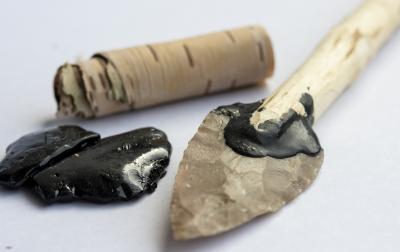
"People from several modern Indigenous cultures, including the Mi'kmaq of eastern Canada, use tar from birch bark to treat skin infections and keep wounds from festering. We know from several archaeological sites that Neanderthals also knew how to extract birch tar and that they used it as an adhesive to haft weapons. A recent study tested distilled birch tar against the bacteria S. aureus and E. coli and found that Neanderthals could easily have used the same material as medicine for their frequent injuries."
"What we call 'birch tar' in English has a lot of other names in multiple Indigenous languages, and it can range from an oily fluid to a brittle, almost solid tarry resin, depending on how long you heat it in the open air after extracting it from the bark. The Mi'kmaq of eastern Canada prefer the more fluid version, which they call maskwio'mi, for wound dressings and skin ointment."
"To test how well birch tar fends off common bacteria, the team gathered up rolls of bark from birch trees, choosing species that had been found at Neanderthal sites. They tested a few different methods to extract the sticky resin, or tar, from the bark. The simplest involved burning a roll of birch bark next to, or underneath, a flat rock, so the resin collects on the underside of the rock; the most efficient requires heating the roll of bark in a clay vessel buried inside a mound of dirt."
Neanderthals possessed knowledge of extracting and utilizing birch tar, a substance with multiple applications beyond adhesive purposes. Modern Indigenous cultures, particularly the Mi'kmaq of eastern Canada, use birch tar to treat skin infections and prevent wound festering. Recent scientific testing demonstrated that birch tar effectively inhibits common bacteria including Staphylococcus aureus and E. coli, suggesting Neanderthals could have employed it medicinally for their frequent injuries. The extraction process varies in complexity, from simple methods involving burning bark near rocks to more sophisticated techniques using clay vessels buried in dirt mounds. The consistency of birch tar ranges from oily fluid to brittle resin depending on heating duration, with different forms serving different purposes in traditional Indigenous medicine.
#neanderthal-medicine #birch-tar-antimicrobial-properties #indigenous-knowledge #archaeological-evidence #wound-treatment
Read at Ars Technica
Unable to calculate read time
Collection
[
|
...
]