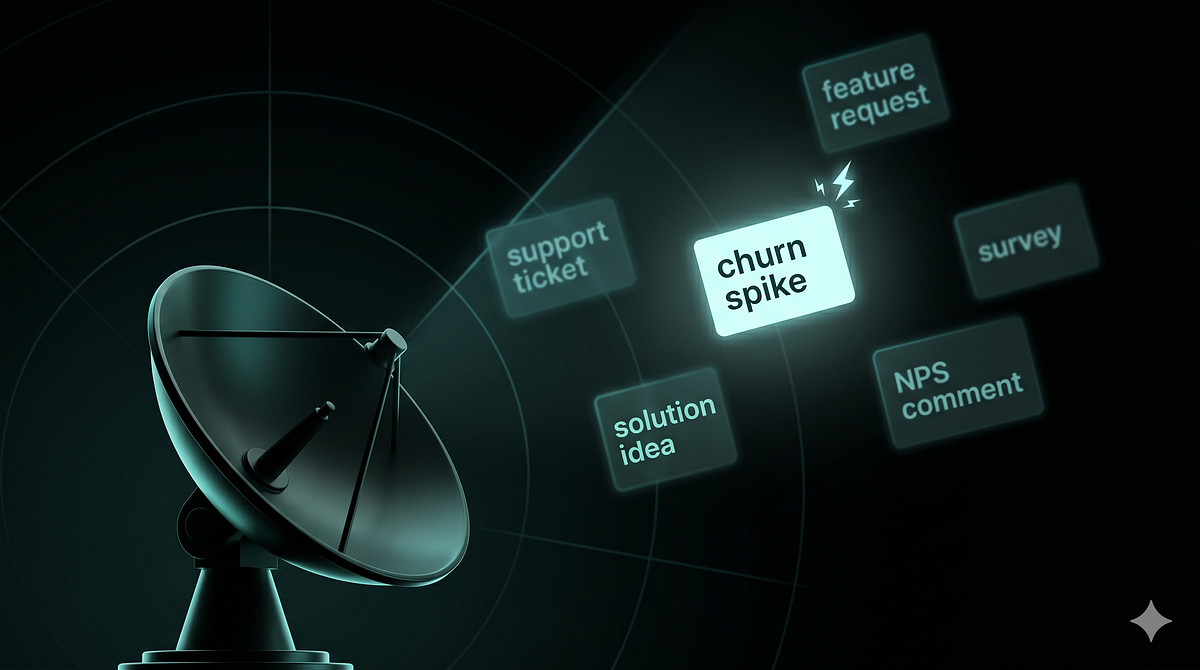
Most discovery work begins with a decision about whether to investigate a problem, idea, or solution, even when that decision is not experienced as a decision. Signals such as customer requests can be treated like instructions, leading to silent upstream choices that determine what teams will later research, prototype, and validate. By the time interviews and prototype testing start, the most consequential call has often already been made, based on the loudest signal or the biggest customer. Faster, cheaper building increases the risk of wrong upstream judgments because the cost of pursuing the wrong direction becomes larger. Discovery should start by evaluating whether a signal deserves attention, not by immediately starting customer research.
"Validating a problem, an idea, or a solution is where most people begin discovery. The skipped judgment is whether to begin it at all. "Customers keep asking us to add more dashboard widgets." Someone raises it in a product roadmap planning meeting, and it sounds less like feedback and more like an instruction. Twenty-three of the last forty calls mentioned it. The people in the room all nod. It is added to the feature backlog. Discovery, if it happens at all, will now be about how to build more widgets, not whether to build them."
"Those nods are a decision. Nobody experiences it as one, which is exactly the problem. By the time a team is running interviews and testing prototypes, the most consequential call has usually already been made upstream, in silence: the decision that this was worth investigating in the first place. Most teams never examine it. The loudest signal, or the one attached to the biggest customer, becomes the work. From there, a team can do everything downstream with real rigour, frame the problem, design the solution, validate it carefully, all in pursuit of something that was never worth investigating at all."
"As building gets cheaper and faster, this becomes more dangerous, not less. When a wrong call costs a quarter of engineering, the judgment about what to pursue matters more than it did when slow building forgave the occasional wrong turn. Before the activities of discovery begin, there is a decision about whether to begin them, and it is the one most often skipped, because it does not look like a decision at all."
"It is tempting to think discovery begins when you start talking to customers. It begins one step earlier, with the call to research this rather than something else. Every signal that reaches a team, a complaint, a feature request, a churn number, a stakeholder's hunch, arrives carrying an implicit claim: this is worth your attention. Evaluating a signal is the act of testing that c"
Read at Medium
Unable to calculate read time
Collection
[
|
...
]