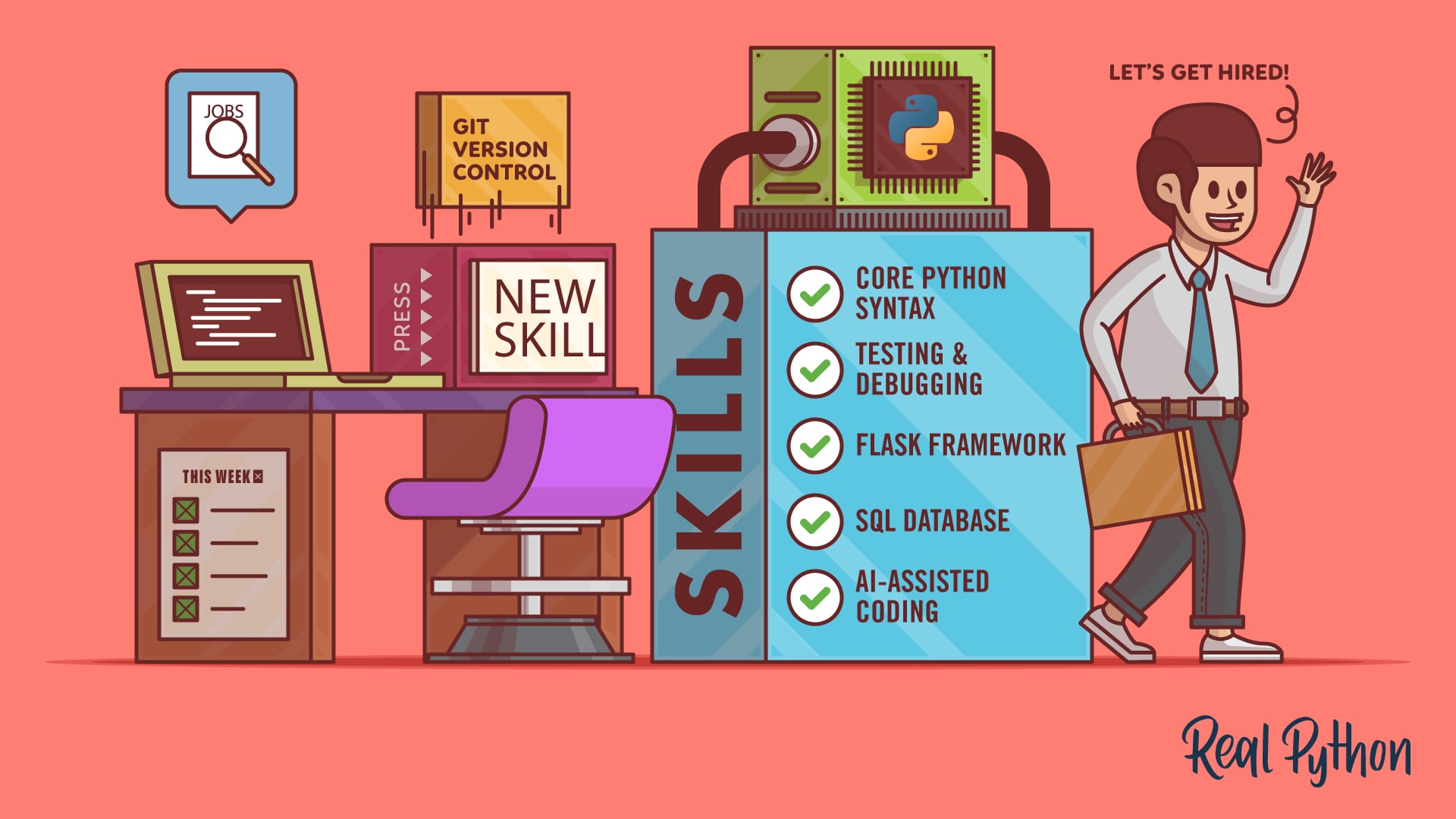
Identify which Python skills appear most often in job listings and focus study accordingly. Inspect five to ten current job postings for titles like Python Developer, Backend Engineer, Data Analyst, or Machine Learning Engineer to find repeated technical requirements. Web roles emphasize Flask, Django, FastAPI, databases, REST API design, and frontend basics such as JavaScript, HTML, and CSS. Data science roles require NumPy, pandas, Polars, Matplotlib, and statistical knowledge. Machine learning roles add PyTorch or TensorFlow, while test automation needs Selenium, Playwright, or Scrapy. Employers also expect deep Python fundamentals, Git version control, unit testing, systematic debugging, DevOps and cloud familiarity, and growing use of AI coding tools.
"Web development roles often emphasize frameworks like Flask, Django, and, more recently, FastAPI, along with database knowledge and REST API design. Employers often seek full-stack engineers who feel comfortable working on the backend as well as frontend, including JavaScript, HTML, and CSS. Data science positions highlight libraries like NumPy, pandas, Polars, and Matplotlib, plus an understanding of statistical concepts. Machine learning jobs typically add PyTorch or TensorFlow to the mix. Test automation roles likely require familiarity with frameworks such as Selenium, Playwright, or Scrapy."
"Despite these differences, nearly every job posting shares a common core. Employers want developers who understand Python fundamentals deeply. They should also be able to use version control with Git, write unit tests for their code, and debug problems systematically. Familiarity with DevOps practices and cloud platforms is often a plus. These professional practices matter as much as knowing any specific framework."
Read at Realpython
Unable to calculate read time
Collection
[
|
...
]