Music production
fromwww.scientificamerican.com
1 day agoAI music is booming, and the player piano saw it coming
Listeners struggle to distinguish AI-generated music from human-made, indicating AI's serious role in the music industry.
Pitchfork is honored to host one of our favorite bands- Mandy, Indiana-to kick off our inaugural reader Q&A series. Starting right now, you can post your questions for guitarist and producer Scott Fair, and synth player Simon Catling to talk about their outstanding record, Fair's solo project set dressing, or whatever else you want to ask them about the joys and difficulties of music, Manchester, and making art.
The vocoder was never supposed to be a revolution in music. Its development began a century ago, when an engineer at Bell Labs was looking for a simpler way to send phone calls across copper telephone lines.
Lightris and his pal sero stumbled into a TikTok hit with 'Kwik Trip,' a feathery, jittery ode to the beloved Midwest gas station chain. In the video, they shimmy shoulders, top rock, and hit Stevedastoner's 'Uptown Downtown' dance in the snow as the handclaps rain down.
On January 17 Jennifer Wright gave a stellar performance of her compositions for her self-crafted instruments. This performance marked the conclusion of a month-long exhibition of her instruments and sound sculptures in the galleria of PLACE in Northwest Portland. This is the performance where she said she "finally had a chance to let all the parts of me out to play."
The Phase8 uses a new form of "acoustic synthesis" that combines acoustic sound generation with electronic control. Takahashi says the synthesizer is "beyond analog vs. digital" and "beyond electronics" altogether. It features chromatically tuned steel resonators, which creates an acoustic sound similar to that of a kalimba. These signals can be manipulated via onboard effects and sequenced like a traditional synthesizer. Here's a video of the synth in action.
Tim Zha is looking for the soul in the machine. While some might hear Auto-Tune as masking a singer's humanity, the London-based artist filters his vocals to highlight technology's inseparability with our notions of self. This is ground well-trodden by Afrofuturist techno pioneers, Atlanta trappers, and PC Music hyperpoppers; for Zha, Auto-Tune represents what he calls the "coincidence of human subjectivity and the networked machine system."
The unit can run on three AA batteries (a set is included) or on the included USB-A to DC adapter (you'll need your own wall charger). The included instruction manual helps you make sense of what the heck all the knobs, levers, buttons, and lights mean.
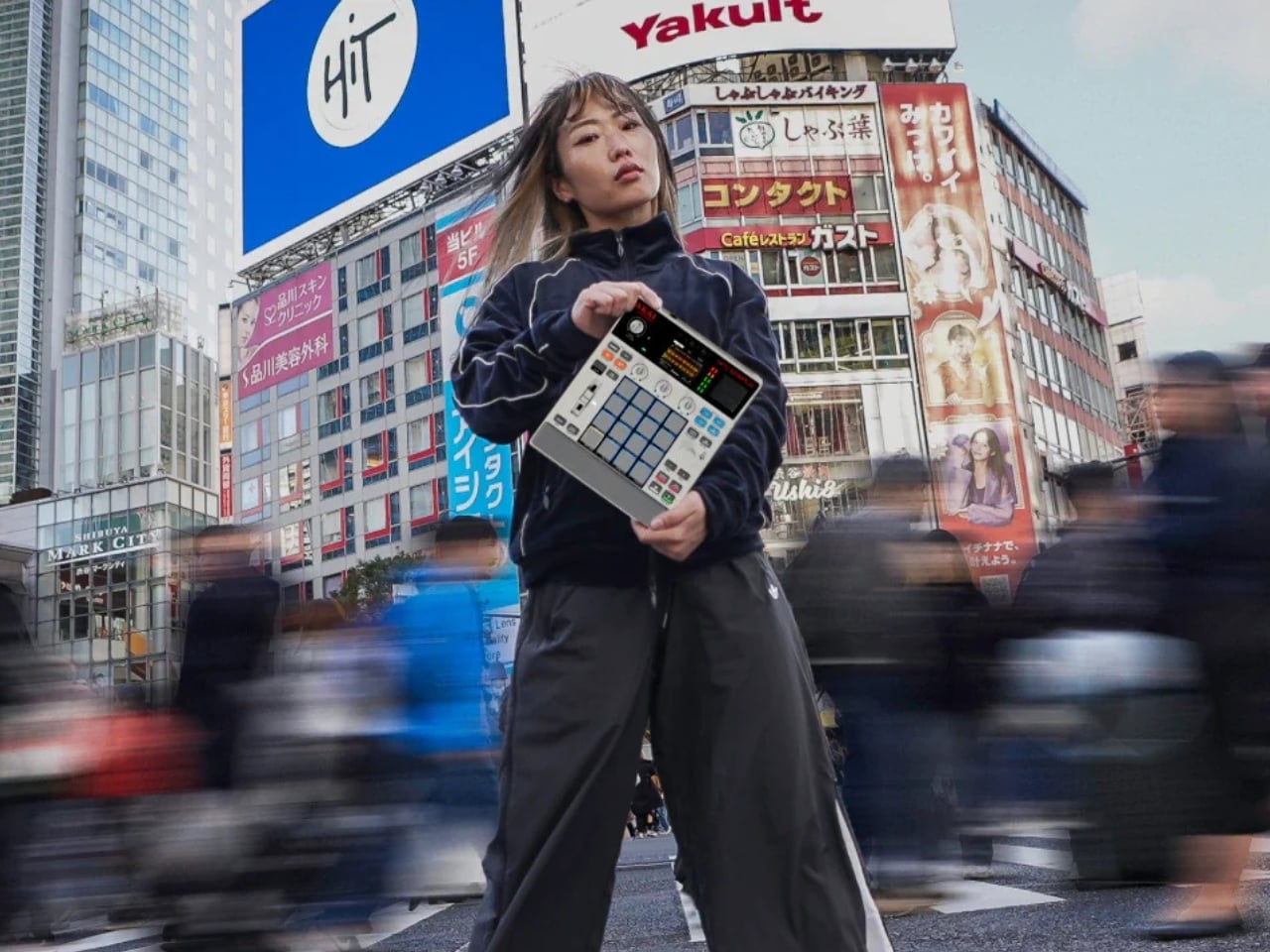
Casio showed up to NAMM (CES for music gear nerds) this year with a prototype sampler called the SX-C1 that looks every bit the lovechild of a Game Boy and an SP-404. The top has a directional pad and four buttons just like you'd find on a game controller, flanking a 1.3-inch OLED screen. But at the bottom, there are 16 rubberized pads for triggering samples with crunchy pixelated number labels on them.
Junho Park's graduation concept borrows all the right cues from TE's playbook, that modular control layout, the single bold color, the mix of knobs and buttons that practically beg to be touched, but redirects them toward a gap in the market. Where Teenage Engineering designs for people who already understand synthesis and sampling, the T.M-4 targets people who have ideas but no vocabulary to express them.
Pitch Shifter-910 is based on the iconic Eventide H910 Harmonizer from 1974, an early digital pitchshifter and delay with a very unique character. Arturia does an admirable job preserving its glitchy quirks. Pitch Shifter-910 is not a transparent effect that lets you create natural-sounding harmonies with yourself. Instead, it relishes in its weirdness, delivering chipmunk vocals at the higher ranges. There is also a more modern mode that cleans up some artifacts while preserving what makes the 910 so special.
The contrast between Sunday night at a concert and Monday morning at your desk is brutal. One moment you're lost in the music, feeling every guitar riff vibrate through your chest. The next, you're answering emails and pretending last night's euphoria wasn't real. The transition back to routine work feels especially cruel when the weekend gave you a taste of something electric.