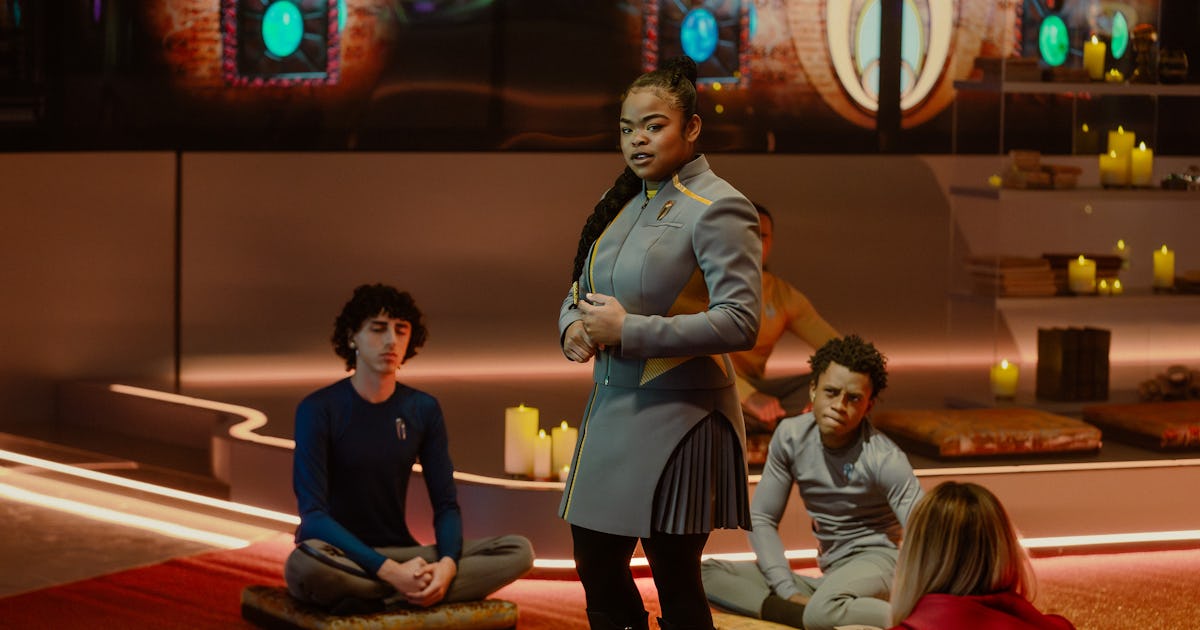
I do feel that [Alex] Kurtzman and Noga [Landau] have both maintained the vision, if you will, of Roddenberry, and enhanced it. And I was blessed with this group, the Starfleet Academy cast, because they had done months and months and thousands of hours together by the time I directed them. They had found each other's rhythm.
I believe in discipline. I do want to—as we say—live long and prosper. There were so many Sunday mornings I woke up groaning: I'll never do that again, after debauched nights at college spent on the beer bus. I've learned that, if you take care of yourself, mother nature will be good to you.
Plato's Politeia (the work we call The Republic thanks to Cicero's Latin mistranslation) describes the soul as having three parts: reason ( logistikon), spirit ( thumos), and appetite ( epithumia). But throughout the dialogue, Plato also describes a fourth element... repeatedly, and by name. He calls it the auto politeia (self-constitution): the governing principle that determines how the three parts relate. Plato has it in the text. His readers have looked right at it and counted three for 2,400 years.
In Star Trek: The Original Series, the USS Enterprise never returned to Earth. In The Next Generation, Picard's Enterprise-D visited every once in a while, and when debuted, the basic premise put the crew on the fringes of the Federation. But in a two-part thriller that aired 30 years ago, on January 1 and January 8, 1996, Deep Space Nine took a trip back to idealistic 24th-century Earth, where even paradise could turn into a snakepit.
We spend one-third of our lives asleep. This biological fact is something that, with time and technology, is less and less taken for granted. In many science fiction stories, the future of sleep is cozy and idyllic - an elevated state living within dream world. In others, sleep is more of an evolutionary shackle that gets in the way of productivity. The latter focuses on questions that haunt anyone who feels there are not enough hours in the day. What if we didn't have to sleep?
I wouldn't have been involved if I didn't have the blessing of Avery Brooks," Lofton tells Inverse. " I also look at this episode as a bridging of two different generations of Star Trek; we are part of the legacy Star Trek now, one of the first five shows, and now this is the future of Star Trek.
In 1977, Star Trek was gearing up for a comeback. After being canceled in 1969 and enjoying a brief return as an animated series in 1973, the beloved sci-fi series was finally coming back to live action. History will tell you this resulted in the 1979 film Star Trek: The Motion Picture, but before that, there were very serious plans for a sequel TV series, generally referred to as Star Trek: Phase II.
When someone mentions 1970s science fiction about a band of rebels fighting an evil, totalitarian space regime, your mind almost certainly goes to the original 1977 Star Wars.Failing that, you might think about the 1978 Battlestar Galactica, or even the TV and film versions of Logan's Run. But the oddest and most under-the-radar 1970s sci-fi rebellion show was Created by Terry Nation (the man who gave us the Daleks), Blake's 7 was ahead of its time when it debuted in 1978.