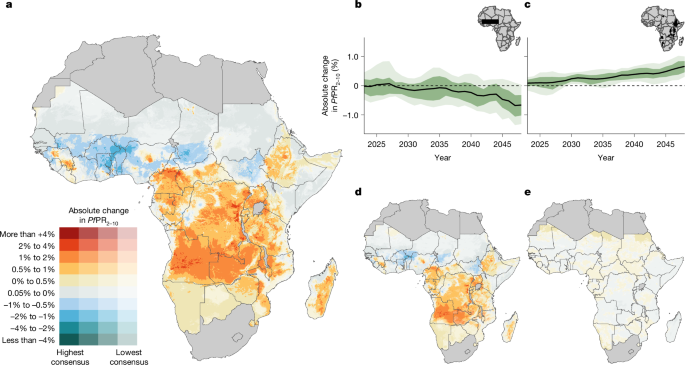
Fifteen years of declining malaria burden in Africa were followed by a decade of faltering progress, with new control tools' optimism tempered by uncertain financing and intensifying biological threats. Climate change threatens progress against malaria and could undermine eradication feasibility by mid-century. Climate influences vector and parasite ecology via ambient temperature effects on mosquito lifespan, blood meal frequency, extrinsic incubation period, and resultant vectorial capacity. Advances have adapted these mechanisms to Anopheles gambiae complex and invasive Anopheles stephensi. Climate also alters larval habitat suitability, affecting adult mosquito abundance. Modeling studies project future impacts, but disagreement on directionality, magnitude, and geographic distribution complicates response planning.
"In the twenty-first century, 15 years of declining malaria burden in Africa have been followed by a decade of faltering progress. Growing optimism around new control tools is being tempered by the concurrent challenges of uncertain financing and intensifying biological threats. At this critical juncture, a question of profound importance is the extent to which climate change threatens progress against the disease and the feasibility of eradication as a mid-century goal."
"Previous studies have explored the effects of ambient temperature on Anopheles mosquito lifespan, blood meal frequency and other life history characteristics11,12, the duration of Plasmodium extrinsic incubation period13, and the combined implications for vectorial capacity and malaria transmission intensity11,12,13. Recent advances have tailored this understanding to the most important malaria vectors in Africa-members of the Anopheles gambiae complex14-and the invasive vector Anopheles stephensi15. Other work has focused on understanding the way climate affects the abundance of adult mosquitoes by influencing larval habitat and its suitability"
Read at Nature
Unable to calculate read time
Collection
[
|
...
]