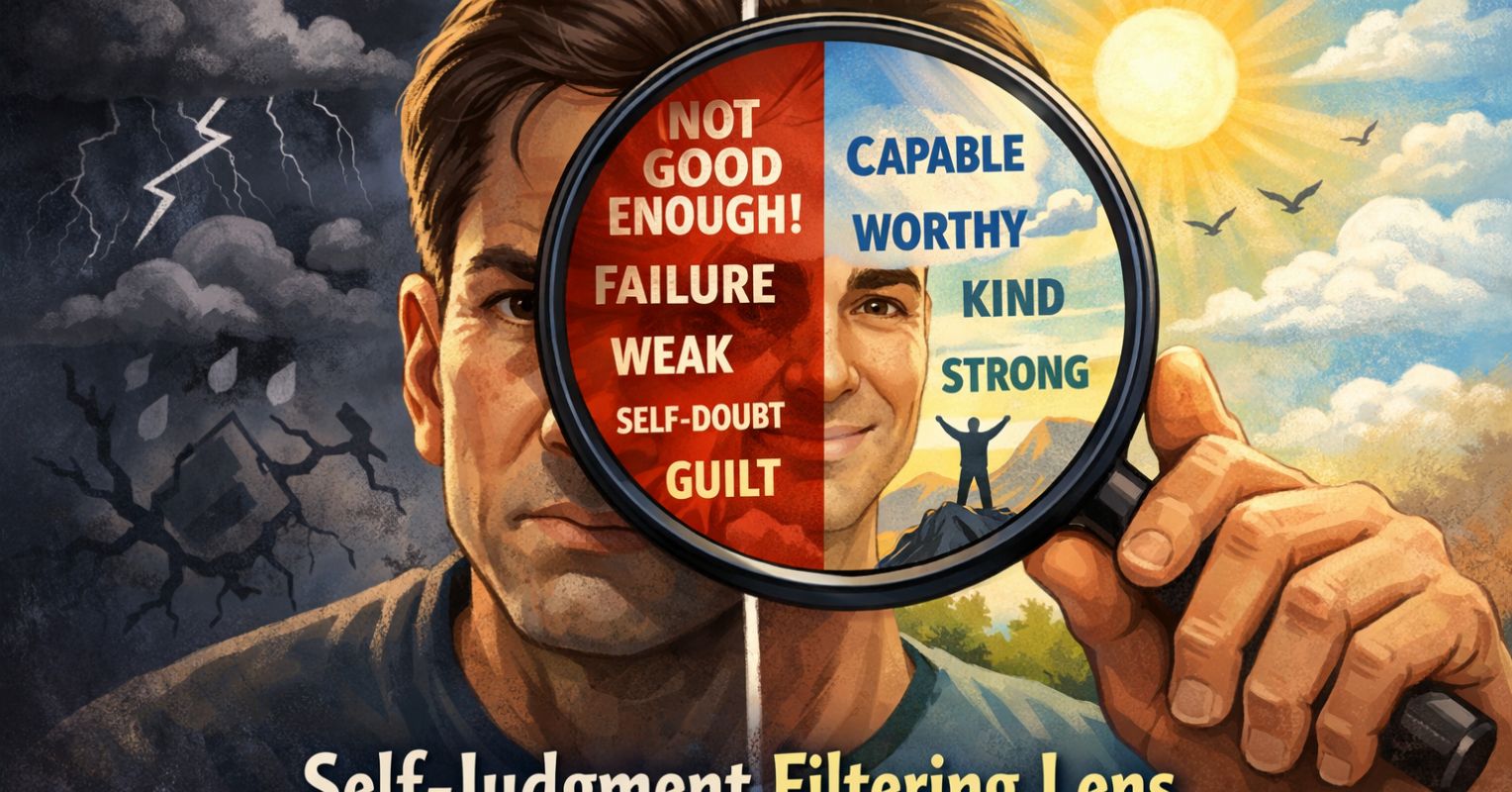
"Our self-judgments are typically distorted and usually in the negative direction. This distortion colors how we see ourselves and thus how we create our identity. And then how the negative view creates an underlying and ongoing nudge towards harm to our psychological and physiological health. It is as if we are wearing a sensory filter that magnifies our faults while minimizing our gifts."
"Negative experiences and beliefs carry more weight in the brain than positive ones. Negative experiences and beliefs carry more weight in the brain than positive ones. You can retrain automatic negative self-assessments through cognitive reappraisal and emotional tolerance."
"Since I had been doing it for a while, I finally decided not to accept that from myself anymore. As I deconstructed my process of self-evaluation, I then imagined that what I was judging about myself was projected onto someone else. And I immediately realized that I would make an entirely different evaluation if someone else had that characteristic (this could also be a behavior)."
"This is an evolutionary development In my work in resilience, I talk about the evolutionary mismatch between the environment in which our stress and survival response developed-around 50,000 to 100,000-plus years ago-and our present environment. We mobilize energy for fight or flight and then have to hold it in as we hear our boss or someone else say something we disagree with. Noticing what's wrong in the environment, what's out of place, was an evolutionary advantage. It increased our chances of survi"
Self-judgments commonly become distorted and skew negative, shaping identity and influencing psychological and physiological health. Negative experiences and beliefs receive greater weight in the brain than positive ones, creating a sensory filter that magnifies faults while minimizing strengths. This bias can function like an evolutionary carryover: attention to what is wrong in the environment once improved survival, but modern situations require holding stress responses in rather than acting. Automatic negative self-assessments can be retrained through cognitive reappraisal, which changes interpretations, and emotional tolerance, which reduces avoidance of difficult feelings.
Read at Psychology Today
Unable to calculate read time
Collection
[
|
...
]