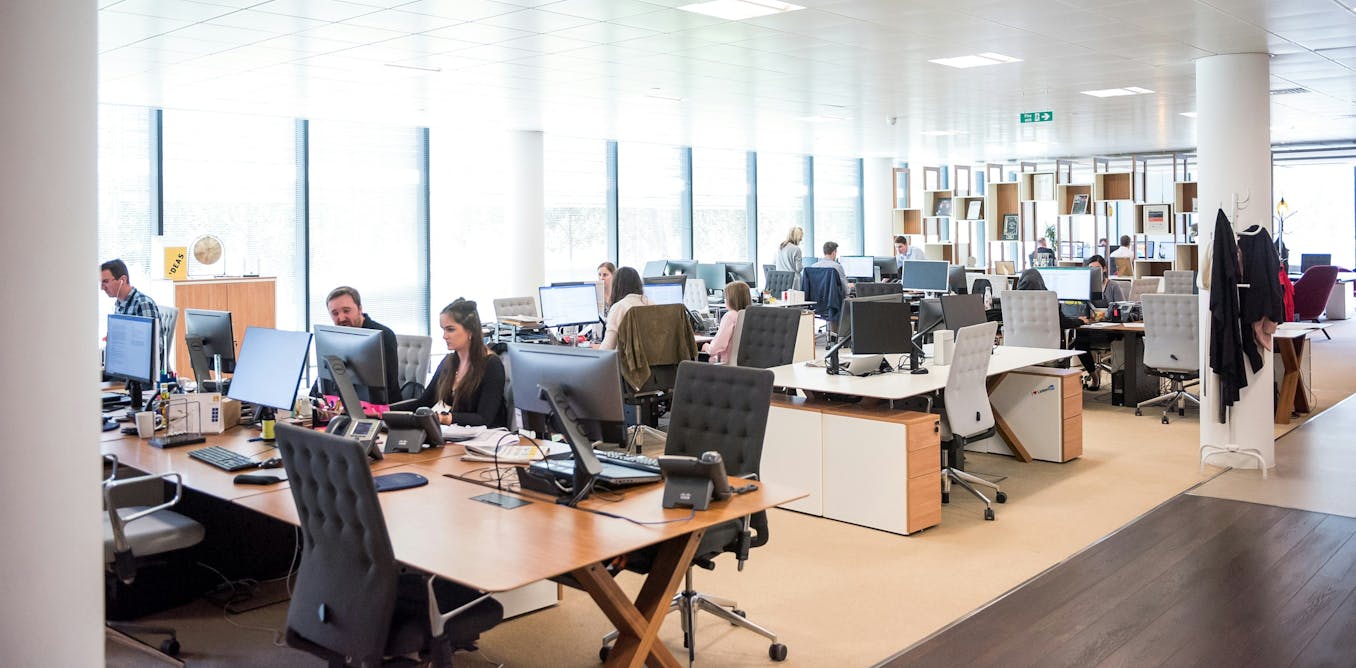
"Since the pandemic, offices around the world have quietly shrunk. Many organisations don't need as much floor space or as many desks, given many staff now do a mix of hybrid work from home and the office. But on days when more staff are required to be in, office spaces can feel noticeably busier and noisier. Despite so much focus on getting workers back into offices, there has been far less focus on the impacts of returning to open-plan workspaces."
"As neuroscientist Susan Hillier explains in more detail, different brain waves reveal distinct mental states: "gamma" is linked with states or tasks that require more focused concentration "beta" is linked with higher anxiety and more active states, with attention often directed externally "alpha" is linked with being very relaxed, and passive attention (such as listening quietly but not engaging) "theta" is linked with deep relaxation and inward focus"
Offices have shrunk since the pandemic as many organisations need less floor space because employees now mix hybrid work from home and the office. On busier in-office days, open-plan spaces can feel noticeably more crowded and noisy. Researchers fitted 26 people with wireless EEG headsets while they completed simulated office tasks, monitoring notifications, emails, and memory lists in both an open-plan workspace and a small enclosed pod. Measurements focused on frontal brain regions that handle attention, concentration, and distraction filtering, and different brain waves were tracked to assess cognitive load and mental states.
Read at The Conversation
Unable to calculate read time
Collection
[
|
...
]