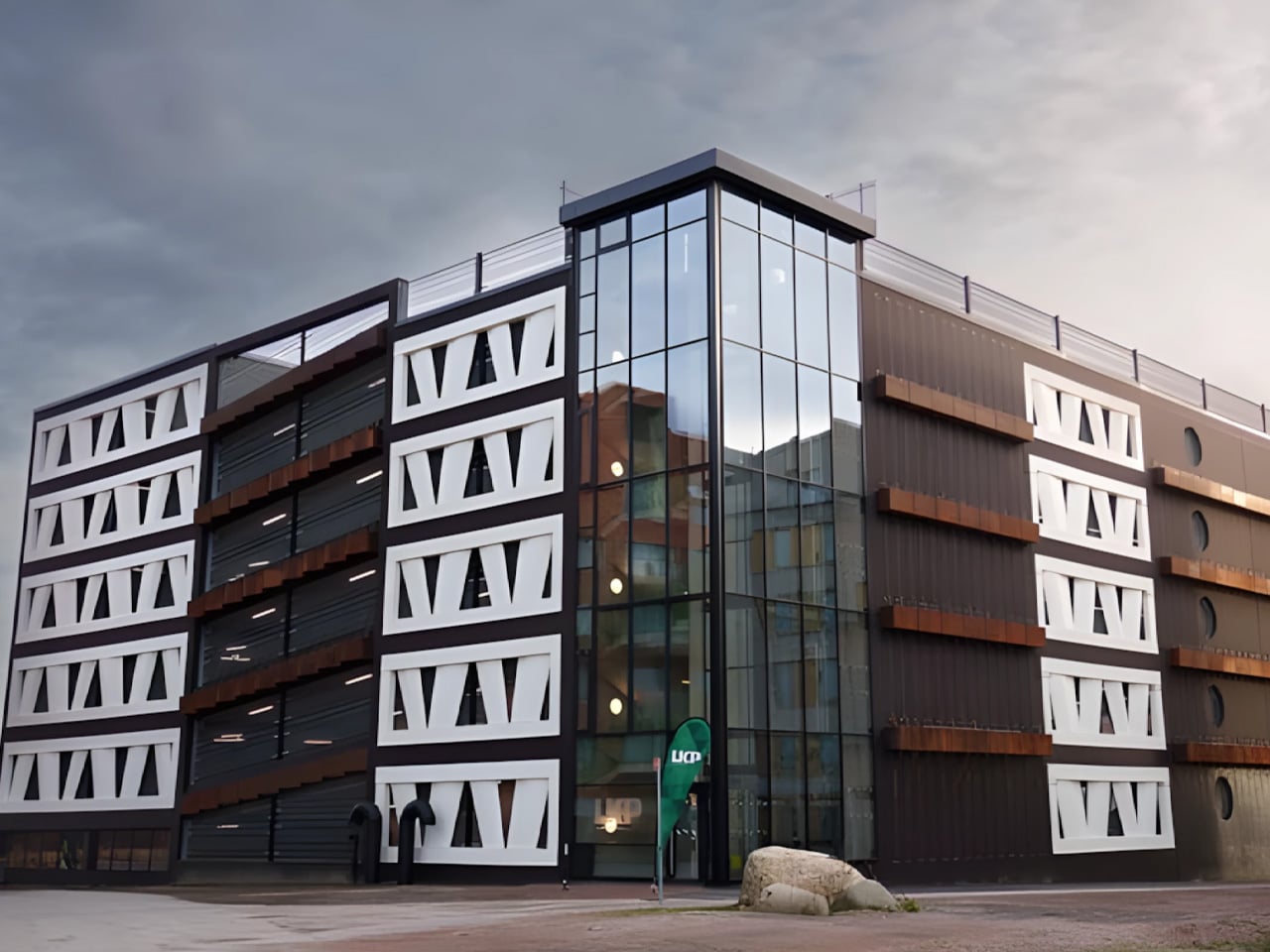
"Sweden has opened the doors to a parking garage unlike any other in Europe. The Niels Bohr car park in Lund stands as a testament to what happens when architectural vision meets environmental necessity. The five-story structure houses 365 parking spaces and represents a groundbreaking approach to renewable energy waste, proving that circular economy principles can produce functional, safe infrastructure that people actually want to use. Architect Jonas Lloyd stumbled upon the project's core concept while flipping through a magazine."
"These massive structures, engineered from glass and carbon fiber composites to withstand decades of punishment from wind and weather, were ending up buried in landfills across the United States. Lloyd saw waste where others saw a dead end. When developer LKP commissioned his firm, Lloyd's Arkitektkontor, to design a new parking structure for Lund's growing Brunnshög district, he pitched an unconventional solution that would give turbine blades a second life as architectural elements."
"Vattenfall, Sweden's green energy giant, donated 57 rotor blades from its decommissioned Nørre Økse Sø wind farm. The team carefully cut and mounted these blades onto the building's exterior, creating striking curtain walls that serve as non-load-bearing façade elements. The result is visually arresting: massive white curves sweeping across the structure's face, their aerodynamic forms now frozen in place instead of spinning against Nordic skies."
Niels Bohr car park in Lund is a five-story structure with 365 parking spaces that repurposes decommissioned wind turbine blades as architectural façade elements. Architect Jonas Lloyd proposed using retired blades after encountering reports of turbine blades being buried in U.S. landfills. Vattenfall donated 57 rotor blades from the decommissioned Nørre Økse Sø wind farm. The design team cut and mounted the blades as non-load-bearing curtain walls, creating large white aerodynamic curves on the building's face. The facility includes forty electric vehicle charging stations tied to an on-site battery storage system and rooftop solar panels that generate daytime power to charge vehicles after dark.
Read at Yanko Design - Modern Industrial Design News
Unable to calculate read time
Collection
[
|
...
]