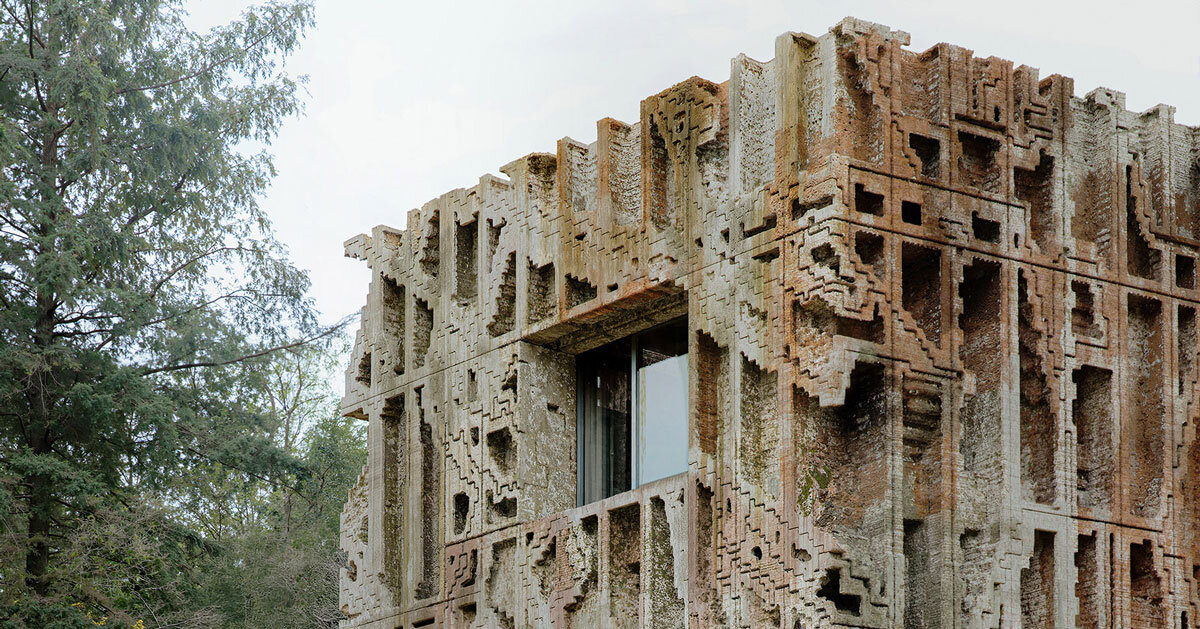
"The residential project is centered on a single-material building envelope composed of large-scale sand blocks. This operates as an independent outer layer, separated from the structural frame and interior spaces. By avoiding complex, multi-layered wall assemblies, the design proposes a simplified and circular construction approach in which materials can be removed, reused, or replaced with minimal waste. Each sand block is printed at a scale sufficient to form a thick, load-bearing facade that also functions as the building's thermal barrier."
"Openings are carved directly into the monolithic elements, with recessed glazing that maintains thermal continuity while admitting daylight. the white, 3D printed blocks when first built | all images by Analog1 Flexible Interior Framework Supports Long-Term Spatial Change Behind the envelope, a lightweight structural system of steel and 3D printed columns supports a flexible interior layout. Glass partitions provide acoustic separation while allowing internal spaces to be reconfigured independently of the outer shell."
A residential design uses large-scale 3D-printed sand blocks as an independent, single-material outer envelope that functions as a load-bearing thermal barrier. The envelope is intentionally monolithic with carved openings and recessed glazing to preserve thermal continuity and daylighting while allowing individual facade components to be removed or reused. Behind the shell, a lightweight steel and 3D-printed column structure supports a reconfigurable interior with glass partitions for acoustic separation. The spatial plan moves from communal ground-level areas to private upper rooms and returns to double-height living spaces and a mezzanine, enabling long-term adaptability and material circularity.
Read at designboom | architecture & design magazine
Unable to calculate read time
Collection
[
|
...
]