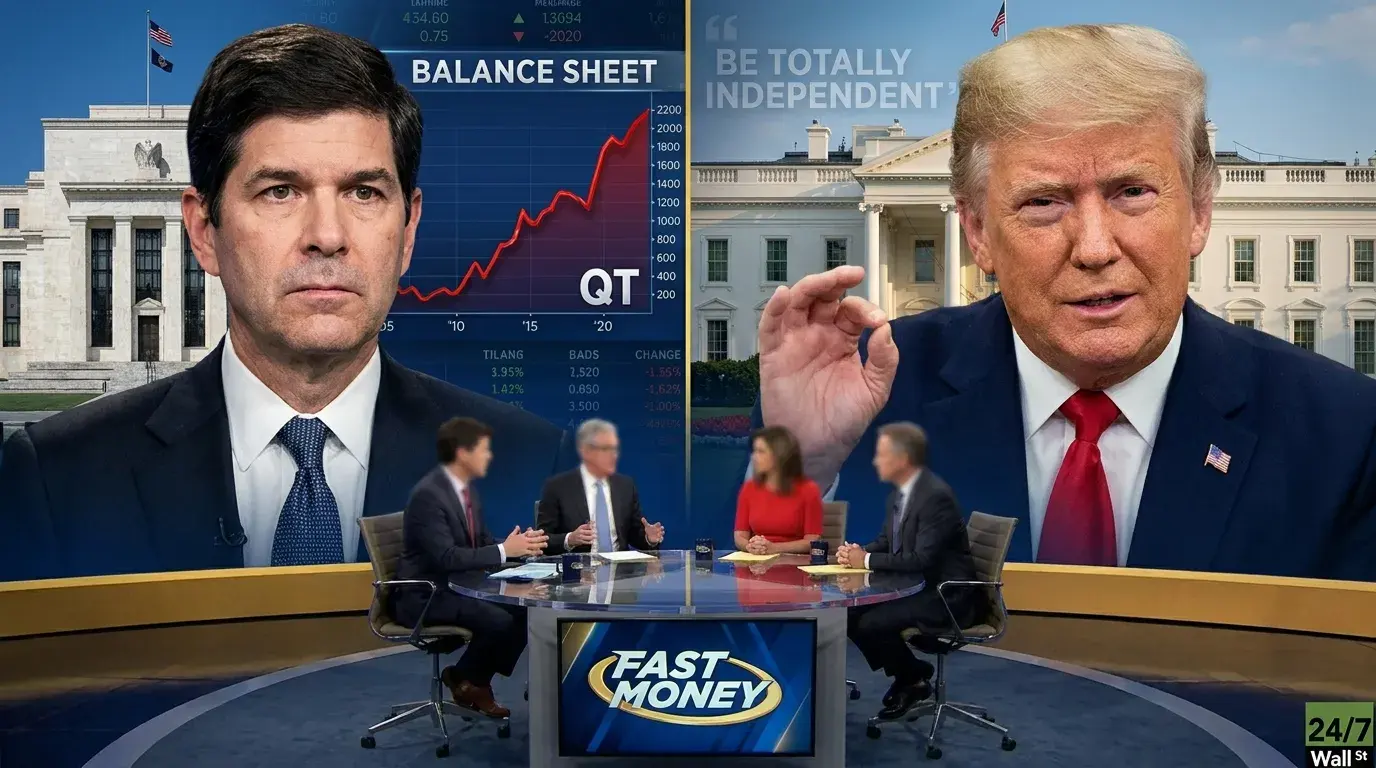
Inflation conditions are worsening, creating pressure for tighter Federal Reserve policy. The new chair must avoid headlines tied to an overt policy-rate hike while still addressing inflation. A balance-sheet approach is presented as a practical alternative because quantitative tightening is slower, more technical, and less likely to trigger political backlash. Core PCE is near the top of its recent range, while CPI has risen notably, indicating persistent inflation momentum. Governor Christopher Waller’s push to remove an easing bias supports a hawkish shift. Interest rate futures now reflect the possibility of either a hike or a cut, increasing uncertainty about the next move.
"The Federal Reserve's new chair faces a political problem more than an economic one. Kevin Warsh needs to tighten policy in an inflation backdrop that is heating up while avoiding antagonizing the president who appointed him. On CNBC's Fast Money this past Friday, the panel zeroed in on how Warsh might thread that needle, and the answer points to the balance sheet rather than the funds rate."
"President Trump has publicly told Warsh "to be totally independent" and "just do a great job". Hiking the policy rate from the current 4% upper bound, after the Fed has already cut 75 basis points over the past eight months, would land Warsh in the headlines for the wrong reason. Quantitative tightening, by contrast, is technical, slow-moving, and rarely makes the evening news."
"Core PCE, which remains the Federal Reserve's absolute preferred inflation gauge, currently sits all the way at the 91st percentile of its trailing twelve-month range. At the same time, the headline Consumer Price Index advanced notably throughout April 2026 to print at an absolute index level of 332.4. JPMorgan's chief economist captured this structural monetary shift perfectly during the panel discussion by bluntly warning investors that Goldilocks is officially leaving the building."
"Federal Reserve Governor Christopher Waller's high-profile public push to officially remove the easing bias from policy statements reinforces this hawkish pivot. Interest rate futures markets, which spent the vast majority of 2025 aggressively pricing in a steady series of cuts, are now actively factoring in the real possibility of an outright rate hike. The consensus among panel members is that there are now completely equal odds of either a hike or a cut acting as the Fed's next strategic policy mov"
Read at 24/7 Wall St.
Unable to calculate read time
Collection
[
|
...
]