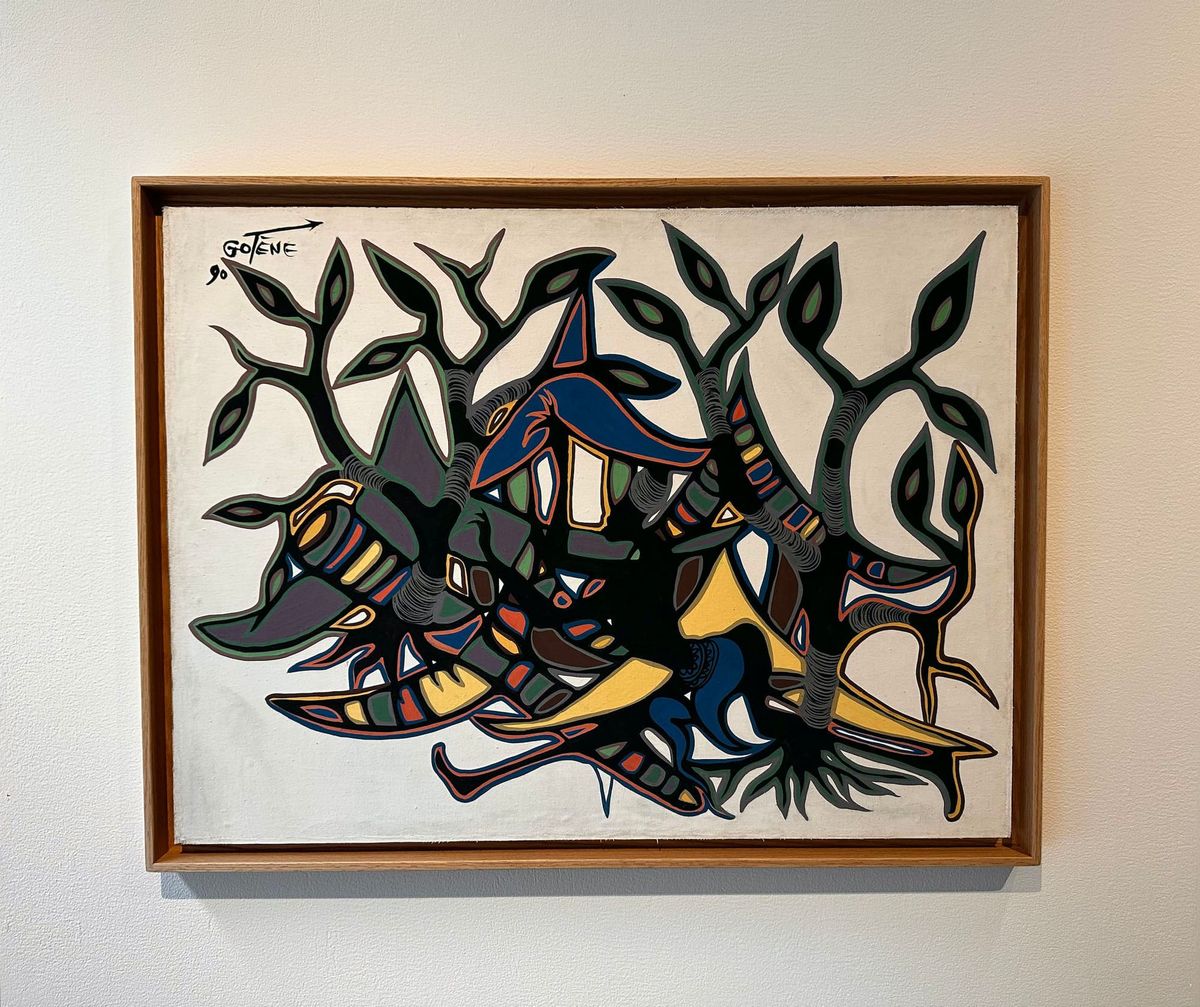
"Every art fair season the question arises: If you aren't an arts journalist or a patron looking to augment your collection, why attend an art fair at all? With regard to the 1-54 Contemporary African Art Fair, which was founded in 2013 by Touria El Glaoui, the answer I find is that it keeps offering surprise and the genuine pleasure of discovery. Among the spring art fairs that take place in New York, 1-54, open at the Starrett-Lehigh Building in Manhattan through Sunday, still features work that's unexpected."
"His wall installation "the physical space requires that the other be ally or enemy, n10" (2025) has a Pop-art sensibility - a roiling confluence of oceanic waves ranging from teal to baby blue cresting against a background of yellow and purple tiles. It's made of completely modern materials: PVC, resin, and automotive paint. Aura Director Edoardo Biancheri explained that Conceição means to provoke a conversation about Brazil's influence on the United States, rather than the typical converse, by way of its Concrete art movement, which in the 1940s and '50s began to explore the possibilities of geometric abstraction."
"The work is playful, and approaching it I realized that it is materially layered in way that creates a variegated topography. It's not a painting exactly. It's a wall work with a secreted history lesson. Other work that combined materials in fresh ways captured my attention. At the booth of the Current: Baha Mar Gallery and Art Center in the Bahamas, I encountered the work of Kendra"
1-54 Contemporary African Art Fair, held in Manhattan, presents contemporary works that feel tactile, surprising, and animated by material expression. A Brazilian gallery, Aura, shows Rommulo Vieira Conceição’s wall installation with Pop-art energy, using PVC, resin, and automotive paint to create layered, topographic surfaces rather than a conventional painting. The installation uses color and tiled backgrounds to evoke oceanic wave forms while prompting conversation about Brazil’s influence on the United States, linked to Concrete art’s geometric abstraction from the 1940s and 1950s. Other booths also attract attention by combining materials in fresh ways, emphasizing playful approaches and new visual textures.
Read at Hyperallergic
Unable to calculate read time
Collection
[
|
...
]