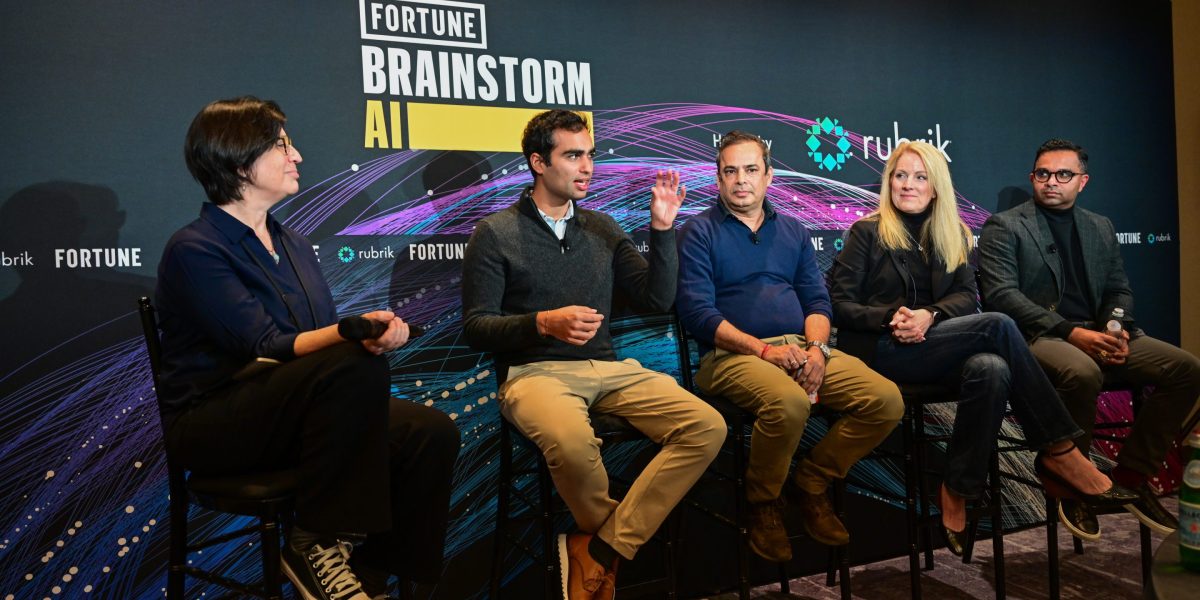
"At Fortune's recent Brainstorm AI event in San Francisco, an expert roundtable grappled with that question as insiders shared how their companies are approaching security and governance-an issue that is leapfrogging even more practical challenges such as data and compute power. Companies are in an arm's race to parachute AI agents into their workflows that can tackle tasks autonomously and with little human supervision."
"Dev Rishi, general manager for AI at Rubrik, joined the security company last summer following its acquisition of his deep learning AI startup Predibase. Afterward, he spent the next four months meeting with executives from 180 companies. He used those insights to divide agentic AI adoption into four phases, he told the Brainstorm AI audience. (To level set, agentic adoption refers to businesses implementing AI systems that work autonomously, rather than responding to prompts.)"
"According to Rishi's learnings, the four phases he unearthed include the early experimentation phase where companies are hard at work on prototyping their agents and mapping goals they think could be integrated into their workflows. The second phase, said Rishi, is the trickiest. That's when companies shift their agents from prototypes and into formal work production. The third phase involves scaling those autonomous agents across the entire company. The fourth and final stage-which no one Rishi spoke with had achieved-is autonomous AI."
Companies are racing to deploy autonomous AI agents into workflows to perform tasks with minimal human supervision. Security and governance concerns are outpacing practical challenges such as data and compute power. Adoption follows four phases: experimentation and prototyping, formal production, company-wide scaling, and full autonomous AI. Many organizations remain in early phases, with roughly half prototyping, 25% formalizing prototypes, 13% scaling, and about 12% not started. A central paradox slows adoption: moving quickly requires trust, yet establishing trust demands significant time and effort. The second phase—transitioning prototypes into production—poses the greatest difficulty.
Read at Fortune
Unable to calculate read time
Collection
[
|
...
]