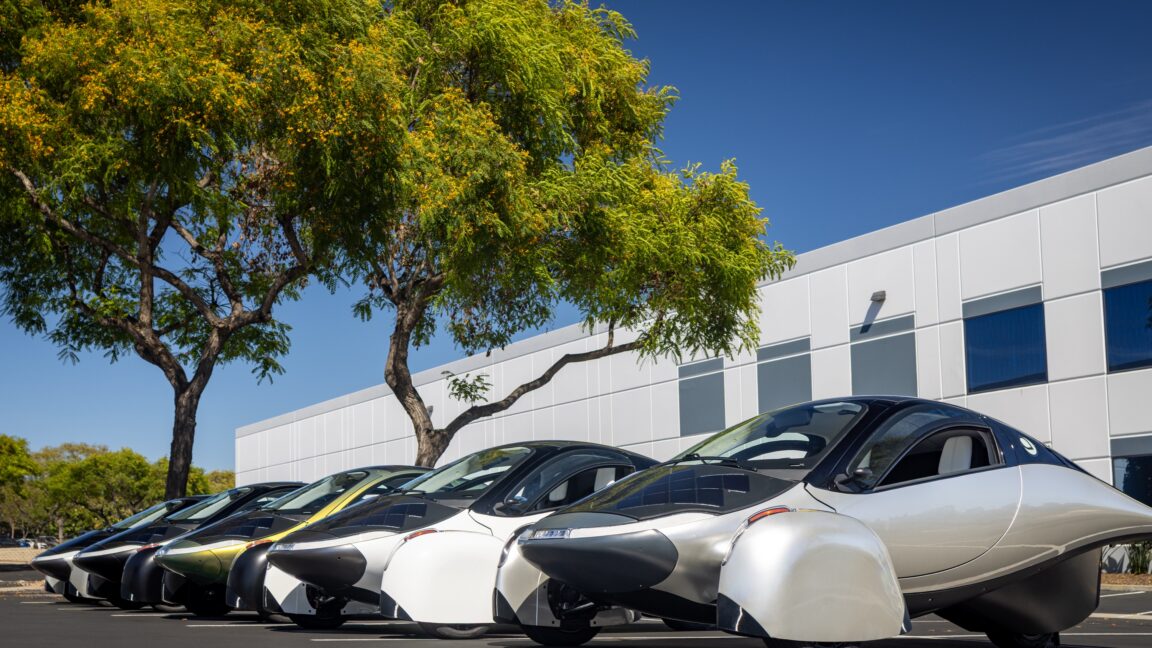
"The vehicle seats just two occupants and their luggage, but it takes up a surprising amount of room on the road-it's actually an inch and a half wider than the gargantuan Hummer EV, if you can believe it, a vehicle so wide it scarcely fits in parking spaces or EV charging bays."
"Visits to those charging bays are meant to be rare; the EV aims to deliver a range of 400 miles (644 km) from a 44 kWh battery pack-10 miles/kWh (6.2 kWh/100 km) is the claim for the $40,000 launch edition. (Should Aptera succeed, it plans a much cheaper version with just 250 miles/402 km of range.)"
"And as you'll note from the pictures, that aero body is clad in photovoltaic panels that provide up to 40 miles (64 km) of range a day, Aptera says. Third time's the charm? But Aptera, or some version of it, has been saying these things for 20 years now."
"In 2012, a Chinese OEM obtained Aptera's intellectual property from one of the company's creditors, promising that cars-now three-wheeled again-would be on sale by the end of that year. The following year, its plans had expanded to include a gasoline-powered version, but this incarnation went dark in 2014. In 2019, Aptera's original founders relaunched the venture and returned to work, trying to make their dream a reality."
The vehicle seats two occupants and their luggage while occupying unusually little road space, measuring about an inch and a half wider than the Hummer EV. It targets a 400-mile range from a 44 kWh battery pack, claiming 10 miles per kWh efficiency for a $40,000 launch edition. A lower-cost version is planned with 250 miles of range. The design uses a drag coefficient of 0.13 and a compact cross-section to reduce aerodynamic losses. The body is covered with photovoltaic panels that provide up to 40 miles of range per day. The company’s history includes multiple shutdowns and redesigns, including attempts involving ATVM loan limitations, Chinese acquisition, and later founder relaunch with prototype testing at CES.
Read at Ars Technica
Unable to calculate read time
Collection
[
|
...
]