#persona-building
#persona-building
[ follow ]
#user-experience #ai #product-design #emotional-connection #social-media #ai-in-design #digital-marketing
Business intelligence
fromFairbanks Daily News-Miner
2 days agoWhy AI Search Matters for Clients. How Brands Can Gain More Visibility, More Trust, and Better Conversion With the Right Strategy
AI Search is crucial for business growth, impacting customer acquisition, brand trust, and visibility in a digital landscape.
#ai
Artificial intelligence
fromMedium
2 days agoNotes from the people building your future
AI-driven job displacement requires thoughtful policy to ensure equitable distribution of prosperity and prevent increased inequality.

Marketing tech
fromTheregister
3 days agoChatbots excel at manipulating people into buying things
Large language models can manipulate consumer choices in online shopping without users' awareness.
Psychology
fromSilicon Canals
1 day agoPsychology says the people who are genuinely magnetic in conversation aren't the ones with the most interesting stories - they're the ones who've learned to make the person in front of them feel like the most interesting person in the room, and that specific skill has almost nothing to do with what you say - Silicon Canals
Magnetic people are those who listen actively rather than those who dominate conversations.
Relationships
fromSilicon Canals
3 days agoI'm 44 and I have started paying attention to how I feel the morning after I spend time with someone - not during, when the performance is running, but after, when the honest version arrives - and that single habit has told me more about my relationships than twenty years of thinking about them - Silicon Canals
The morning after social interactions reveals true emotional states, often contrasting with the perceived enjoyment during the event.
Mental health
fromSilicon Canals
2 days agoThere's a kind of exhaustion that has nothing to do with how much you did today and everything to do with how many versions of yourself you performed. The tiredness isn't physical. It's the weight of translation between who you are privately and who each room requires you to become. - Silicon Canals
Exhaustion often stems from the cognitive load of managing multiple identities rather than just physical effort or workload.
Psychology
fromSilicon Canals
3 days agoNobody prepares you for the exhaustion of being naturally magnetic - the way people assume your warmth has no limits, your attention has no cost, and your need to be seen doesn't exist - Silicon Canals
Emotional Magnetic Load (EML) describes the invisible weight of managing others' emotions while neglecting one's own needs.
Writing
fromSilicon Canals
5 days agoI've been useful my entire life - to my employer, my family, my parents when they were aging - and I'm only now beginning to understand that being useful and being known are not the same thing, and I've had plenty of the first and almost none of the second - Silicon Canals
Being useful does not equate to being known or valued as a person.

#social-media
Social media marketing
fromSilicon Canals
3 days agoPsychology says people who never post on social media but check it every day aren't passive - they opted out of the performance while keeping the window, and keeping the window without paying the price is the most rational position available and the one the platform was specifically designed to make feel antisocial - Silicon Canals
Silent scrollers on social media actively choose to observe rather than post, demonstrating discipline and self-control contrary to common perceptions.
Social media marketing
fromBuffer: All-you-need social media toolkit for small businesses
4 days agoYes, You Can Create Content: A Neurodivergent's Guide to Getting Started
Developing a personalized system for content creation can help neurodivergent individuals maintain consistency and overcome challenges associated with ADHD and autism.
Marketing tech
fromLondon Business News | Londonlovesbusiness.com
4 days agoConversational marketing: How chatbots and artificial intelligence transform digital engagement - London Business News | Londonlovesbusiness.com
Conversational marketing transforms customer interactions into relationship opportunities using AI and chatbots for personalized, two-way communication.

UX design
fromLondon Business News | Londonlovesbusiness.com
3 days agoDerribar Ventures on User-Centric Design: 5 Pillars Every Team Needs - London Business News | Londonlovesbusiness.com
Most product failures stem from not understanding user needs, leading to feature-bloated platforms that solve non-existent problems.
fromBuzz Usborne
1 month agoDesigning AI Experiences People Actually Use
For decades in SAAS, products reduced ambiguity. Users supplied constrained inputs, and the system handled the output. It's never been Minority Report cinematic, but it was predictable. By providing predictable environments for manipulating data, users learned by moving things, adjusting variables - and the outcome emerged through interaction.
Design
fromEntrepreneur
1 month agoHow to Keep Your Marketing Human in an Algorithm-Driven World
Today's marketers operate in an environment shaped by algorithms that surface signals in real time, showing us what resonates, what converts and where attention is moving. Data is no longer a support function. It is the foundation of modern marketing.
Marketing

fromMedium
7 months agoWho are we designing for now?
AI is disrupting more than the software industry, and is doing so at a breakneck speed. Not long ago, designers were deep in Figma variables and pixel-perfect mockups. Now, tools like v0, Lovable, and Cursor are enabling instant, vibe-based prototyping that makes old methods feel almost quaint. What's coming into sharper focus isn't fidelity, it's foresight. Part of the work of Product Design today is conceptual: sensing trends, building future-proof systems, and thinking years ahead.
UX design
fromMedium
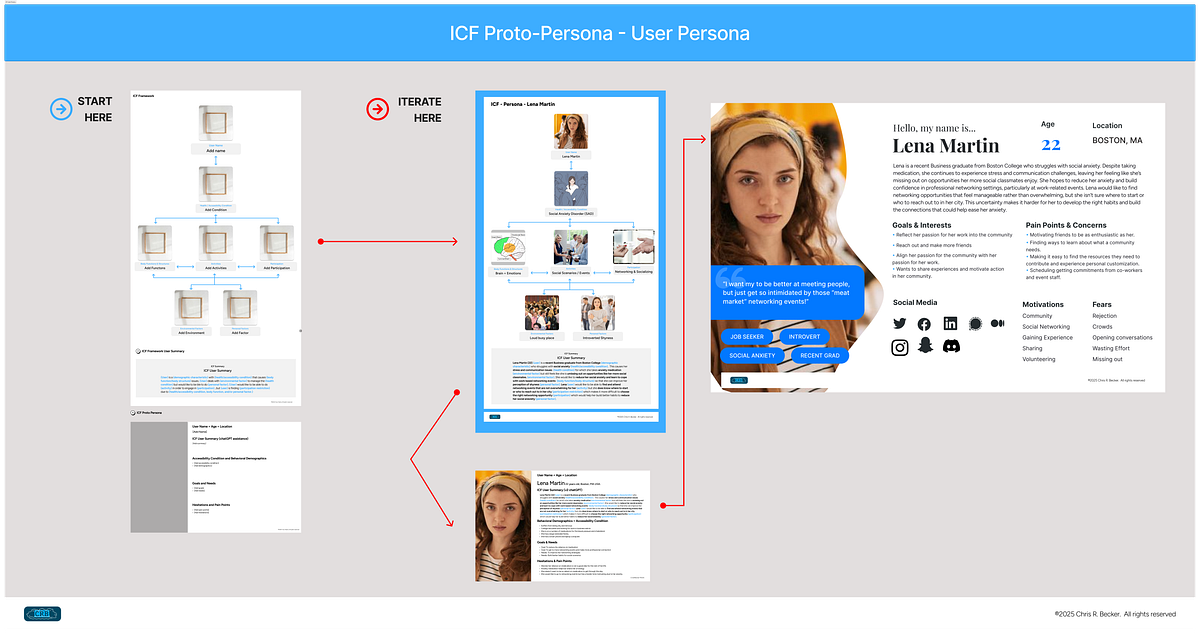
2 months agoHow UX personas made our AI training data more inclusive
My role was straightforward: write queries (prompts and tasks) that would train AI agents to engage meaningfully with users. But as a UXer, one question immediately stood out - who are these users? Without a clear understanding of who the agent is interacting with, it's nearly impossible to create realistic queries that reflect how people engage with an agent. That's when I discovered a glitch in the task flow.
UX design
fromMedium
2 months agoHow UX personas made our AI training data more inclusive
My role was straightforward: write queries (prompts and tasks) that would train AI agents to engage meaningfully with users. But as a UXer, one question immediately stood out - who are these users? Without a clear understanding of who the agent is interacting with, it's nearly impossible to create realistic queries that reflect how people engage with an agent. That's when I discovered a glitch in the task flow. There were no defined user archetypes guiding the query creation process. Team members were essentially reverse-engineering the work: you think of a task, write a query to help the agent execute it, and cross your fingers that it aligns with the needs of a hypothetical "ideal" user - one who might not even exist.
UX design
fromMedium
2 months agoThe dawn of Authentic Experience (AuX)
UX is entering a new era. At the centre of every design conversation in 2026 lies a singular force: Artificial Intelligence. It is now so pervasive that even five-year-olds can explain its utility, while the AI natives of the new Beta generation are coming of age in a world where a conversational digital collaborator is not a feature but a baseline reality.
UX design
[ Load more ]