California
fromKqed
20 hours agoBay Area Weather Turns the Corner With More Late Spring Rain | KQED
A storm is expected to increase Sierra Nevada snowpack, but drought concerns persist despite good reservoir conditions.
We created Earth in Action to provide a lens into what's happening on our planet, as it happens. Whether it's something typical, like the current air temperature, or an extreme event like a major dust storm, we wanted to provide an opportunity for people to see them.
"This is going to help fill that gap in minutes to hours lead time that's vital to know where the heaviest rain is going to hit," Ralph said. "And when and what communities are going to be affected so people in the preparedness community and water resource management community can take action to help protect people's lives and property."
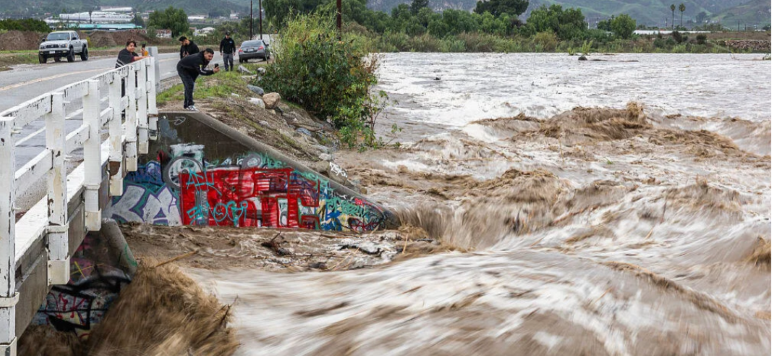
While humans have assembled a lot of weather data, flash floods are too short-lived and localized to be measured comprehensively, the way the temperature or even river flows are monitored over time. That data gap means that deep learning models, which are increasingly capable of forecasting the weather, aren't able to predict flash floods.
"Don't entirely trust any of these slopes until temperatures dramatically cool down. Each day, the sun climbs higher in the sky, and the oppressive heatwave sends meltwater deeper into colder snowpacks."
If you've ever glanced at your phone's weather app to check the day's forecast or to help plan for an upcoming storm, you've probably run across a scenario where you see an outrageous forecast. It happened to me earlier this week when I noticed my app was predicting more than 13 inches of snow for the Charlotte, NC area. Not only would that be a historic storm, but it would also be fairly apocalyptic for an area where even an inch of snow is a rarity.
In November 2025, a massive storm rolled across the lower Mekong River delta, dumping multiple inches of rain onto the wide, flat river plain that covers much of Cambodia. The river rose and rose. The force of the water churned up mud from the river bottom. The muddy water flowed downstream and rushed into the many farming and fishing towns that line the Mekong's banks.
SWE is the most important metric for all of our water resources. It's the metric that we deal with the most and the one that the entirety of the snow research and operations community is working to get right. So, seeing an increase in SWE like that, even if it's from mid-winter rain, is a great thing because that means we have more water stored in the snowpack moving forward.
Warwick, N., Griffiths, P., Keeble, J., Archibald, A., & Pyle, J. Atmospheric implications of increased Hydrogen use. GOV.UK https://www.gov.uk/government/publications/atmospheric-implications-of-increased-hydrogen-use (2022).
To get back to average snowpack, we essentially need to have the most snow that we've ever had for the last 30 years between now and mid-April. It would be extremely difficult for Colorado to get back to a normal/average snowpack. As an example, when looking at the Independence Pass SNOTEL site in central Colorado outside of Aspen, we typically have 13 inches of snow-water-equivalent at the end of February. This year, we only have 6.7 inches of SWE.
From late Saturday night through Sunday, guidance is converging on timing and warmer snow levels but diverging on intensity and ridge-top wind magnitude, with the most consistent signal for light snowfall in the northern and central ranges and limited coverage farther south. Most mountains should stay in the low single digits for accumulation during this first push, with favored terrain near the Continental Divide able to approach around 4 inches by Sunday evening.