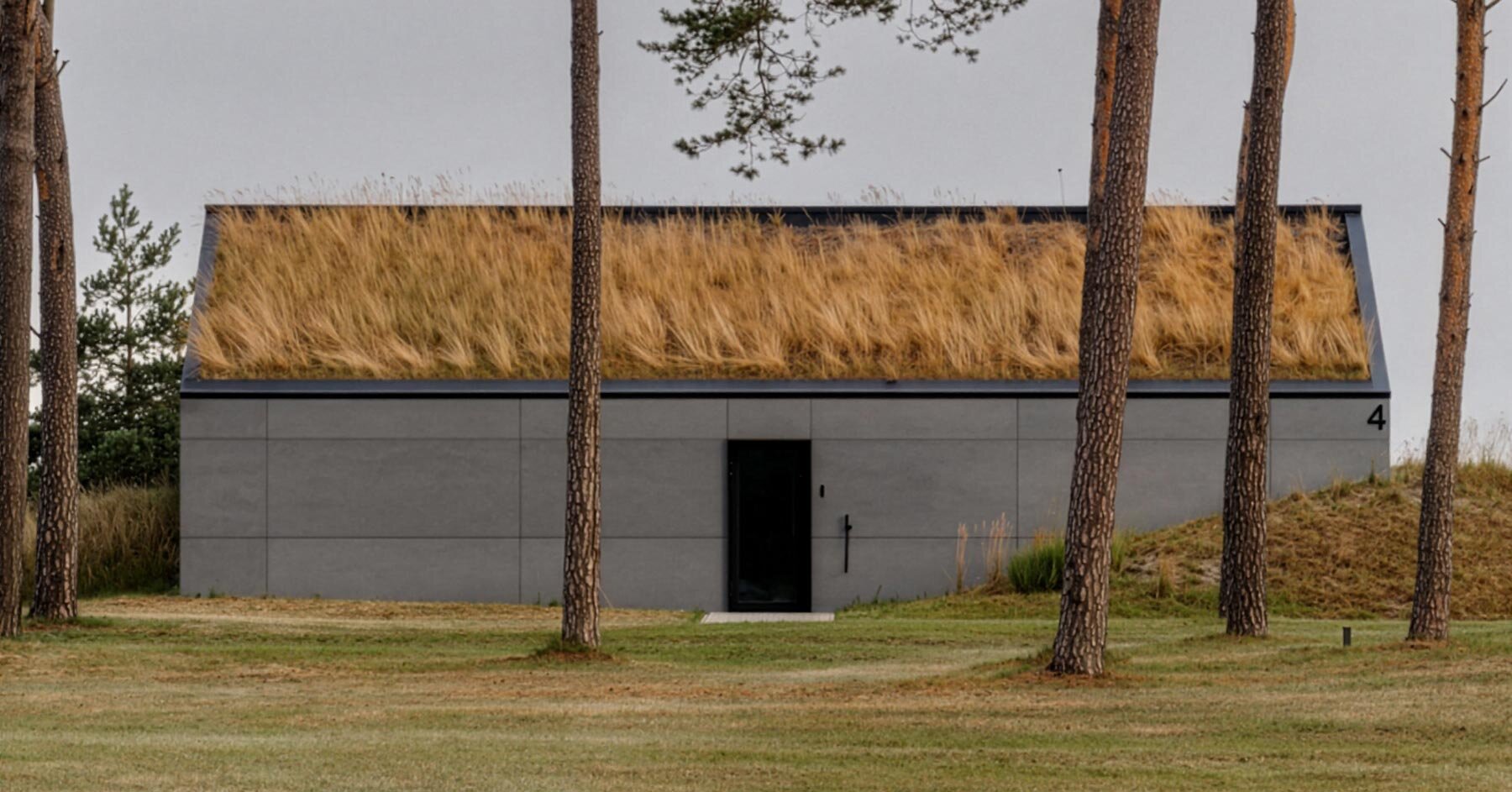
SAR is a residential project on Latvia's Saraiki coastline that adaptively reuses four abandoned Soviet-era military bunkers as foundations for new construction. Rather than demolishing the structures, the design integrates them into a multi-generational family home comprising a main residence and two guest houses. The main dwelling features a dual-sloped roof clad in fiber cement panels referencing Soviet construction aesthetics, supported by a custom metal frame. Living spaces occupy the second floor while the entrance sits beneath the elevated volume. The two guest houses feature grass roofs that blend with the coastal landscape. This approach preserves historical infrastructure while minimizing environmental impact on the surrounding dune habitat.
"The site contained four abandoned bunkers partially covered by vegetation. Rather than removing them, the design incorporates these foundations into the new residential program. The intervention reuses the structures as the base for the main dwelling and two smaller guest houses, establishing a relationship between the existing military infrastructure and the new domestic environment."
"The main residence is defined by a large dual-sloped that follows local architectural regulations while introducing a contemporary material expression. Fiber cement panels clad the roof surface, referencing the material language associated with Soviet-era construction. To support the roof above a facade, OAD developed a custom metal frame that functions both as a structural solution and as a visible architectural element."
"The two guest houses draw directly from the form of the original bunkers. Their low volumes are covered with grass roofs, allowing them to merge visually with the coastal terrain while extending habitat conditions for local fauna."
Read at designboom | architecture & design magazine
Unable to calculate read time
Collection
[
|
...
]