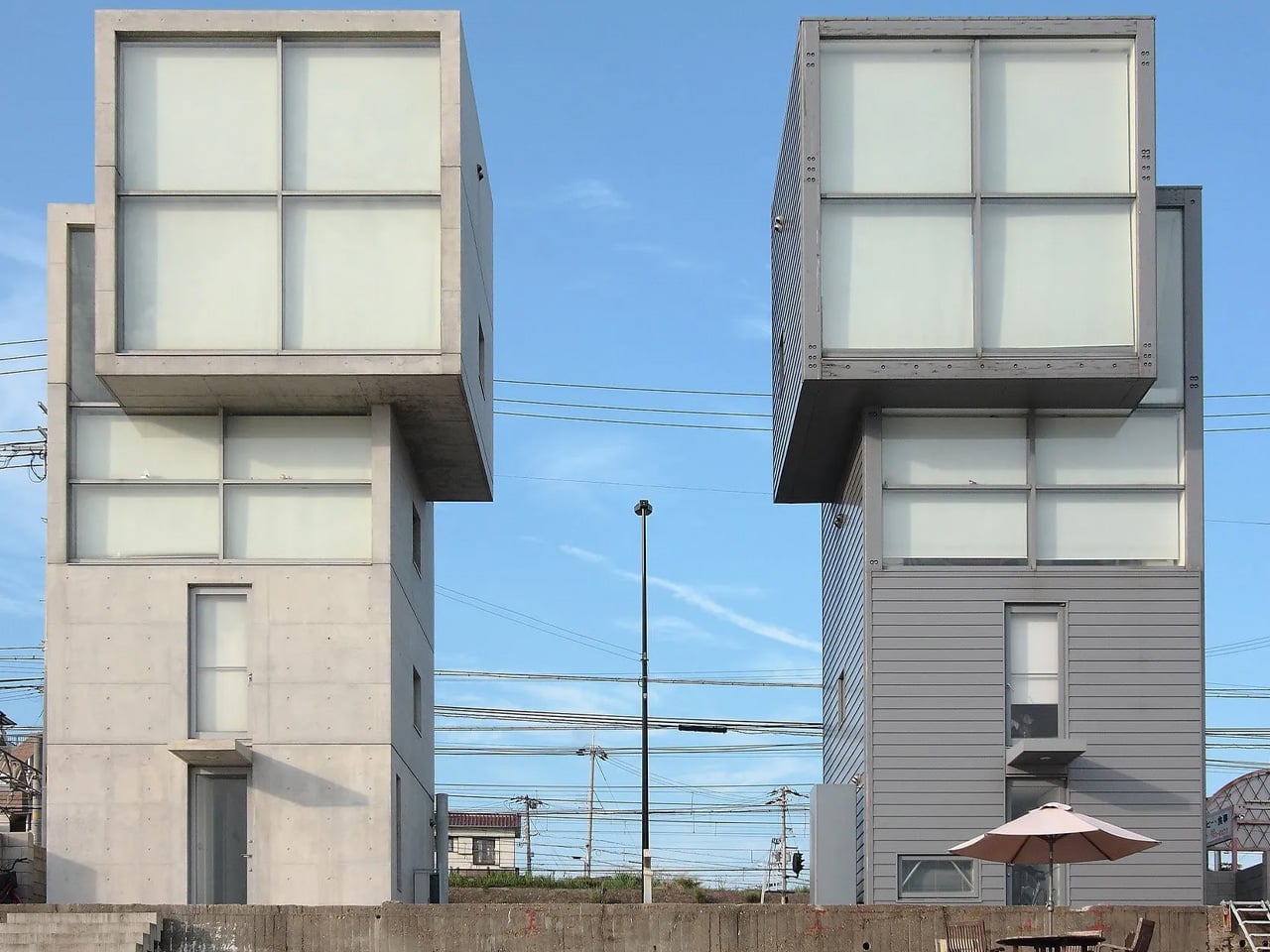
A 4x4 House stands on a narrow coastal strip in Tarumi-ku, Kobe, where construction was not previously considered feasible. Completed in 2003, it responds to the Great Hanshin earthquake by prioritizing precision rather than conventional size or safety. The structure is a four-story reinforced concrete tower with a footprint of four meters by four meters, totaling sixteen square meters of floor area stacked upward to a height of 13.4 meters. Deep foundations resist lateral forces, and a square concrete patio at the base disappears beneath the tide, blurring the boundary between architecture and ocean. Inside, a vertical sequence of rooms stacks with column-like discipline, while a slightly off-axis top-floor cube and controlled light create framed views. A second, nearly identical tower was later built next to it, forming concrete twins without physical connection.
"Perched on the coast of the Seto Inland Sea in Tarumi-ku, Kobe, the 4×4 House by Tadao Ando occupies a narrow coastal strip that Japanese authorities had not even considered constructible. That is exactly why Ando built there. Completed in 2003, the house rose in the shadow of the Great Hanshin earthquake, a catastrophe that reshaped the region and the consciousness of everyone who lived through it. Ando's response was not to build bigger or safer in the conventional sense."
"It was to build with precision - a four-story reinforced concrete tower with a footprint of just four meters by four meters. Sixteen square meters of floor area, multiplied upward toward the sky. The name is the blueprint. At 13.4 meters tall, the structure reads less like a residence and more like a sentinel. Its silhouette evokes a watchtower - upright, deliberate, scanning the horizon. Ando sank the foundations deep into the ground to resist lateral forces, and at the base, a square concrete patio disappears beneath the waterline when the tide comes in."
"The interior climbs through a vertical sequence of rooms, each floor stacked with the discipline of a column. What makes the composition unusual is the top floor - a cube shifted slightly off-axis from the floors below, a geometric move that feels almost offhand but transforms the entire silhouette. Light enters in controlled bursts. Views are framed like paintings. Nothing is accidental."
"Not long after the first house was finished, a second client commissioned Ando to build an identical tower on the neighboring plot. The result is a pair of concrete twins standing side by side on the coastline, same in form but different in material - a duality Ando had quietly envisioned from the beginning. The two buildings share no physical connection. They stand together, facing the sea, as if in silent convers"
Read at Yanko Design - Modern Industrial Design News
Unable to calculate read time
Collection
[
|
...
]