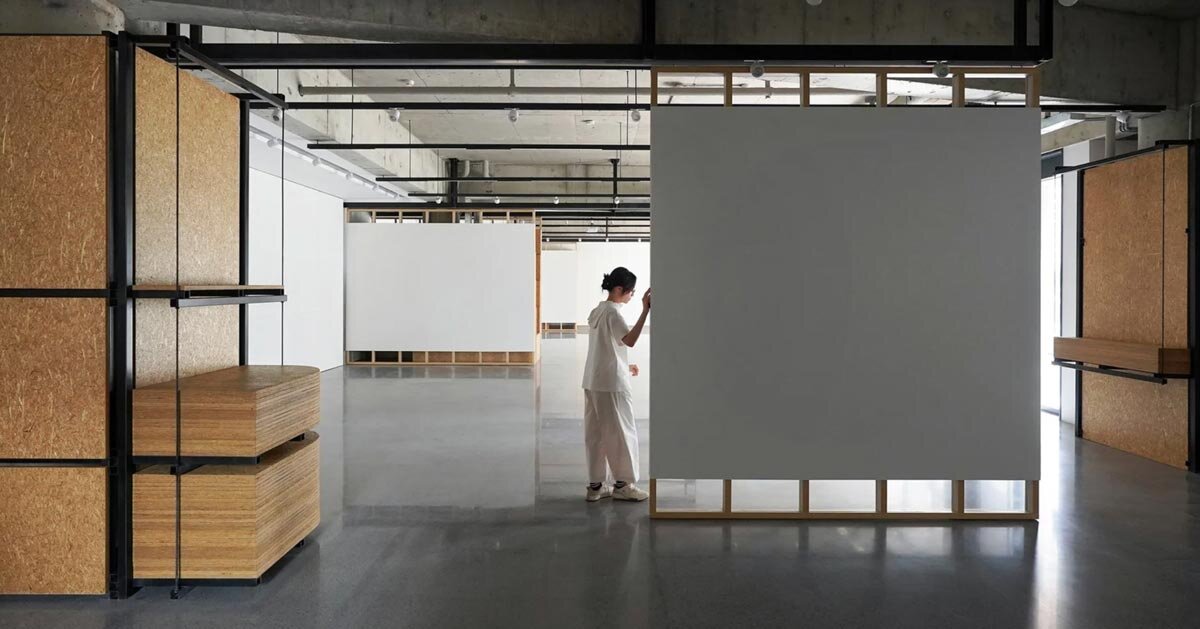
Jiadu Art Center, designed by MINOR lab in Yanjiao, Hebei Province, exemplifies China's shift from urban expansion to transforming existing buildings. The project reconfigures three separate spaces—an ancillary structure, commercial area, and residential unit—into an integrated community art center and artist studio. The design employs flexible interior systems with movable walls enabling transitions between separated zones and open areas. Existing columns are reimagined as hybrid elements providing seating, display, and storage. Modular furniture supports continuous spatial reconfiguration. This approach demonstrates small-scale activation within residential environments, supporting exhibitions, workshops, lectures, screenings, and community activities through adaptable spatial frameworks.
"Located within a residential development completed in 2021 in Yanjiao, Hebei Province, Jiadu Art Center by MINOR lab responds to broader shifts in China's urban development, where emphasis is moving from expansion to the transformation of existing building stock. Within a context largely defined by housing, the intervention reconfigures three separate spaces, an ancillary structure, an adjacent commercial area, and a residential unit, into a connected system comprising a community, and artist studio."
"The art center is organized as a flexible interior that accommodates multiple uses through adaptable spatial systems. Working within the constraints of the existing structure and services, the intervention adopts a light-touch strategy, relying on reconfiguration rather than extensive reconstruction. A system of movable walls enables the space to shift between separated zones and a continuous open area."
"Existing columns are integrated into the design through framed enclosures clad in strawboard, forming hybrid elements that combine seating, display, and concealed storage. Modular furniture further supports flexibility, allowing configurations to be adjusted or cleared as needed. These systems establish a spatial framework that can be continuously redefined through use."
#adaptive-reuse #community-art-space #flexible-interior-design #sustainable-architecture #residential-transformation
Read at designboom | architecture & design magazine
Unable to calculate read time
Collection
[
|
...
]