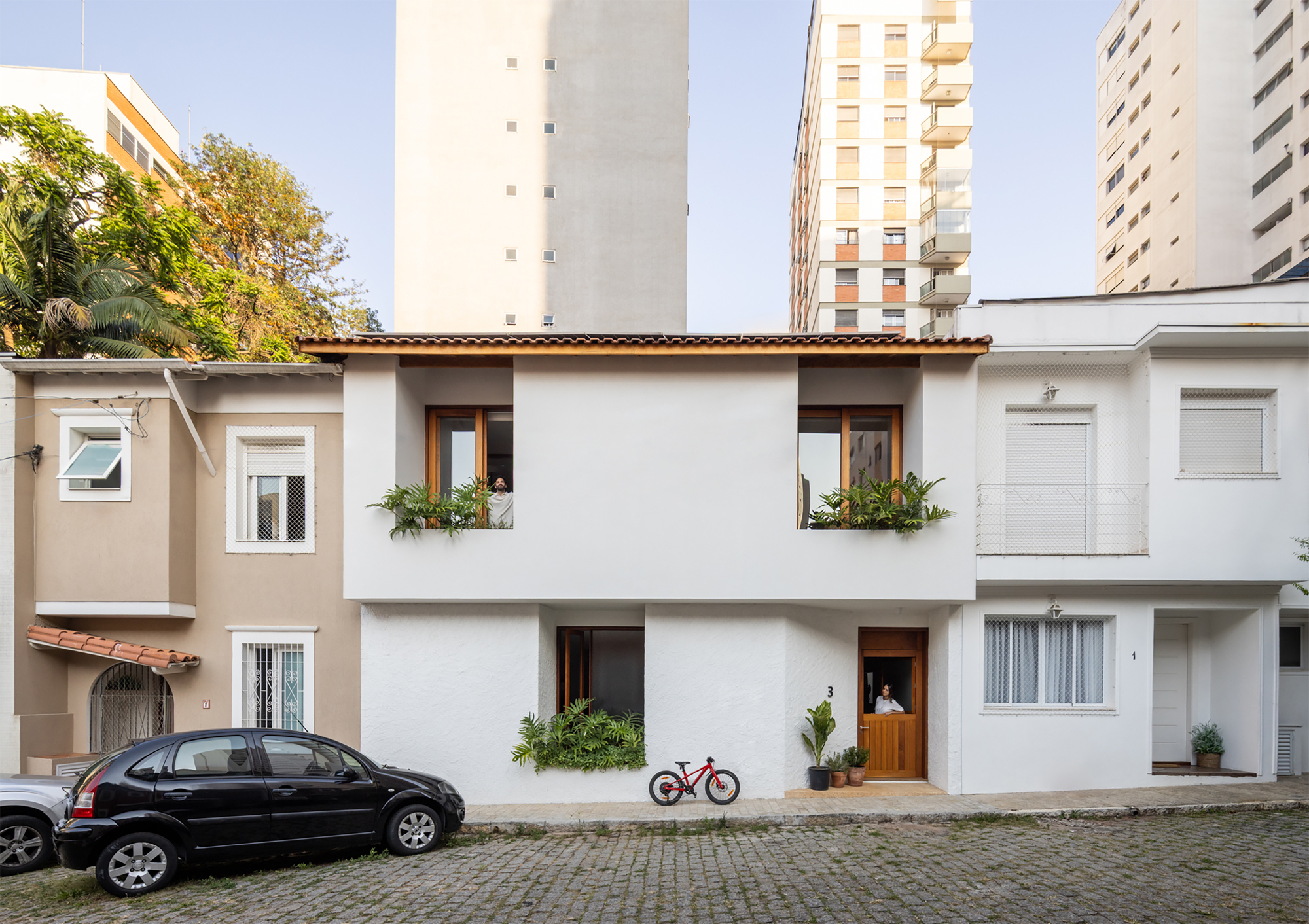
The project converted two semi-detached houses joined by a superficial intervention into a cohesive Village House. The original condition showed fragmented compartments, underutilized areas, overlapping uses, unclear passages, and an adapted staircase that disrupted vertical continuity. Natural light was timid and failed to structure daily life. The intervention restored logic and spatial purpose, transforming two disconnected halves into a single organism and improving circulation and daylight penetration. The residential project covers 280 m2 and was completed in 2025. Lead architects were Gabriel Cesar e Santos, Jose Guilherme Carceles, and Eugenio Amodio Conte, with coordination by Lizzy Dreifus and manufacturers including GRAPHISOFT, Assoalhos Murata, Casa Franceza, Fernando Jaeger, and Marcenaria da Fazenda.
"Upon taking on the project and construction of the Village House, we encountered a building formed by the joining of two semi-detached houses, "regularized" by a superficial intervention that did not address the essential issues of the space. The initial diagnosis revealed a fragmented configuration, with compartments lacking a clear purpose, underutilized areas, and a staircase adapted to reach the upper floor, highlighting the lack of continuity between the parts."
"The initial diagnosis revealed a fragmented configuration, with compartments lacking a clear purpose, underutilized areas, and a staircase adapted to reach the upper floor, highlighting the lack of continuity between the parts. There were overlapping uses, unclear passages, and timid natural light that entered, unable to structure daily life. Our starting point was to restore logic and meaning to the whole, transforming two disconnected halves into a single organism."
Read at www.archdaily.com
Unable to calculate read time
Collection
[
|
...
]