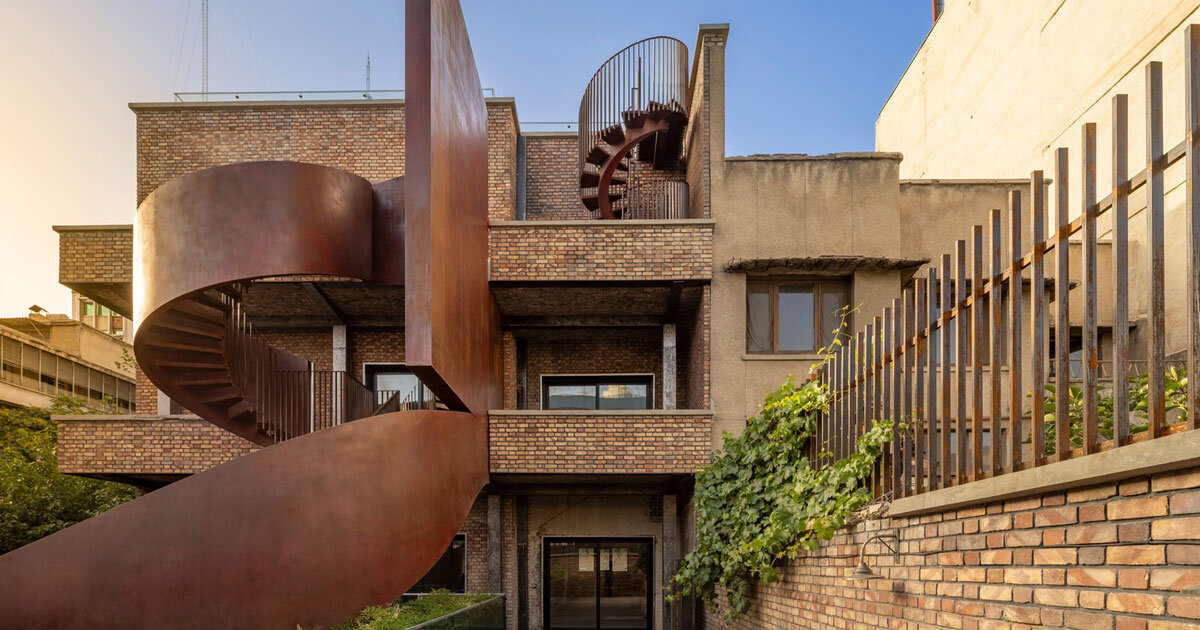
"The intervention centers on a second-floor wall inscribed with a handwritten poem by Shamlou addressed to his wife and muse, Aida. Rather than treating the inscription as a preserved artifact, the design extends this wall into a spatial and semi-structural element that organizes circulation throughout the building. Known as the 'Aida Wall,' the new structure rises from the to the , forming a three-dimensional promenade that connects interior programs and visually opens the house toward the surrounding city."
"The original building's brick load-bearing structure required reinforcement to accommodate the new public program, which includes exhibition spaces, a library, bookstore, café, and restaurant. The structural intervention was made explicit rather than concealed, with the steel wall functioning as both reinforcement and architectural framework. This strategy establishes a clear dialogue between the existing masonry structure and the inserted contemporary system."
NextOffice restored and adaptively reused a 1970s residential building in downtown Tehran, formerly the home of Ahmad Shamlou, as a cultural center. Key architectural features such as rounded corners and expressive lintels were retained. A second-floor wall bearing a handwritten poem to Aida was transformed into the 'Aida Wall,' a spatial, semi-structural element that organizes circulation and connects interior programs. The building's brick load-bearing structure was reinforced with an explicit steel wall that serves as both support and contemporary framework. The private courtyard was reconfigured as a public open space, and the steel intervention was designed to be reversible and to weather over time.
Read at designboom | architecture & design magazine
Unable to calculate read time
Collection
[
|
...
]