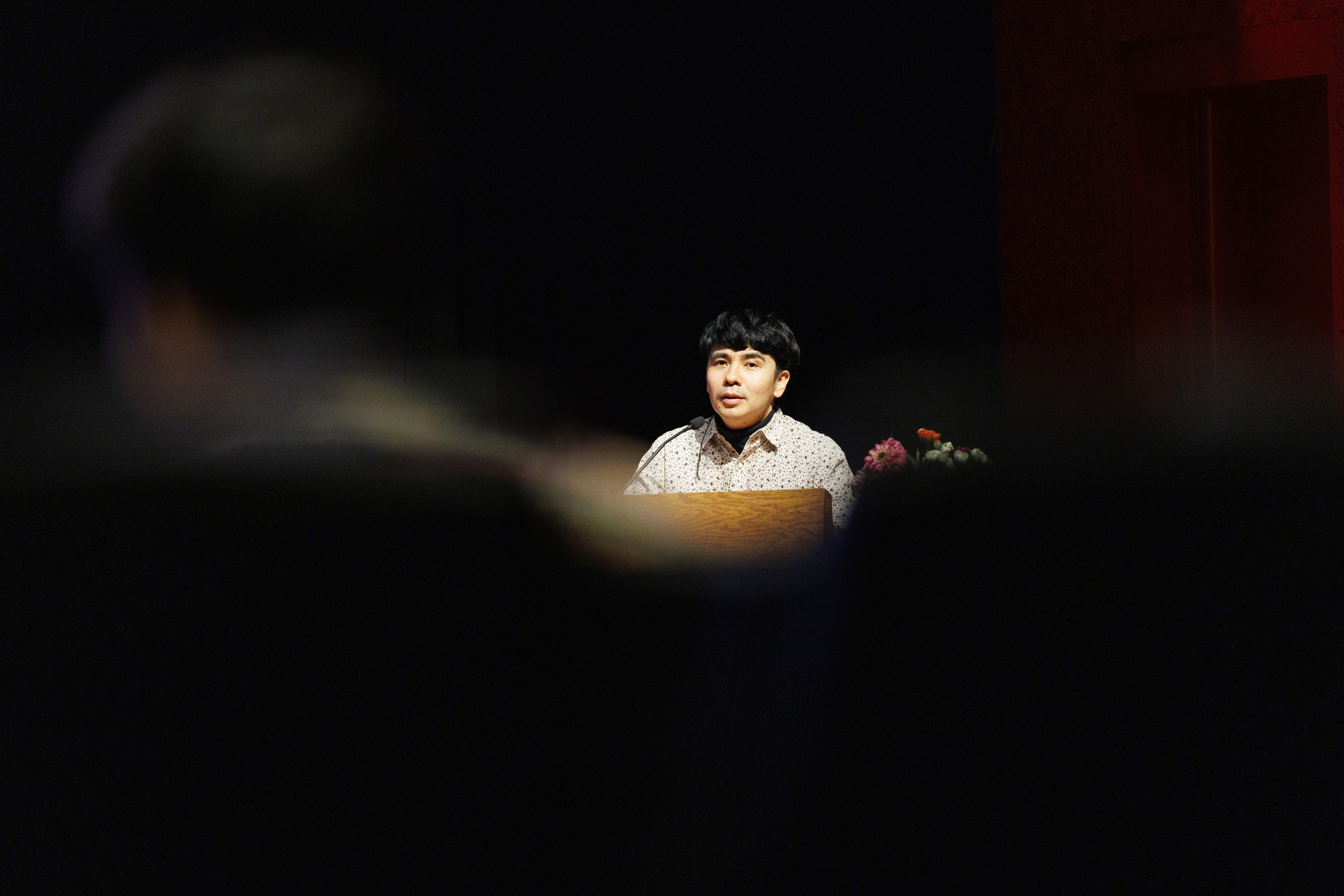
"It makes sense that in our culture of gain and scarcity that [finding a voice] should be a hunt or search or possession, but I don't think that's true," said Vuong, an award-winning poet, novelist, and the featured speaker at the recent annual Eliot Memorial Reading. "I don't think one finds a voice ... I think one develops it throughout one's life ... I'm still discovering mine."
"We all have a thumbprint; it's idiosyncratic to us," he said at the event presented by the Woodberry Poetry Room and funded by the T.S. Eliot Foundation. "Language syntax, how you arrange your words; that's the thumbprint of an inner life, and that could be replicated, shifted and grown inexhaustibly." The author of several poetry collections, Vuong wrote "On Earth We're Briefly Gorgeous," a New York Times best-selling book that has sold more than a million copies."
Finding a distinctive voice is not a single discovery but an ongoing process of development across a lifetime. Searching for a fixed voice early can become a limiting hunt driven by cultural ideas of gain and scarcity. Each writer carries a unique thumbprint in language—syntax and word arrangement reflect an inner life. That thumbprint can be shaped, shifted, replicated, and expanded without exhaustion. Emphasis on practice and shaping rather than possession encourages continual growth and discovery of new expressive possibilities. Literary craft benefits from embracing evolution and experimentation in voice and form.
Read at Harvard Gazette
Unable to calculate read time
Collection
[
|
...
]