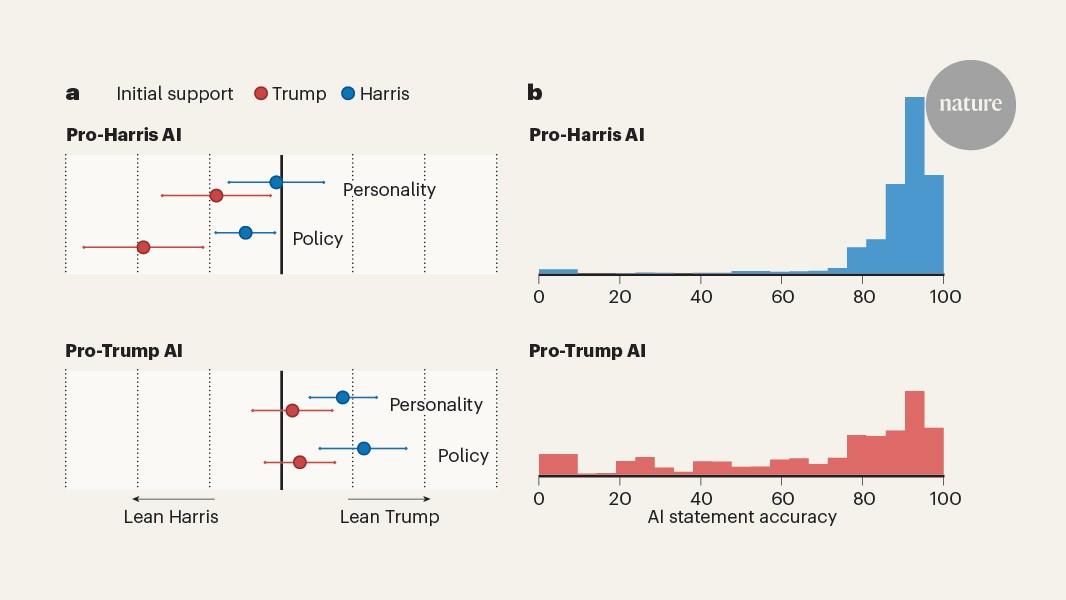
"The world is getting used to talking' to machines. Technology that just months ago seemed improbable or marginal has erupted quickly into the everyday lives of millions, perhaps billions, of people. Generative conversational artificial-intelligence systems, such as OpenAI's ChatGPT, are being used to optimize tasks, plan holidays and seek advice on matters ranging from the trivial to the existential a quiet exchange of words that is shaping how decisions are made1."
"Against this backdrop, the urgent question is: can the same conversational skills that make AI into helpful assistants also turn them into powerful political actors? In a pair of studies2,3 in Nature and Science, researchers show that dialogues with large language models (LLMs) can shift people's attitudes towards political candidates and policy issues. The researchers also identify which features of conversational AI systems make them persuasive, and what risks they might pose for democracy."
Dialogues with large language models can shift people’s attitudes toward political candidates and policy issues. Generative conversational AI is becoming pervasive, used to optimize tasks, plan travel and provide advice, producing quiet exchanges that influence decisions. Specific conversational features increase persuasiveness, enabling AI to act as powerful political actors. These persuasive effects create risks for democratic processes by potentially manipulating opinions and shaping electoral outcomes. The widespread adoption of conversational AI elevates the need for safeguards, transparency, and design choices that mitigate undue influence on public attitudes and political behavior.
Read at www.nature.com
Unable to calculate read time
Collection
[
|
...
]