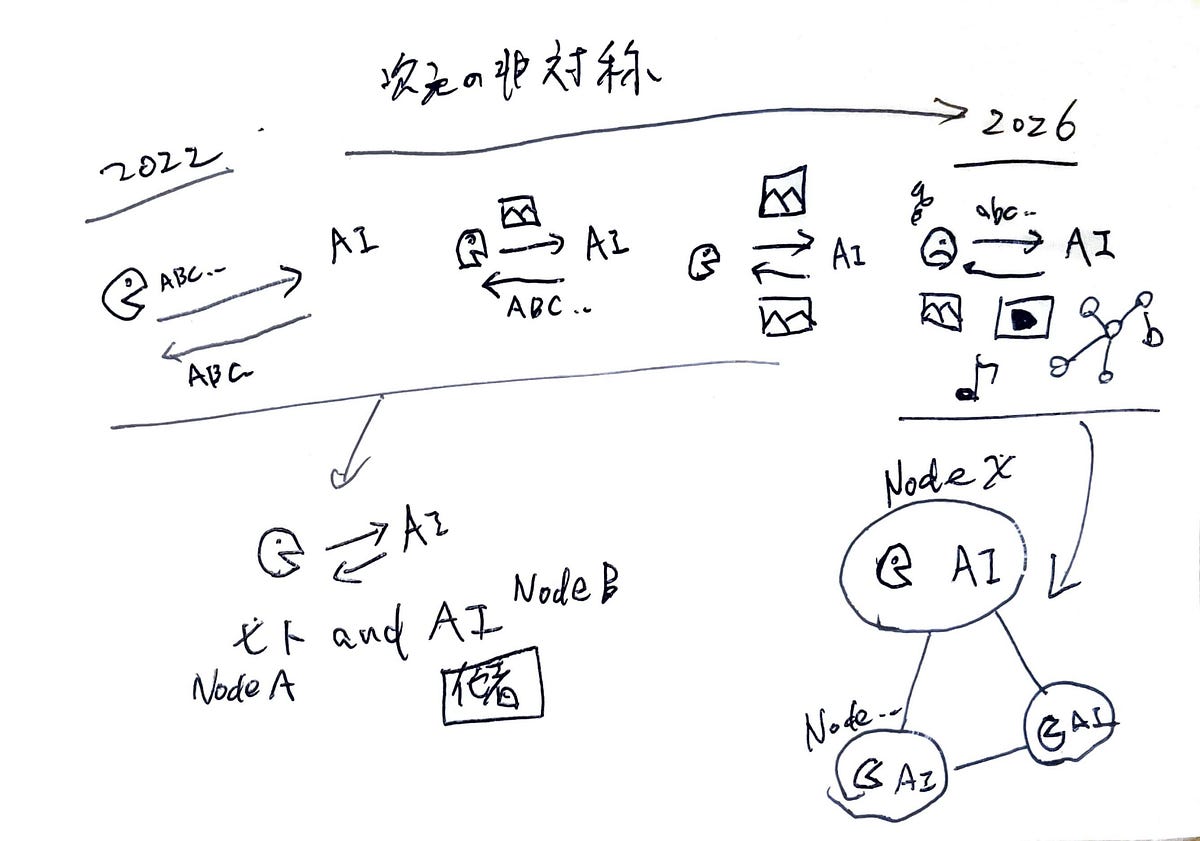
"A *node*, in the way I will use the word here, is simply a point capable of processing information - receiving it, transforming it, passing it on. You are a node. So is your closest collaborator. So, increasingly, is the AI on the other side of your screen. Between any two nodes runs a *channel*: the medium through which information actually moves. Sentences. Gestures. Sketches. Tone of voice."
"Among humans, we rarely feel that channels are inadequate for nodes. This is not because we are talented. It is because we have spent thousands of years building channels of many different shapes for many different kinds of thought. An architect needs to convey the spatial reality of a building that does not yet exist, and so reaches for the plan, the elevation, the section - a multidimensional channel that words could not carry."
"Leigh argues that decades of interaction design were spent moving away from typed commands toward direct manipulation - toward seeing and pointing and dragging - and that with AI we have retreated, all at once, to the very paradigm those researchers spent their careers escaping. For tasks that are inherently visual or spatial, he writes, the text prompt forces a translation that loses signal at every step."
"The question is this: why didn't we feel this strain in 2022? And why are people starting to feel it so sharply now? What follows is one attempt at an answer. It is offered alongside Leigh's piece, not in place of it. I want to ask what changed, and what it might be asking of us."
A node is a point that processes information, and a channel is the medium that carries information between nodes, such as sentences, gestures, sketches, or tone of voice. Humans rarely experience channel inadequacy because many channels have been developed over thousands of years for different kinds of thought. Visual and spatial tasks are naturally expressed through multidimensional channels like plans, elevations, sections, and choreography notation, which words cannot carry without losing information. Typed prompts require translating rich visual or spatial intent into text, causing signal loss at each step. The strain was less noticeable earlier and is becoming sharper now, suggesting a change in what AI systems demand from users and how interaction is structured.
Read at Medium
Unable to calculate read time
Collection
[
|
...
]