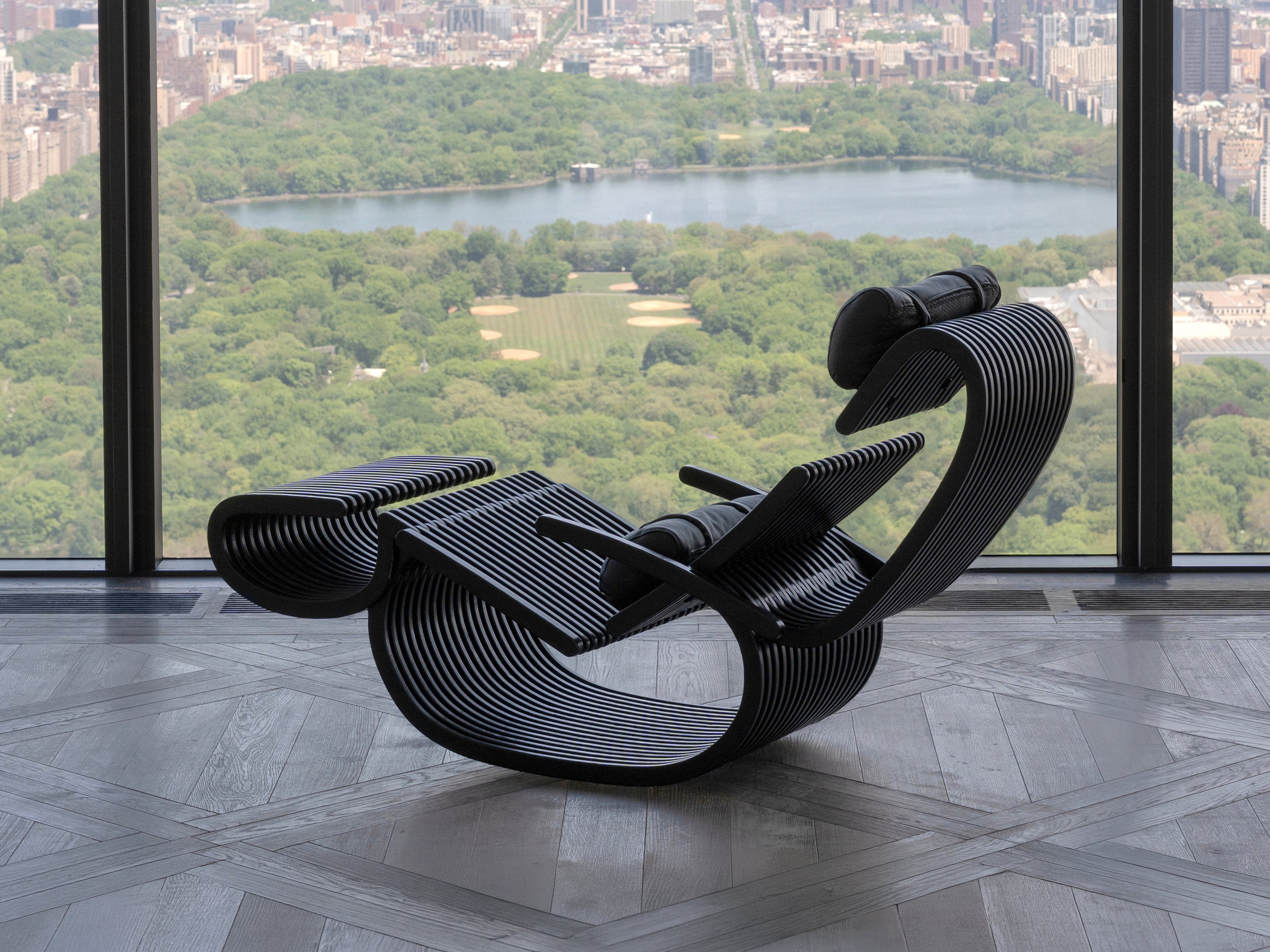
Convertible furniture often shows exposed hinges, wall-mounted hardware, and visible frames, making it look more mechanical than furniture. Murphy beds and sofa beds reveal their dual functions through industrial geometry that upholstery cannot fully disguise. A convertible chair called Silhouette treats visible ugliness as the design problem rather than an unavoidable byproduct. The chair uses layered Baltic birch plywood shaped into looping, scroll-like curves that remain visually coherent in multiple configurations. Transformation occurs through structural rotation of the headrest and legrest, switching between suspended cushion supports and load-bearing legs. Concealed locking components in the base secure each position. A black stain under clear polyurethane unifies the assembly visually, making it appear carved rather than constructed.
"The transformable furniture category has an ugliness problem. Murphy beds wear their utilitarian origins on their sleeve, all exposed hinges and wall-mounted hardware that reads less like furniture and more like a filing system for humans. Sofa beds announce their dual nature through the awkward geometry of frames that can never quite commit to either function they serve. The mechanical logic of most convertible furniture sits right on the surface, visible and apologetic, because the joinery required to make an object shapeshift tends to be industrial in a way that no amount of upholstery can fully absorb."
"Jonah Rappaport's Silhouette, a convertible chair that just won at the A' Design Award 2025-2026, treats that ugliness as the actual design problem, not a side effect of solving a functional one. What Rappaport made instead looks, depending on the configuration, like a piece of abstract calligraphy that somebody decided to sit in. The layered Baltic birch plywood builds into looping, scroll-like curves that read as pure formal composition regardless of which of the three configurations the chair currently occupies, armchair, lounge chair, or chaise longue."
"Nothing about the silhouette suggests mechanism, utility, or compromise. The transformation is structural rather than additive: the headrest and legrest rotate to swap between suspended cushion supports and load-bearing legs, with concealed locking components in the base securing each position. Rappaport conceived and fabricated the entire object across four months at Yale's wood and metal shops, and the finish, a true black stain under clear polyurethane, gives the whole assembly the visual unity of something carved rather than constructed."
"Most convertible furniture relies on added hardware, external pivots, visible bolts, upholstered-over frames, precisely because the transformation logic lives outside the primary structure"
Read at Yanko Design - Modern Industrial Design News
Unable to calculate read time
Collection
[
|
...
]