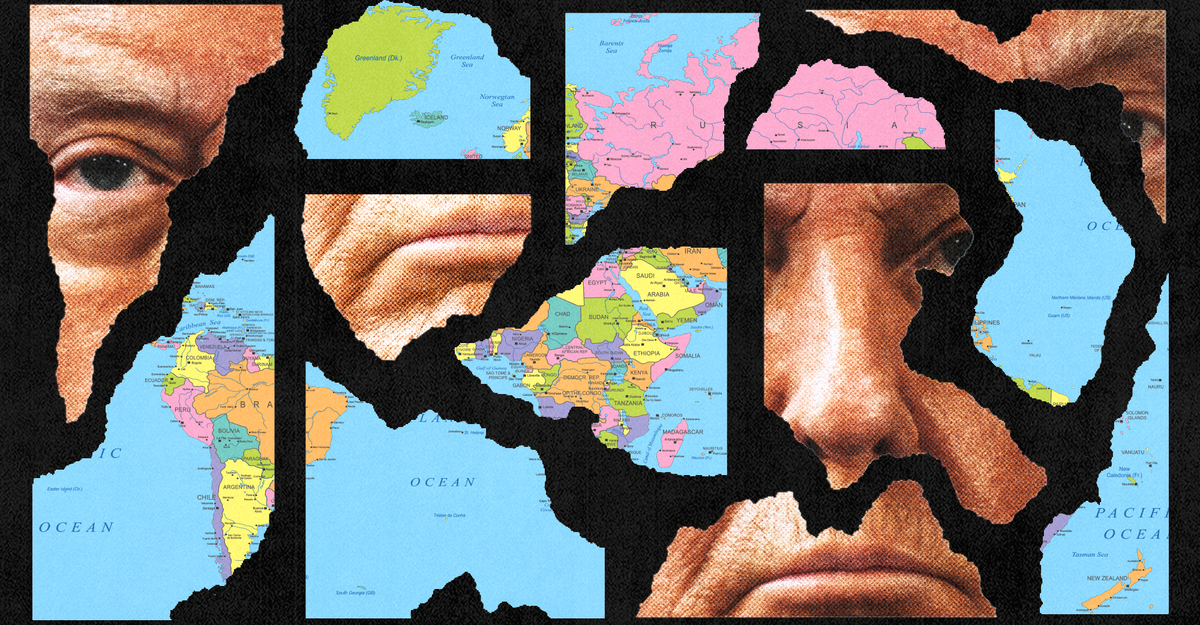
"In Marco Rubio's telling, the stunning events in Venezuela on Saturday illustrate an essential truth-possibly the essential truth-about Donald Trump's presidency: Global leaders cross him at their peril. "I don't understand yet how they haven't figured this out," Trump's secretary of state told reporters at Mar-a-Lago just hours after the capture of Nicolás Maduro. World leaders could be forgiven for not understanding the simplicity of the Trump Doctrine, especially those who assume that the world's dominant superpower"
"The country that gave the world the Truman Doctrine and the Reagan Doctrine as well as Trump's apparent favorite, the Monroe Doctrine, now embraces the plainest and most ostentatiously bellicose of national-security policies: Fuck around and find out. Trump's own Pentagon chief, the self-styled (until Congress approves the title change) secretary of war, Pete Hegseth, said as much when he told the nation that Maduro "effed around, and he found out.""
"Some experts reject the idea that something this crude even earns the right to be called a doctrine. As John Bolton, currently a Trump nemesis but once one of his first-term national-security advisers, told us, "There is no Trump Doctrine: No matter what he does, there is no grand conceptual framework; it's whatever suits him at the moment." Kori Schake, the director of foreign- and defense-policy studies at the American Enterprise Institute, cautioned us that "we shouldn't ennoble Trump policy by saying there's a doctrine.""
Venezuelan events are presented as evidence that the Trump presidency enforces a simple, punitive logic: leaders who cross U.S. interests will face harsh consequences. The U.S. foreign-policy tradition that produced the Truman, Reagan, and Monroe doctrines has given way to an ostentatiously bellicose posture encapsulated by 'fuck around and find out.' Senior officials celebrated the punitive outcome, while analysts warned that such a crude approach lacks a stable conceptual framework and should not be elevated into an enduring doctrine. Critics describe the stance as opportunistic, personalized, and unpredictable rather than principled or institutionalized.
Read at The Atlantic
Unable to calculate read time
Collection
[
|
...
]