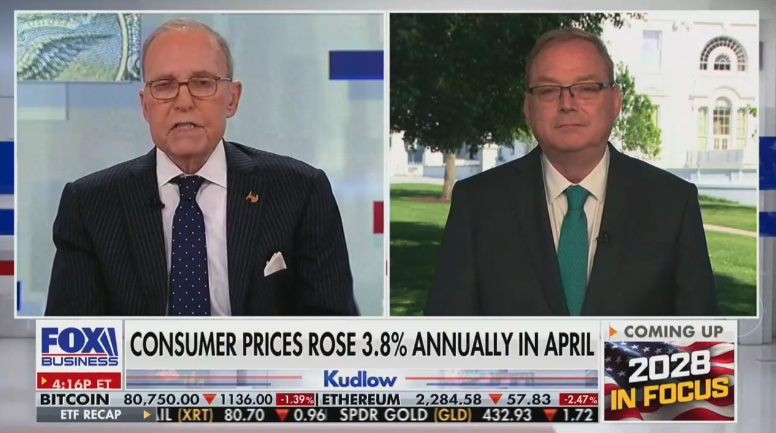
"“Well, first of all, this is a temporary energy shock,” Hassett insisted. “And that’s very clearly in the data. And so, the history of this is that people at the Federal Reserve and elsewhere tend to peer through energy shocks and use core CPI to forecast the future, not the energy shock data.”"
"“So, the 12-month change is 3.8% and the core change is 2.8%.” Kudlow began. “What does an NEC director say on a day like today when the CPI is coming out so poorly?”"
"“Not even a little bit,” the president replied. “The only thing that matters when I’m talking about Iran, they can’t have a nuclear weapon. I don’t think about Americans’ financial situation. I don’t think about anybody. I think about one thing: we cannot let Iran have a nuclear weapon. That’s all. That’s the only thing that motivates me.”"
"“Trump’s tariffs, as well as his decision to wage war on Iran, have created upward pressure on prices, especially oil, 20% of which flows through the Strait of Hormuz, which Iran has effectively closed.”"
The Consumer Price Index increased 3.8% in April compared with the prior year, the largest rise since May 2023. Core inflation excluding energy rose 0.4% and showed a 2.8% year-over-year change. The increase was attributed to temporary energy shocks driven by tariffs and heightened tensions involving Iran. Oil prices faced upward pressure because about 20% of oil flows through the Strait of Hormuz, which Iran has effectively constrained. Federal Reserve practice emphasizes looking through energy shocks and relying more on core CPI to forecast future inflation. The president stated he does not consider economic costs related to the Iran conflict, focusing instead on preventing Iran from obtaining a nuclear weapon.
Read at www.mediaite.com
Unable to calculate read time
Collection
[
|
...
]