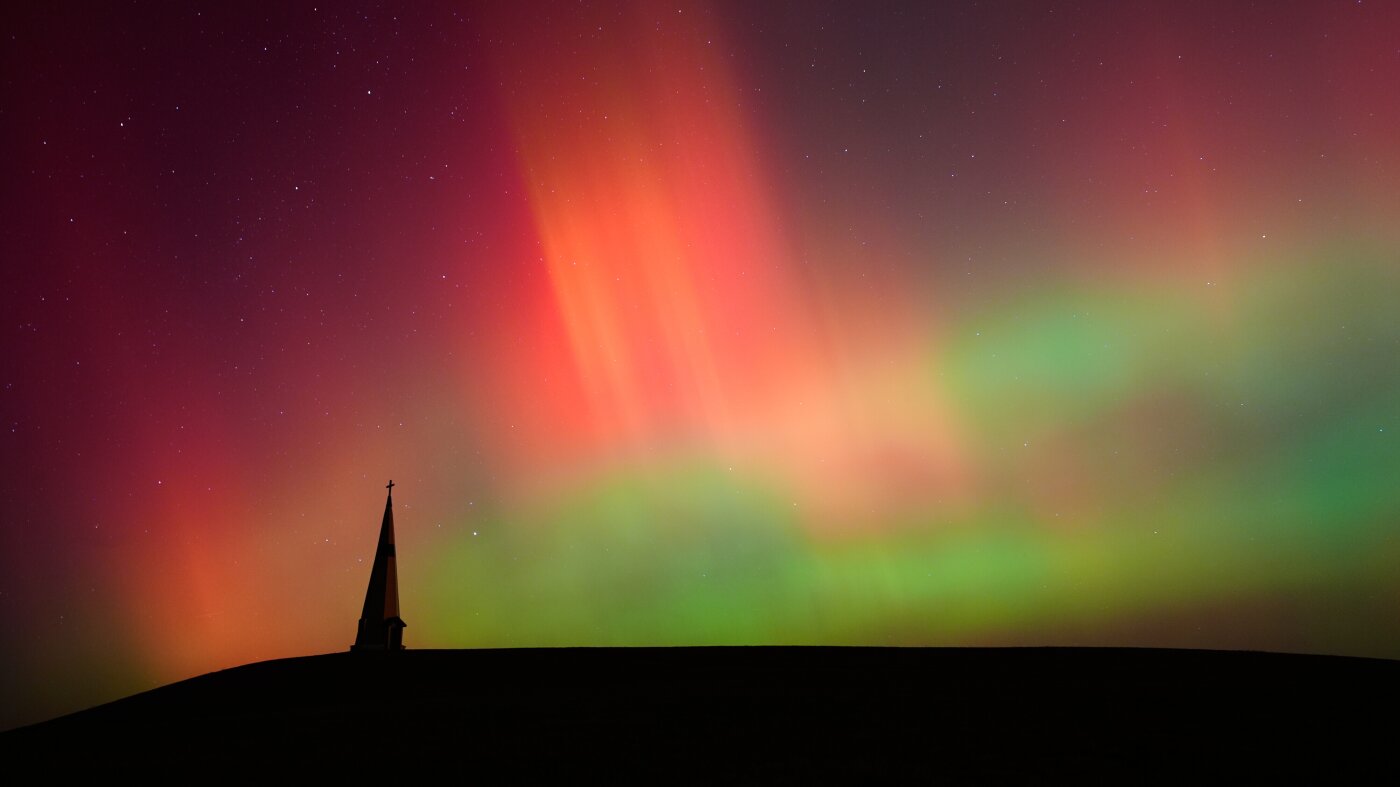
"Brilliant splashes of green, purple and pink will streak the night sky for many stargazers in North America on Saturday and Sunday night, as energized particles from space collide with the Earth's atmosphere to create the dazzling effect, known as the Northern Lights or aurora borealis. The northern United States and much of Canada will have the best view of the natural aurora phenomenon, according to the National Oceanic and Atmospheric Administration (NOAA)."
"The best sightings will come from where the aurora is directly overhead, but hopefuls can catch sight of the light show from up to 1000 km away. The best time to catch the streaks of light will be just after sunset or just before sunrise; the aurora is not visible during the day. The beautiful display of lights results from a form of space weather, according to NASA, when high-energy space particles violently collide with atoms of gas in a planet's atmosphere, close to its magnetic pole."
"The geomagnetic storm causing this latest aurora is expected to be at its strongest on Saturday night, and will provide onlookers with their best chance to see the show, according to the NOAA. Catching these lights can be a rare treat for some who do not live near the poles, where auroras occur most commonly. In North America, auroras are typically best observed in March and November, for reasons scientists still don't fully understand."
"They are usually most visible in the Earth's northernmost latitudes, in countries including Russia, Norway, Sweden and territories like Greenland and Alaska. "For many people, the aurora is a beautiful nighttime phenomenon that is worth traveling to arctic regions just to observe," says NOAA "It is the only way for most people to actually experience space weather.""
Brilliant green, purple, and pink streaks will appear in the night sky across North America as energized particles from space collide with Earth’s atmosphere. The northern United States and much of Canada are expected to provide the best views, especially where the aurora is directly overhead. Sightings may be possible from as far as 1000 km away. The aurora is not visible during the day and is most likely to be seen just after sunset or just before sunrise. The phenomenon is a form of space weather caused by high-energy particles colliding with atmospheric gas near magnetic poles. A geomagnetic storm is expected to be strongest on Saturday night, improving viewing chances. Auroras are most commonly observed in March and November and are typically visible in the northernmost latitudes, including Russia, Norway, Sweden, Greenland, and Alaska.
Read at www.npr.org
Unable to calculate read time
Collection
[
|
...
]