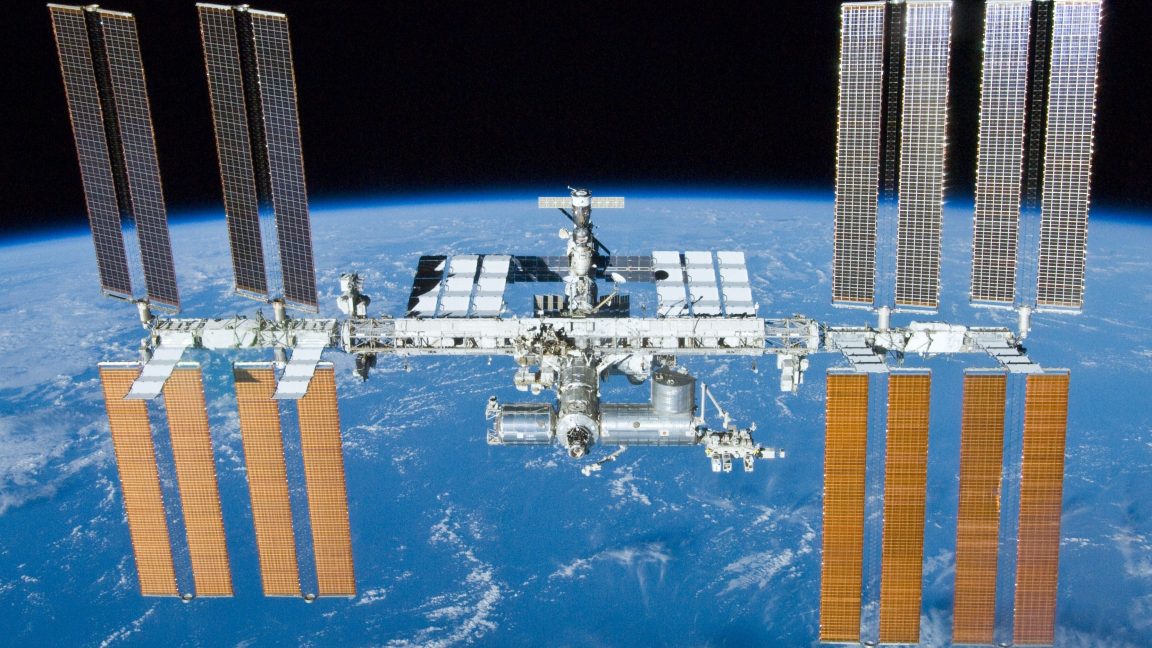
NASA confirmed that the Russian segment of the International Space Station has started leaking atmosphere into space again. Engineers from Roscosmos and NASA have tracked the leak rate from the PrK module, a transfer tunnel attached to the Zvezda Service Module and leading to a docking port. The leak source has been microscopic structural cracks that are difficult to locate and repair. In January, NASA reported that inspections and sealant applications produced a stable configuration. The leak returned three weeks ago, and Roscosmos reported a slow pressure drop after unloading cargo from Progress 95 on May 1. NASA said the loss is about one pound per day, with the area maintained at lower pressure and small repressurizations as needed, and no impacts to station operations.
"NASA spokesperson Josh Finch told Ars. "Teams performed data analysis, which indicated a loss of about one pound per day." "Roscosmos allowed the pressure in the transfer tunnel to gradually decrease while monitoring the rate. The area now is being maintained at a lower pressure, with small repressurizations as needed. There are no impacts to station operations, and NASA and Roscosmos are coordinating on next steps.""
"For more than half a decade, engineers from Roscosmos and NASA have been tracking the leak rate from a small Russian module attached to the space station that leads to a docking port. The source of these leaks, microscopic structural cracks, have been difficult to find and address."
"In January, NASA said that after multiple inspections and sealant applications, the pressure inside this segment, known as the PrK module, had reached a "stable configuration." The PrK module is essentially a transfer tunnel attached to the Zvezda Service Module on the Russian segment of the space station."
"On May 1, after Russian cosmonauts unloaded cargo from the Progress 95 cargo spacecraft, Roscosmos noted a "slow pressure drop" in the PrK module. Although there is no impact on astronauts aboard the station, nor any immediate concerns about the station's health, the returning leak issue raises new questions about the long-term viability of the ISS."
Read at Ars Technica
Unable to calculate read time
Collection
[
|
...
]