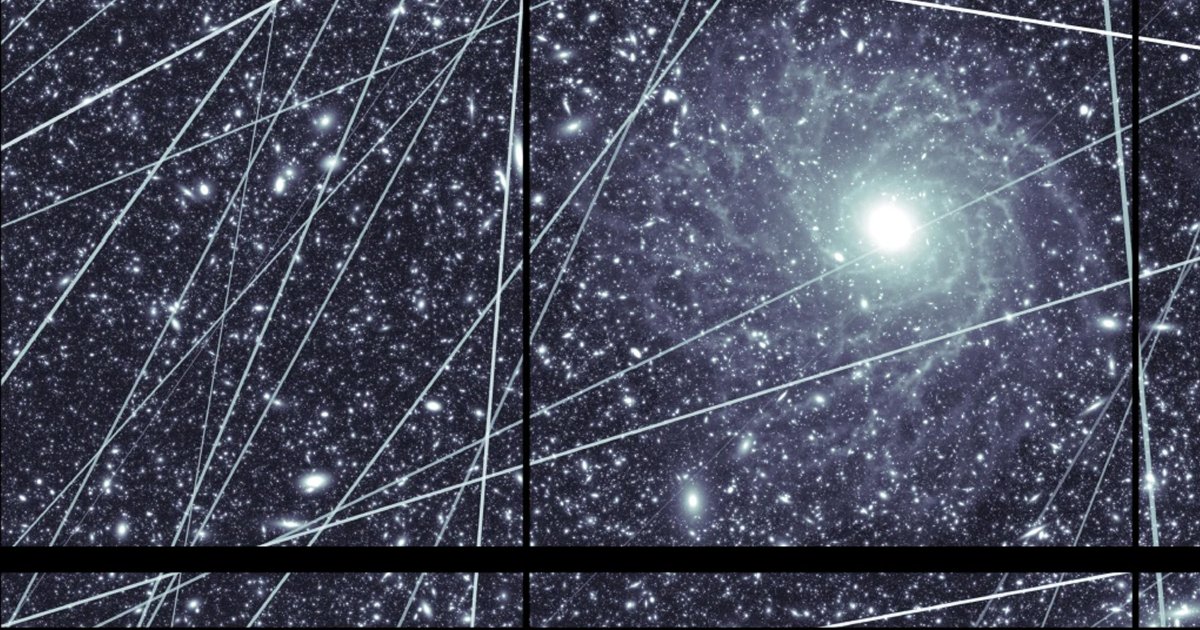
Growing low Earth orbit satellite constellations are increasing light pollution and radio interference that disrupt astronomical observations and space telescopes. SpaceX currently has permission to deploy 12,000 satellites and is pursuing tens of thousands more; industry proposals could add as many as 500,000 additional satellites over the next decade. One out of every three Hubble images is projected to be contaminated by light pollution if planned deployments proceed. Future telescopes face worse outcomes: ARRAKIHS may have bright streaks in 96 percent of images, and SPHEREx could see up to 99 percent contamination. The expanding swarm threatens current and planned space-based astronomy.
"Numerous stories have been written about the growing swarm of Starlink satellites in low earth orbit (LEO) over the past few years, as astronomers grow increasingly worried about the crafts' impact on their observation equipment. Launched by Elon Musk's SpaceX, each satellite has the potential to disrupt astronomy through both radio emissions and light pollution - and as the number of satellites grows, so too does the amount of interference. Now, a new study by researchers at NASA is warning that obstructions caused by SpaceX and other private satellite companies are becoming so severe that not even the Hubble Space Telescope is safe."
"As reported by El Pais, the research was led by led by Spanish astrophysicist Alejandro Serrano Borlaff at NASA. In the study, Borlaff concludes that one out of every three Hubble images will become contaminated by light pollution if satellite projects planned for the next decade come to fruition. Currently, SpaceX has permission from the US Federal Communications Commission to launch 12,000 satellites into LEO, and is eyeing an additional 30,000 over the next few years."
"Hubble is far from the only space telescope affected, and future astronomy craft will likely fare much worse. According to Borlaff and his team, bright streaks of light are projected to appear in 96 percent of the images from the European Space Agency's ARRAKIHS, which is eying a launch window sometime in the 2030s. NASA's recently launched SPHEREx, meanwhile, could see upward of 99 percent of its images contaminated with light pollution."
Read at Futurism
Unable to calculate read time
Collection
[
|
...
]