"Exposure to cytosolic DNA triggers innate immune responses through cyclic GMP-AMP (cGAMP) synthase (cGAS)1,2,3. After binding to DNA, cGAS produces cGAMP as a second messenger that binds to stimulator of interferon genes (STING), a signalling adaptor protein anchored to the endoplasmic reticulum (ER)3,4,5. STING then traffics from the ER through the Golgi to perinuclear vesicle clusters, which leads to activation of the kinases TBK1 and IKK and subsequent induction of interferons and other cytokines6,7,8,9."
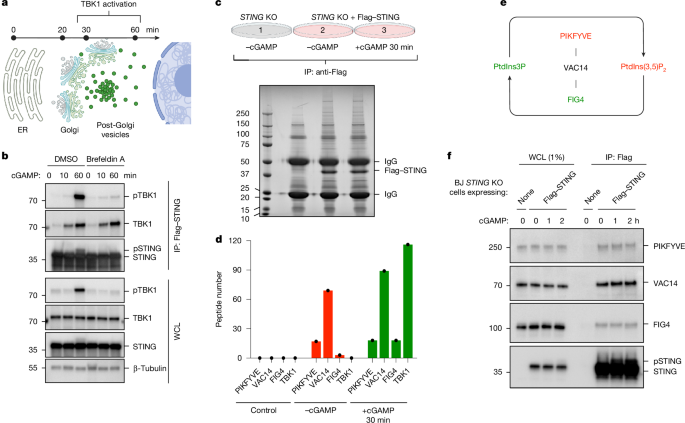
"Proteomic analyses identified a constitutive interaction between STING and PIKFYVE, an enzyme that produces PtdIns(3,5)P 2 in mammalian cells. Deletion of PIKFYVE blocked STING trafficking from the ER and TBK1 activation. In vitro reconstitution uncovered a strong and selective effect of PtdIns(3,5)P 2 on STING activation by cGAMP. PtdIns(3,5)P 2 bound directly to STING in fluorescence resonance energy transfer assays. Consistently, cryo-electron microscopy revealed that PtdIns(3,5)P 2 promotes cGAMP-induced STING oligomerization10, functioning as a molecular glue."
Phosphatidylinositol 3,5-bisphosphate (PtdIns(3,5)P2) functions as an endogenous ligand of STING and cooperates with cGAMP to activate STING. Proteomic data show a constitutive interaction between STING and PIKFYVE, the enzyme that produces PtdIns(3,5)P2. Loss of PIKFYVE prevents STING trafficking from the ER and blocks TBK1 activation. In vitro reconstitution demonstrates a strong and selective enhancement of cGAMP-induced STING activation by PtdIns(3,5)P2. Fluorescence resonance energy transfer assays indicate direct binding between PtdIns(3,5)P2 and STING. Cryo-electron microscopy shows that PtdIns(3,5)P2 promotes cGAMP-induced STING oligomerization by acting as a molecular glue. Mutation of the PtdIns(3,5)P2-binding residues in STING largely abolishes trafficking and downstream signalling, establishing essential roles for this lipid in innate immune activation.
Read at Nature
Unable to calculate read time
Collection
[
|
...
]