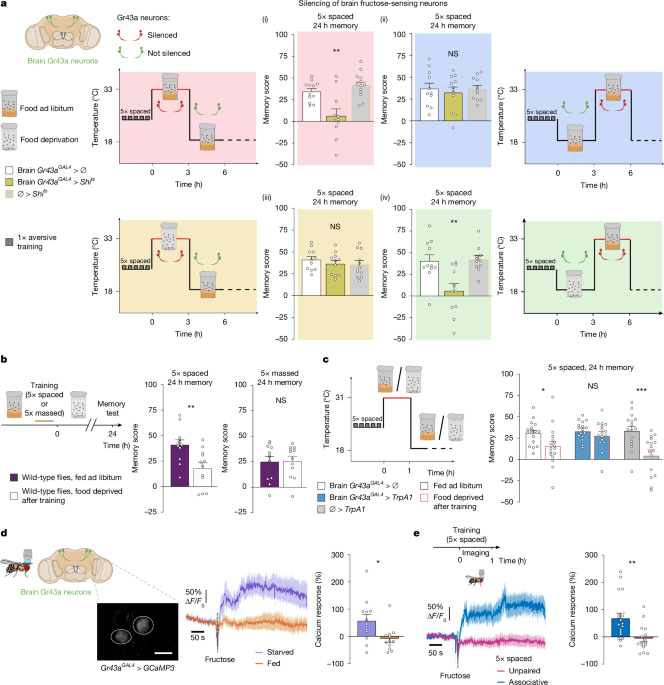
"Internal nutrient-sensing systems are major regulators of appetite and feeding behaviour, participating in memory processes that enable the assignment of value to food-related sensory cues."
"After a single learning session, this memory decays within hours. Multiple sessions spaced in time induce the formation of long-term memory that lasts for days and is protein-synthesis dependent."
"The same number of immediately consecutive sessions induces another form of consolidated memory that lasts for around 1 day, but this memory does not correspond to long-term memory."
Nutrient sensing is essential for evaluating energy availability and regulating metabolic states. Both peripheral taste receptors and internal nutrient sensors in the digestive tract and brain influence appetite and feeding behavior. In Drosophila melanogaster, a study on a brain sugar sensor revealed its role in aversive olfactory learning. Spaced training sessions lead to long-term memory that depends on glucose metabolism, while massed training results in a shorter-lasting memory linked to lipid metabolism. This highlights the different neural circuits involved in memory consolidation.
Read at Nature
Unable to calculate read time
Collection
[
|
...
]