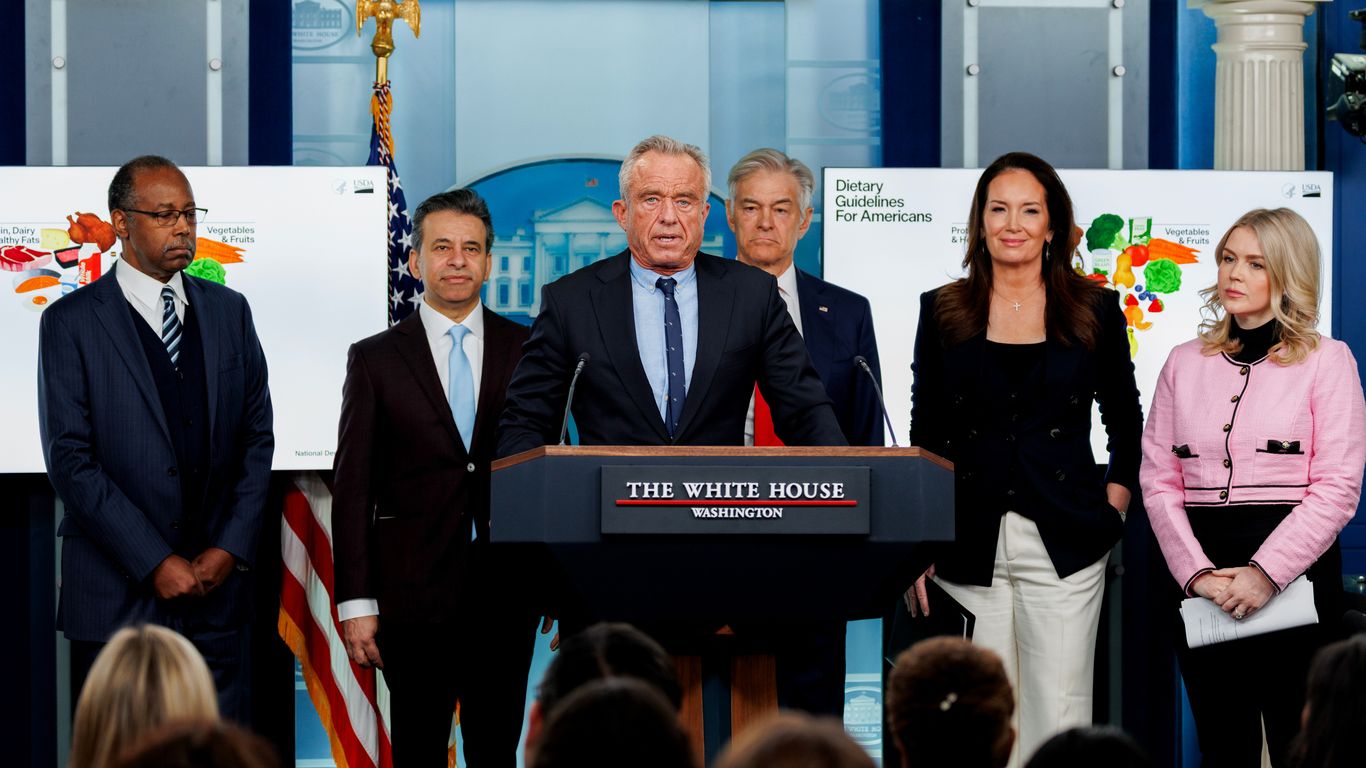
"Yes, but: Some questioned how Kennedy could assert the government is "ending the war" on saturated fats when the recommendations maintain advice to limit intake to 10% or less of total calories. Following the guidance would require eating less meat and fatty dairy, not more, said Marion Nestle, nutrition expert and professor emerita at New York University. "You can't [eat more meat] without raising the saturated fat content," she said. "That's a contradiction." Nestle said recommending less highly processed food is a good idea. But she said the guidelines ignore decades of research showing the health benefits of plant-forward diets."
"Food manufacturers and some Democrats panned the recommendations for putting sound bites above science. The guidelines go beyond what's supported by evidence,Rocco Renaldi, secretary general of the International Food and Beverage Alliance, said in a statement. "Terms like 'highly processed' lack a globally agreed, science-based definition," he said. The lack of specificity further risks students' well-being after the Republican budget law limited access to nutritious school meals, said Rep. Bobby Scott (D-Va.)."
Federal guidance emphasizes prioritizing protein at every meal, reducing added sugars, eating more vegetables, and including full-fat dairy. The guidance for the first time explicitly advises against consuming highly processed foods and urges a variety of protein sources, including red meat, eggs, and plant proteins. The guidance accompanies efforts to push states toward new restrictions on what Supplemental Nutrition Assistance Program benefits can cover. Critics question claims of "ending the war" on saturated fats because the guidance still recommends limiting saturated fat to 10% or less of calories. Industry groups and some lawmakers criticized vague terms like "highly processed."
Read at Axios
Unable to calculate read time
Collection
[
|
...
]