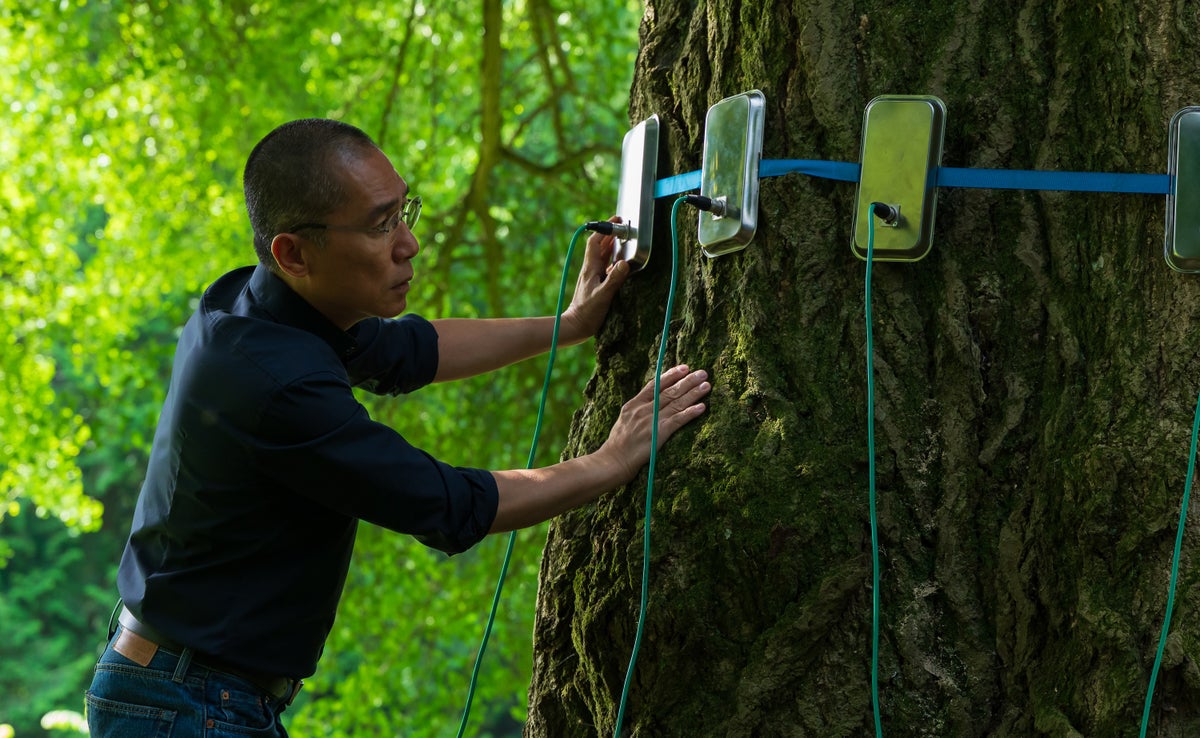
"By the end of the movie, he's using computer-generated visualizations to look at how the tree responds to its environmentnot exactly becoming its friend but getting a touch closer to understanding the tree's experience of its surroundings. The film isn't based on a real studyif plants do have anything like consciousness, scientists have yet to formally describe itbut it's an imaginative exploration of how consciousness might manifest in different forms of life."
"Researchers tend to define consciousness loosely as the ability to experiencethe subjective, ineffable feeling of being alive. This involves some combination of being awake and aware, having internal awareness (such as mental imagery and inner thoughts), and being connected to the world with an ability to perceive stimuli."
"Many cultures around the world have long thought of nonhuman animals as having something like consciousness; some even presume plants have it, too. But in the Western scientific tradition, starting with philosopher Rene Descartes, the idea of nonhuman consciousness has been questionedand frequently dismissed."
A neurologist studies brain activity in infants and applies similar methods to a ginkgo tree on a university campus. The work aims to quantify internal signaling and use computer-generated visualizations to show how the tree responds to its environment. The film is not based on a real study, and scientists have not formally described plant consciousness. Consciousness is described as the ability to experience subjective, ineffable feelings of being alive, involving being awake and aware, having internal awareness, and perceiving stimuli while being connected to the world. Many cultures attribute consciousness to nonhuman animals and sometimes to plants, while Western scientific tradition has often questioned or dismissed nonhuman consciousness since Descartes.
Read at www.scientificamerican.com
Unable to calculate read time
Collection
[
|
...
]