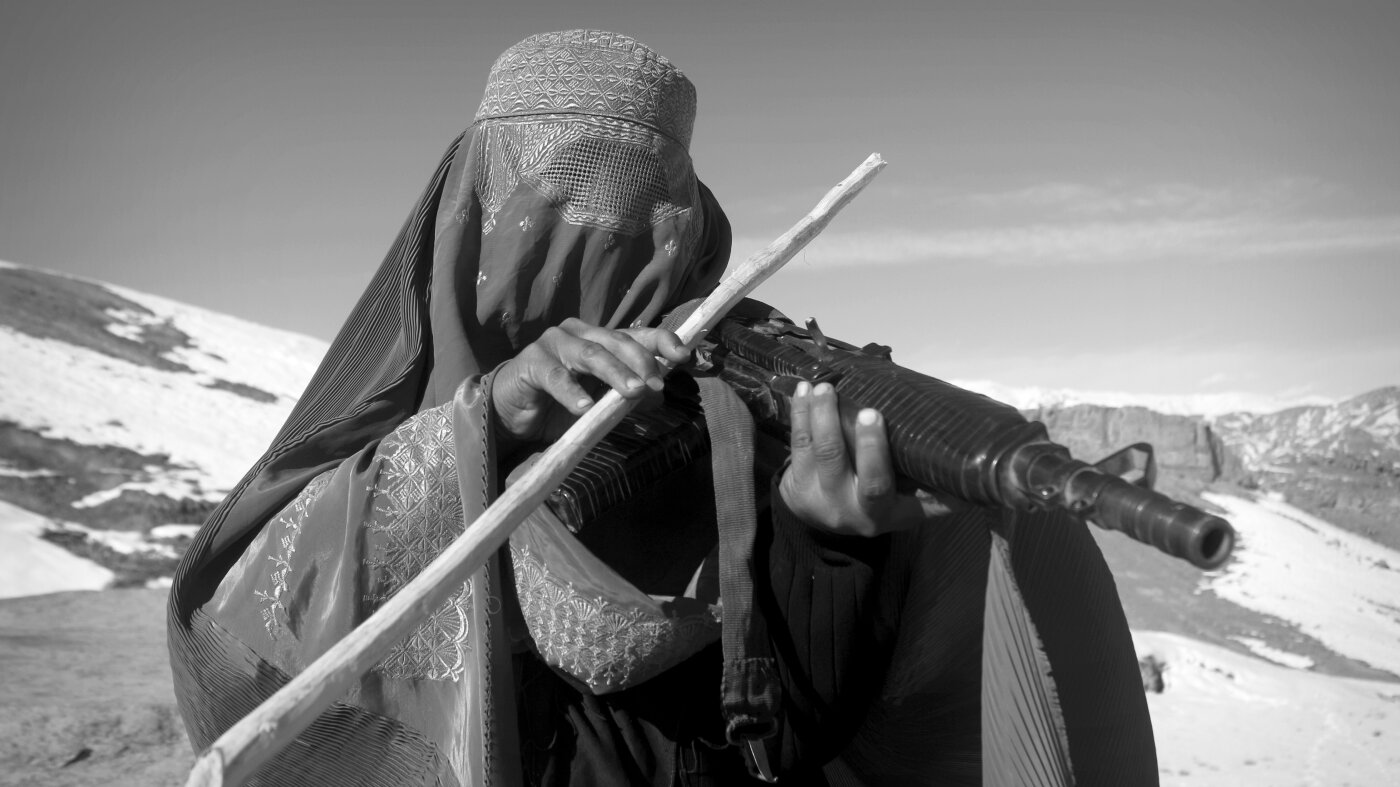
A bicyclist wearing a dark burka rides with a meshed veil over her eyes, with a title stating determination. Another figure swirls so fast that the fabric lifts, with a Farsi phrase about dreaming of a prosperous homeland. A third figure holds an automatic rifle like a violin, with a title about the music of poverty and violence. The images are created by two Afghan cousins who use pseudonyms to avoid Taliban retribution. They are Hazara and Shia Muslims from a remote mountain farming village, previously carpet weavers in Kabul. After the Taliban returned to power in 2021, they left to seek refuge from repression and persecution. They began taking photos in 2022 without formal training, and a curator connected with them through Instagram.
"A bicyclist whose dark, flowing burka enfolds her body from head to ankles sits with hands perched on the handlebar, seemingly undaunted by the meshed veil that covers her eyes and restricts her sight. Her determination is suggested by the photo's title, "It will not stand in my way." A similarly clad figure swirls so swiftly that the billowing fabric appears to lift her into the air like a bird in flight; scribbled in Farsi across the brick wall in front of her is the phrase, "I dreamed that my homeland was prosperous.""
"A third burka-draped figure places an automatic rifle on her shoulder as she would a violin, "bowing" it with a long wooden stick as if to make music. The photo's title is "The Music of Poverty and Violence." Two Afghan cousins who created these starkly evocative black-and-white photographs. They do not want their real names revealed because they fear Taliban retribution for their work. So they use the pseudonyms Mahnaz Ebrahimi (born in 2000) and Somayeh Ebrahimi (born in 2001)."
"They live in a remote Afghan mountain farming village. They and their families, all members of the Hazara ethnic group and Shia Muslims, had previously worked as carpet weavers in Kabul. When the Taliban regained power in 2021, they left, seeking refuge from the repression and persecution permitted under the laws of the country's ultra-conservative Sunni rulers. Neither cousin had any training in photography when they started taking photos on their cellphones in 2022 or so, says Madrid-based curator and gallery director Edith Arance."
"She came across their work on Instagram and was struck by the skillful melding of their bleak surroundings with messages ranging from the poetic to the political. "I know a little Farsi [the Persian language] so I could approach them," she says. The cousins and Arance worked together via Instagram. In November 2024, Arance presented their wo"
Read at www.npr.org
Unable to calculate read time
Collection
[
|
...
]