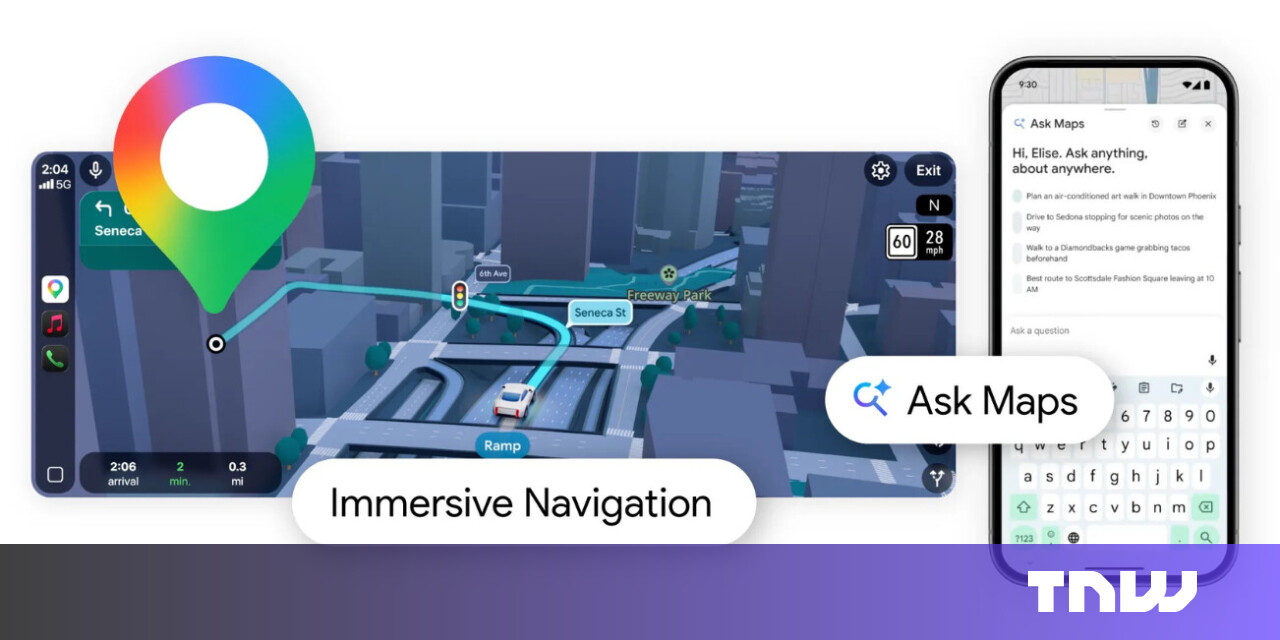
"Ask Maps works by allowing users to pose complex, contextual queries rather than searching for a specific place or category. 'Is there a public tennis court with lights on that I can play at tonight?' is the example Google offers. The system draws on personalisation signals, including a user's saved places and past searches, to weight its answers, so a user who has previously sought out vegan restaurants will find vegan-friendly options surfaced without having to specify."
"Immersive Navigation, the second major component of the update, replaces the current flat-map navigation overlay with a 3D view that incorporates nearby buildings, overpasses, and terrain. Lane markings, traffic lights, crosswalks, and stop signs are rendered as visual cues rather than text instructions. Voice guidance has been updated to use landmark-based phrasing, 'Go past this exit and take the next one for Illinois 43 South', rather than distance-based phrasing."
Google has unveiled Ask Maps, powered by Gemini, enabling users to pose complex, contextual queries in natural language rather than searching for specific places. The system personalizes results using saved places and search history, surfacing relevant options without explicit specification. Simultaneously, Immersive Navigation replaces flat-map overlays with photorealistic 3D rendering that incorporates buildings, terrain, and visual cues like lane markings and traffic lights. Voice guidance has been updated to use landmark-based phrasing instead of distance-based instructions. These features are rolling out in the US and India on Android and iOS, with desktop versions forthcoming. Together, they represent Google's most significant Maps update in over a decade.
Read at TNW | Google
Unable to calculate read time
Collection
[
|
...
]