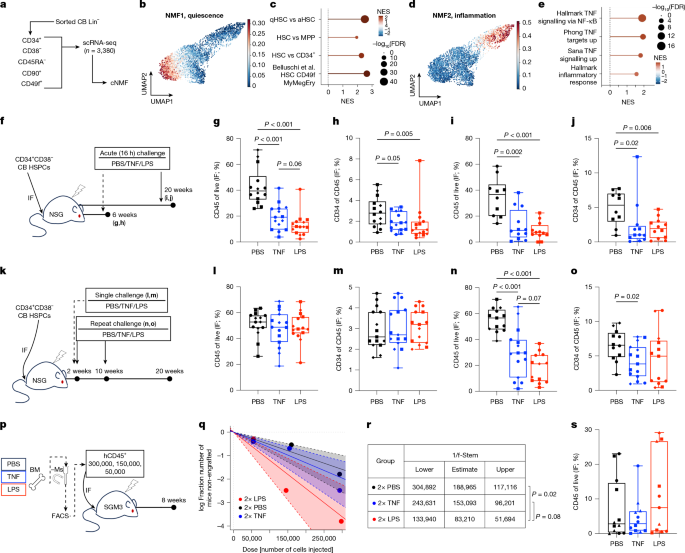
Humans require continuous blood production from bone marrow hematopoietic stem and progenitor cells, with millions of cells generated each second. Hematopoietic stem cells form a diverse pool that maintains lifelong output, yet their function declines with age. Aging is associated with reduced clonal diversity, increased incidence of clonal hematopoiesis, and higher risk of blood malignancy. Daily production must be coordinated with stem cell pool maintenance, especially under inflammatory stress such as recurrent infections that can activate HSCs. HSC activation and fate transitions are essential for function but can become dysregulated with aging and inflammation. Pre-leukemic clonal mutations arise decades before disease detection, and inflammation can alter HSC differentiation and self-renewal, affecting clonal selection and clone size.
"Humans have enormous demand for haematopoietic output that is met by a complex cellular hierarchy with HSCs at its apex. Mature blood cells with a finite lifespan are continuously replenished by bone marrow haematopoietic stem and progenitor cells (HSPCs) producing 3 million cells per second in human adults, via a tightly controlled process. Human HSCs are both genetically and functionally diverse with 50,000-200,000 HSCs contributing to haematopoiesis at any one time."
"With age, HSCs show functional decline, have a marked decrease in clonal diversity, a consequent increase in incidence of clonal haematopoiesis (CH), and an increased risk for blood malignancy. How daily blood production is coordinated with HSC pool maintenance over a lifespan is unclear, especially when exposed to inflammatory stressors, for example, recurrent infections, which can induce HSC activation. In addition, HSC fate transitions from quiescence towards activation are essential for HSC function, but can be dysregulated with ageing and inflammatory stress."
"Finally, HSCs are not homogeneous; HSCs exhibit transcriptional, epigenetic and functional heterogeneity, where inflammatory pathways are a major source of variation. Together, this indicates that heterogeneous cellular responses to inflammation within the human HSC pool might drive ageing phenotypes in response to life-long inflammatory insults. Human lineage tracking shows that pre-leukaemic CH mutations arise decades before disease detection."
"Crucially, mechanisms regulating CH clone size are poorly understood. Mouse models have shown that inflammation activates HSCs, consequently impairing differentiation and self-renewal, affecting clonal selection in CH. Some inflammatory responses include activation of target genes downst"
Read at Nature
Unable to calculate read time
Collection
[
|
...
]