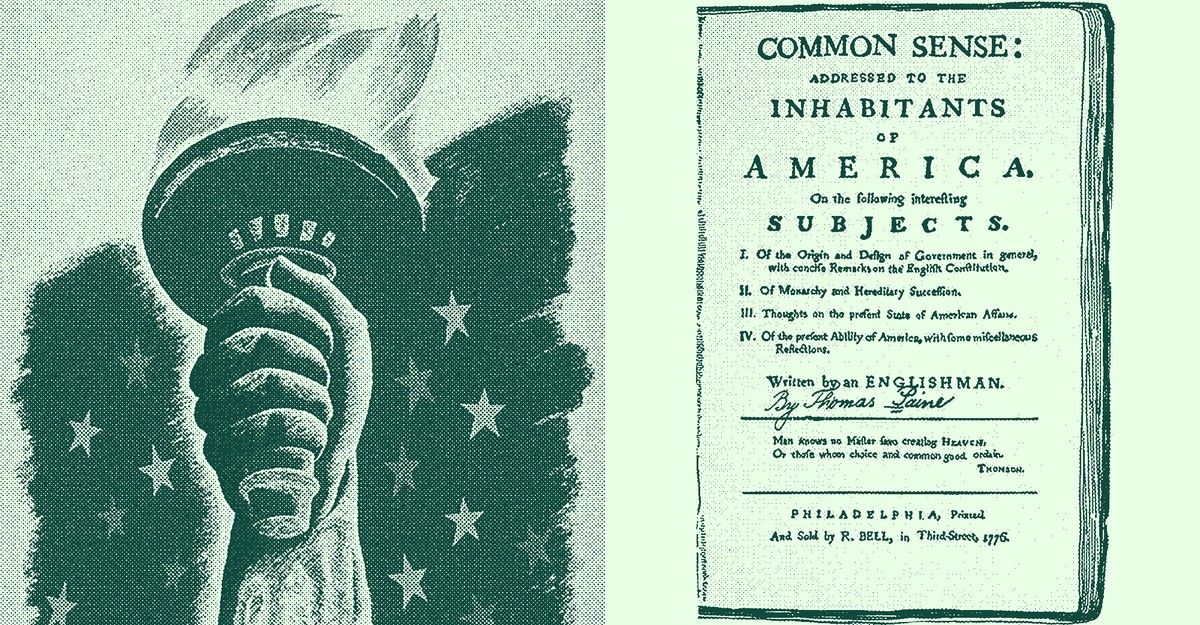
"Published 250 years ago last week, Common Sense is perhaps the most consequential piece of political writing in American history. At a moment when hostilities with Britain had already commenced but many still entertained hopes of reconciliation, it made a forceful and seemingly irrefutable argument for independence. As the Atlantic writer Frederick Sheldon wrote in an 1859 portrait of Paine, many Americans "stood shivering on the banks of the Rubicon" at the beginning of 1776. Common Sense helped them cross it."
"Reading it now, Paine's words are a kind of portal back to the Revolutionary moment. Although Common Sense is an 18th-century text with 18th-century language and preoccupations, a live current still runs through it. To revisit what Paine captured as a turning point in human history is to be reminded of the most expansive possibilities of the American idea at its creation."
Common Sense, published 250 years ago, forcefully argued for American independence and became perhaps the most consequential piece of political writing in American history. Hostilities with Britain had already commenced while many colonists still hoped for reconciliation; the pamphlet presented an apparently irrefutable case for separation and helped shift public opinion. Paine's rhetoric served as a catalyst for decisive action, prompting hesitant Americans to commit to independence. Paine arrived from England at age 37 with a mixed career of failures, an introduction from Benjamin Franklin, and experience editing the Pennsylvania Magazine. He addressed slavery, British troop presence, defensive war, and personal trials.
Read at The Atlantic
Unable to calculate read time
Collection
[
|
...
]