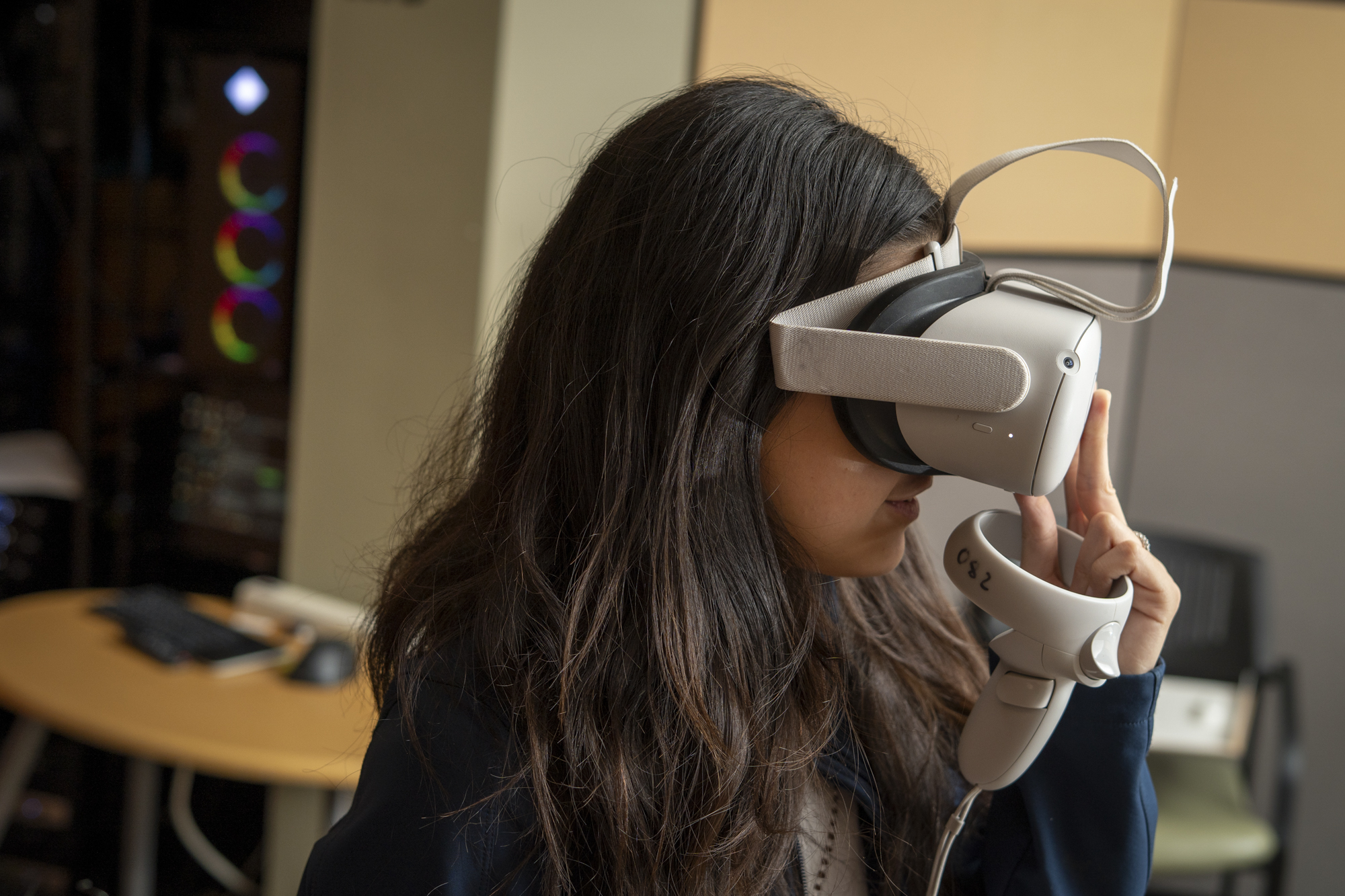
"Bailenson is the founder of Stanford's Virtual Human Interaction Lab, a research center studying the psychological and behavioral impacts of virtual and augmented reality, the latter of which overlays digital images onto the real world. He's worked on experiments aimed at increasing people's focus on climate change for more than a decade, having found some success. His team discovered that when people put on a VR headset and cut down a tree, feeling the vibration of the chainsaw, they use less paper afterward."
"He's also spent years and "hundreds of thousands of dollars" building virtual reality films that place the participant underwater, witnessing ocean acidification. When people put on the headset, these experiences changed their attitudes and behaviors. But when researchers installed the VR in a museum or other exhibit, people chose not to engage: It was too much doom and gloom."
"Santoso and her team, including her advisor Bailenson, used preexisting tools that are low-cost or free, like Google Earth and Google Fly, a VR app that allows you to explore the world by flying above it, plus a headset, to send people to another location. With these tools, "you can poke your head over your neighbor's fence and see what's on the other side. You can fly through New York City," Bailenson said."
Immersive virtual reality increases emotional engagement and can produce measurable behavioral change on environmental issues. Control groups exposed to similar news and still photographs did not show the same caring response. Experiments at a Virtual Human Interaction Lab found that embodying actions in VR, such as cutting down a virtual tree while feeling a chainsaw vibration, reduced subsequent paper use. Large VR films depicting ocean acidification changed attitudes when experienced individually but deterred engagement when placed in public exhibits. Low-cost tools like Google Earth and Google Fly plus headsets can transport people to distant places to reduce psychological distance and build connection.
Read at Kqed
Unable to calculate read time
Collection
[
|
...
]