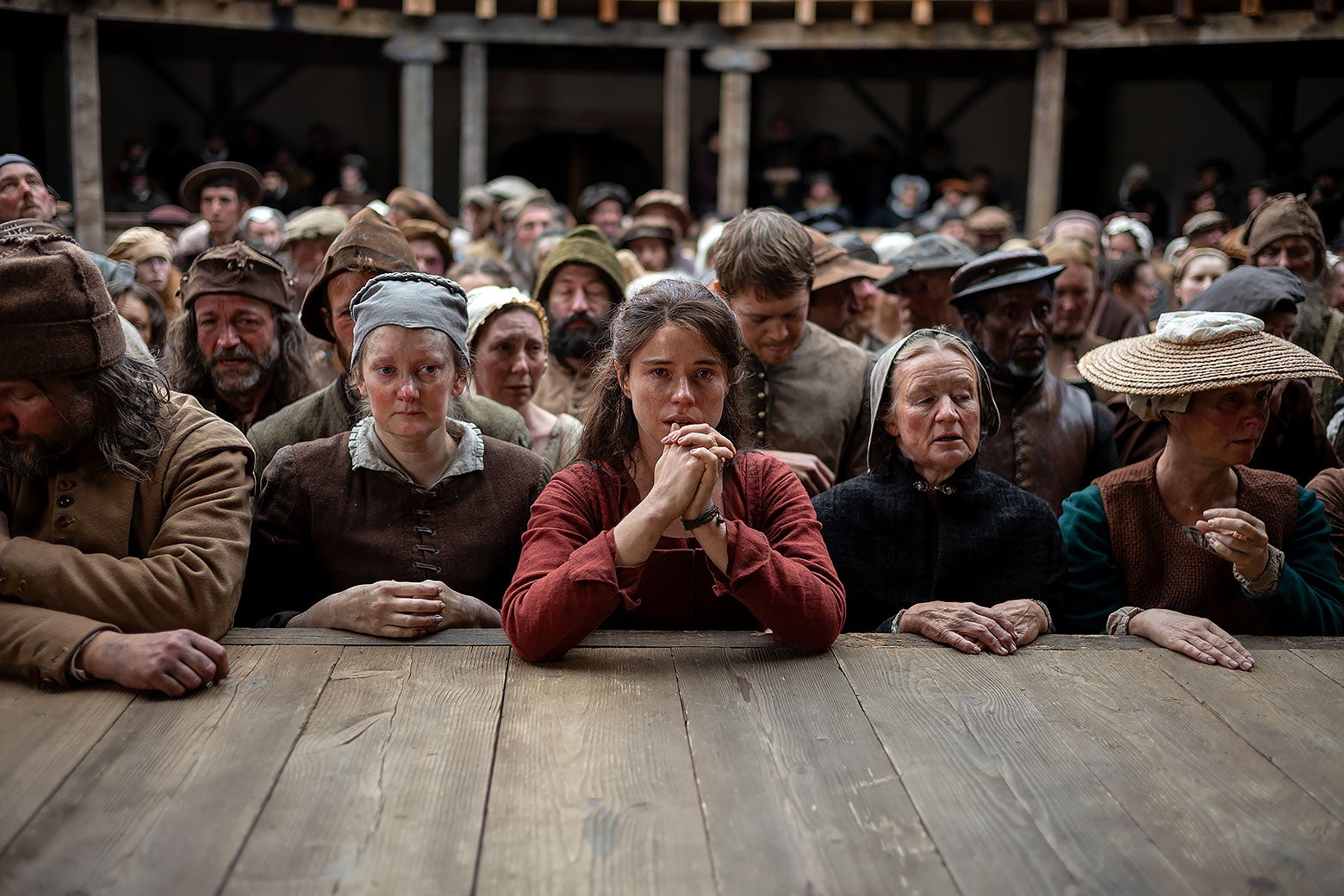
"Among the words that never appear in Maggie O'Farrell's 2020 book Hamnet: A Novel of the Plague, two in particular are notable for their absence: William Shakespeare. A historical note prefacing the text informs us that in the 1580s, a couple living in Stratford-upon-Avon had three children, that one, an 11-year-boy, died in 1596, and that "four years or so later, the father wrote a play called Hamlet.""
"Why would a man mourning the death of his son write a play about a son mourning his father? Placing Hamlet center stage is a substantial step in the direction of Hollywood convention. O'Farrell's novel resists the temptation to build the story around the play, to suggest that although Agnes' grief at the loss of her son is terribly sad and all that, what really matters is its effect on the work of a great man."
The novel Hamnet never names William Shakespeare, referring to him only as "the father," "her husband," or "the glover's son." A historical note situates a Stratford-upon-Avon couple, their three children, the death of an eleven-year-old in 1596, and a play called Hamlet written a few years later. A film adaptation reveals the playwright more directly, initially coy in subtitles but clarifying identity as children recite Macbeth; the screenplay preserves temporal slippages and shifting perspectives while omitting an owl's viewpoint. The film devotes its final quarter to staging Hamlet and Agnes's reaction, while the novel resists centering the play so Agnes's grief remains primary.
Read at Slate Magazine
Unable to calculate read time
Collection
[
|
...
]