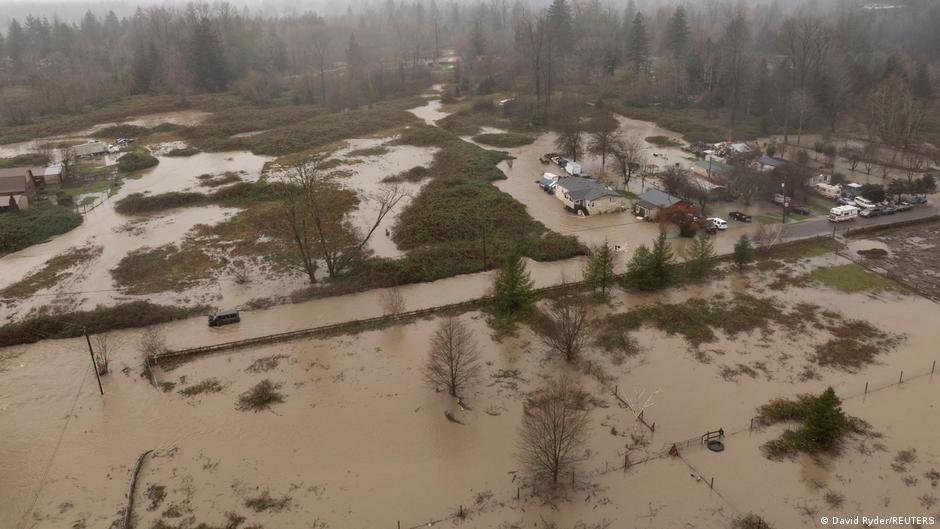
"Days of relentless rainfall in western Washington state has left tens of thousands of residents waiting for evacuation orders before potentially catastrophic flooding hits. As rivers reach near historic levels, state Governer Bob Ferguson declared a statewide emergency. "Lives will be at stake in the coming days," he said. Meteorologists say the extreme rains have been caused by an "atmospheric river" soaking the region along the coast of Oregon and Washington."
"What is the science behind extreme flooding? Rising global temperatures, caused by burning fossil fuels, is making rainfall more frequent and severe across most parts of the world. Rivers are set to hit record peaks in Washington this weekImage: Nick Wagner/AP Photo/picture alliance Tropical storms and intensified monsoon systems have also triggered catastrophic flooding and landslides across Sri Lanka, Indonesia, Thailand, Malaysia and Vietnam since mid-November."
"While modeling precipitation patterns is complex, a clear guiding principle is that when air gets hotter it holds more moisture. Greenhouse gases released into the atmosphere act to insulate Earth, trapping heat and causing temperatures to rise. One consequence is more rapid evaporation of water on land and at sea, so more water is released when it rains, which can result in flooding."
Relentless rainfall in western Washington has left tens of thousands awaiting evacuation as rivers near historic levels and a statewide emergency has been declared. An atmospheric river is delivering extreme precipitation along the Oregon and Washington coasts, with estimates of up to 76 centimeters over a three-week period in some areas. Tropical storms and intensified monsoon systems have caused catastrophic flooding and landslides across Sri Lanka, Indonesia, Thailand, Malaysia and Vietnam since mid-November. Warmer air holds more moisture, increasing heavy-rain frequency and intensity. Greenhouse gases trap heat, boost evaporation, and raise flood risk through heavier rains.
Read at www.dw.com
Unable to calculate read time
Collection
[
|
...
]