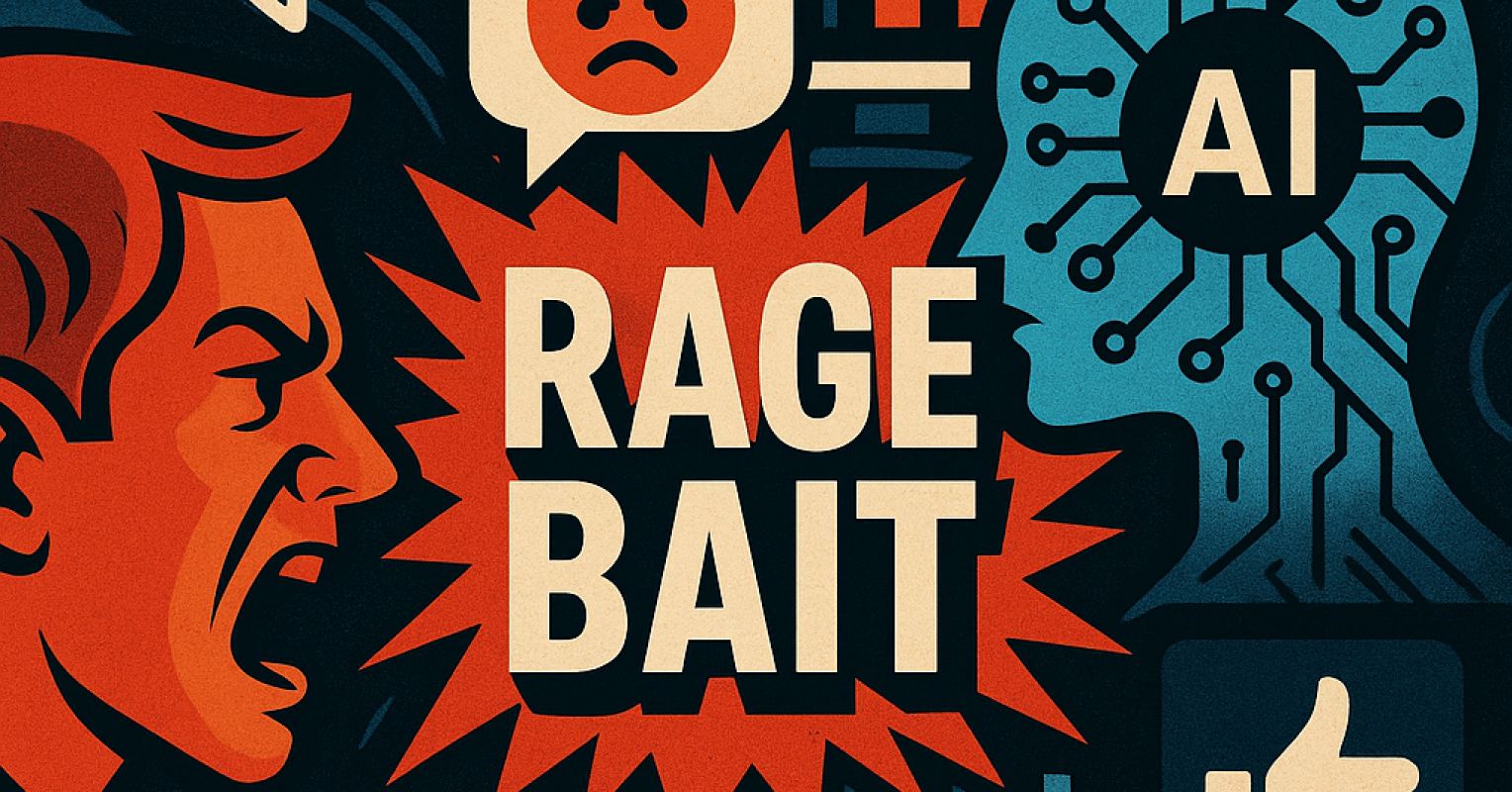
Oxford's Word of the Year 2025 is 'rage bait,' defined as online content deliberately designed to elicit anger or outrage and engineered to drive traffic and engagement. Rage bait replaces clickbait by relying on user anger rather than curiosity to increase time spent, sharing, and return visits. Rage bait and brain rot form a cycle in which outrage sparks engagement, algorithms amplify that engagement, and constant exposure causes mental exhaustion. Generative AI is accelerating the production, timing, and emotional precision of rage bait, making outrage a scalable commodity while contributing to agency decay and reshaped behaviours.
"'Rage bait' becoming Oxford's Word of the Year 2025 offers a psychological X-ray of (the anglophone parts of) society today. Defined as online content "deliberately designed to elicit anger or outrage," engineered to drive traffic and engagement, rage bait had two challengers: aura farming and biohack. The choice landed at a moment when AI is accelerating the production, timing, and emotional precision of such content, turning outrage into a scalable commodity."
"Its logic is simple: If content makes you angry, you spend longer with it, share it more often, and return to the platform more quickly. As lexicographers noted in their announcement, rage bait dominated public conversation because it captures a shift in how emotional manipulation has been woven into the fabric of digital communication."
"Together, they form a painful cycle in which outrage sparks engagement, algorithms amplify it, and 24/7 exposure leaves us mentally exhausted. Making this sad trend even more worrisome is its ascension as our journey amid generative AI is taking us beyond experimentation to integration, which is one step closer to reliance, and only a short distance away from full-blown addiction."
Read at Psychology Today
Unable to calculate read time
Collection
[
|
...
]