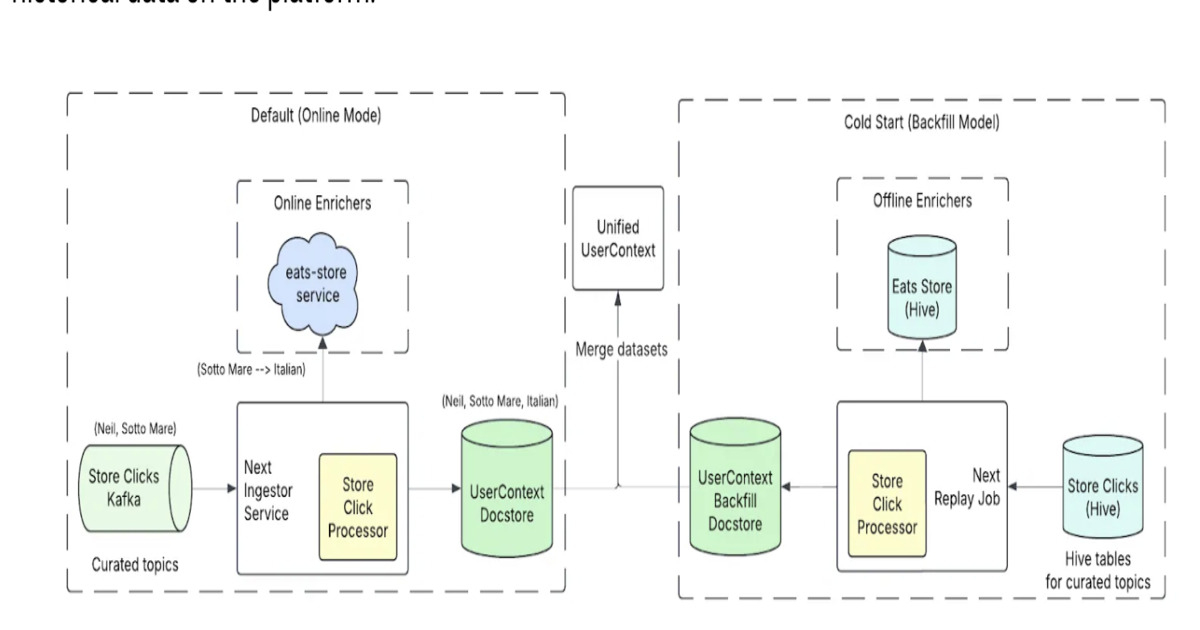
Uber Eats introduced updates to its recommendation system that use real-time user signals and listwise ranking to improve restaurant discovery. The system is deployed within Uber Eats to power homepage feeds and discovery surfaces. A new real-time signal processing layer continuously ingests interactions such as clicks, searches, and order history to keep user behavior representations current. Near-real-time feature updates reduce latency between user actions and personalization outcomes, allowing recommendations to adapt during active browsing sessions. The ranking approach evaluates multiple restaurant candidates together in a single inference step, optimizing relative ordering across options rather than independent scoring. A unified user behavior representation combines short-term session activity with longer-term historical signals.
"Uber has introduced updates to its Uber Eats recommendation system, incorporating real-time user signals and a listwise ranking approach to improve restaurant discovery. The system is designed to reflect user intent during active browsing sessions better while improving ranking efficiency across candidate restaurants. It is deployed within the Uber Eats platform to support homepage feeds and discovery surfaces."
"The updated architecture replaces earlier batch-oriented feature pipelines with a real-time signal processing layer. This layer continuously ingests user interactions such as clicks, searches, and order history to maintain an up-to-date representation of user behavior. By shifting to near-real-time feature updates, the system reduces latency between user actions and personalization outcomes, enabling recommendations to adapt more quickly to changing preferences within a session."
"Uber's recommendation stack also incorporates listwise ranking, where multiple restaurant candidates are evaluated together in a single inference step rather than individually. This approach allows the model to optimize relative ordering across a set of options, rather than assigning independent scores to each restaurant. According to Uber, this improves both computational efficiency and ranking quality by enabling direct comparison among candidates in the same context."
"The system builds on a unified representation of user behavior that combines short-term session activity with longer-term historical signals. Personalizing a marketplace at this scale isn't just about showing 'good food'-it's about balancing real-time intent, diverse merchant ecosystems, and complex ranking objectives to create a seamless discovery experience."
#recommendation-systems #real-time-personalization #listwise-ranking #uber-eats #machine-learning-architecture
Read at InfoQ
Unable to calculate read time
Collection
[
|
...
]