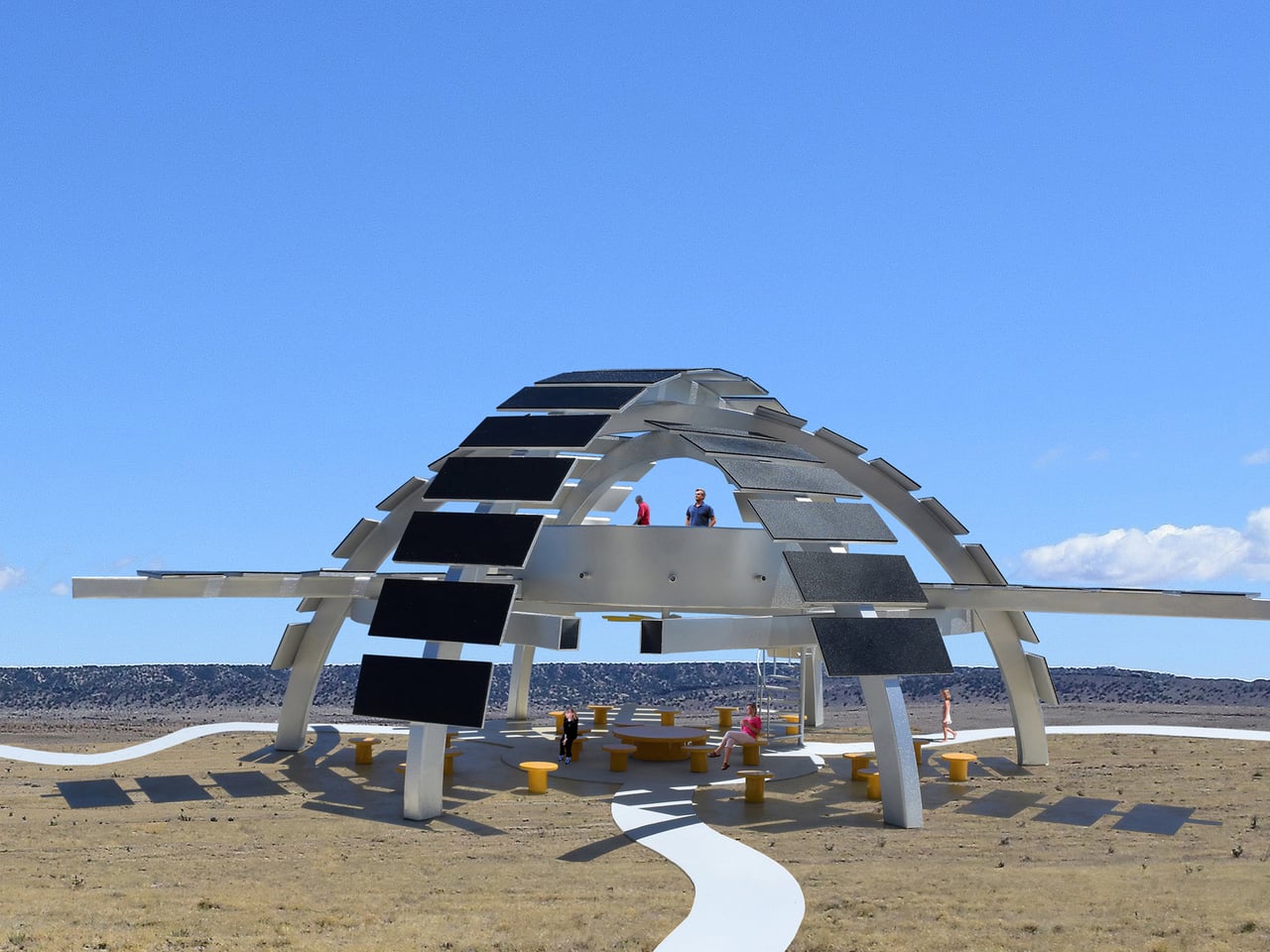
"Jantzen has spent years exploring sustainable architectural experiments where structures are expressive about how they work. The Solar Electric Pavilion is conceived as a public gathering place and shade structure that generates and stores electricity from the sun for the local community, celebrating the relationship between form and renewable energy instead of hiding the technology behind walls or burying it on rooftops where no one sees it."
"Approaching the pavilion on a hot day, you are drawn under its open steel shell to escape the sun. Underneath, a circular field of cylindrical seats and tables invites people to sit, talk, or work, with a large ceiling fan overhead moving air. The space behaves like a familiar pavilion, a place to meet or rest, but everything around you is quietly tuned to capture and use sunlight."
"Sixty photovoltaic panels are mounted along the curved and straight steel box beams, converting sunlight into electricity. Most of that power is sent into the local grid, while some is stored in batteries hidden inside the cylindrical seats. That stored energy runs the pavilion's lighting at night, powers the ceiling fan, and lets visitors charge phones or laptops, turning sitting down into a direct connection with the solar infrastructure."
Michael Jantzen designed a Solar Electric Pavilion that functions as a public gathering place and a visible renewable-energy installation. The open steel shell provides shade and invites people to sit on cylindrical seats and tables beneath a large ceiling fan. Sixty photovoltaic panels mounted on curved and straight steel box beams convert sunlight into electricity. Most generated power feeds the local grid while some is stored in batteries concealed inside the seats. Stored energy powers lighting, the ceiling fan, and device charging. A raised circular platform accessed by a spiral stair frames the landscape and reads the structure as a solar sculpture.
Read at Yanko Design - Modern Industrial Design News
Unable to calculate read time
Collection
[
|
...
]